
Website owners often say they want more traffic, better rankings, or greater search visibility.
Those ambitions make sense, but they are usually too broad to guide useful decisions.
What does “more traffic” actually mean for your website? Which pages matter most? Which audience are you trying to reach? What outcome would make the effort worthwhile? And over what period should you reasonably expect to work toward it?
That is where SEO targets become useful.
An SEO target is a defined outcome or milestone that gives direction to your organic-search work. A useful target connects what your website wants to achieve with a specific area of focus, a realistic scope, and a reasonable planning timeframe.
The goal is not to predict exactly what Google will do.
It is to decide what your website is trying to accomplish before you begin judging whether your SEO work is helping.
What Are SEO Targets?
SEO targets are desired outcomes or defined milestones connected to a website's organic-search objectives.
They can relate to things such as improving the discoverability of important pages, attracting more relevant organic visitors, increasing qualified search-driven inquiries, or strengthening visibility around a meaningful topic or service area.
The important point is that the target should make sense for the website.
A new educational site may care about getting its priority content discovered for relevant searches.
A local service business may care more about attracting people who are actively looking for its services.
An established content site may want stronger organic discovery across a particular topic category.
Those are different situations, so copying another website's targets rarely makes sense.
“Get more traffic” is an ambition. A useful target identifies what improvement matters, where it matters, and over what period the website plans to work toward it.
SEO Goals vs. SEO Objectives vs. SEO Targets
People often use the terms SEO goals, SEO objectives, and SEO targets interchangeably. There is no single universal naming system that every company or SEO professional follows.
For planning purposes, however, it can be helpful to distinguish them.
| Term | Practical meaning | Example |
|---|---|---|
| SEO Goal | A broad desired outcome | Attract more relevant visitors from organic search |
| SEO Objective | A more clearly defined result that supports the goal | Improve organic discovery of important service pages |
| SEO Target | A specific outcome or milestone that makes the objective actionable | Increase relevant organic visits to a defined group of service pages during an agreed planning period |
| KPI | A metric used later to assess progress | Organic visits to those service pages |
The exact labels matter less than using them consistently.
A goal gives direction.
An objective narrows that direction.
A target makes the desired result clearer.
A KPI is something you may later use to assess progress toward that target.
This article focuses on defining the destination, not on building reporting dashboards or interpreting performance data.
What Makes an SEO Target Realistic?
A realistic target should be useful enough to guide decisions without pretending to predict the future.
Before adopting a target, check whether it meets a few basic standards.
The standards below broadly resemble the SMART goal-setting framework, although no particular framework is required for SEO.

Specificity
The target should identify what kind of outcome matters.
For example, “improve SEO” is too vague to guide much of anything.
“Improve organic discovery of our core service pages” is clearer because it identifies a specific area of focus.
Specificity may come from defining the page group, audience, market, search opportunity, or business outcome connected to the target.
Relevance
A target should support the actual purpose of the website.
A publisher may care about reaching readers who are interested in a particular topic.
A service company may care about attracting people who are actively looking for its services.
An ecommerce store may care about improving discovery of important product or category pages.
Total traffic is not automatically the most useful target for every website.
Measurability
A target should be clear enough that progress can eventually be assessed.
That does not mean every target needs a complex reporting framework.
It simply means the desired outcome should be defined well enough that the website can later determine whether it moved closer to that outcome.
Achievability
A realistic target should reflect the website's circumstances.
That includes factors such as whether the site is new or established, how much relevant search demand exists, how competitive the opportunity is, what resources are available, and how much work can realistically be supported.
There is no universal organic-traffic percentage, ranking position, or growth number that every website should adopt.
Timeframe
A target is more useful when it includes a reasonable planning period.
The timeframe should support planning, not become a promise that Google will deliver a particular result by a fixed date.
Uncertainty
Search results and traffic can be influenced by competition, demand, algorithm changes, user behavior, and other factors outside the website owner's control.
A useful target gives direction without guaranteeing an outcome.
How to Set SEO Targets for Your Website
Once you know what a good target should look like, the next step is to define one for your website.

1. Identify the Outcome That Matters
Start by asking what the website actually needs from organic search.
A blog may want more relevant readers to discover its strongest educational content.
A service business may want more potential customers to reach important service pages.
An ecommerce site may want qualified shoppers to discover key category or product pages.
The answer should reflect the website's real purpose.
Do not assume that every website's best target is simply “more traffic.”
2. Define the Audience and Scope
A target becomes clearer when you specify what it applies to.
You may be targeting the entire website, but often the target is more useful when it applies to a defined area.
For example, it might apply to a group of service pages, a particular content category, an important product range, or a specific geographic or customer audience.
This is not about building a complete SEO strategy.
It is about defining the part of the website or audience connected to the desired outcome.
3. Consider the Current Starting Point
A target should not be set blindly.
A brand-new site and an established site should not automatically adopt the same expectations.
Useful context can include whether important pages are already discoverable, whether the website has existing organic-search activity, how large the search opportunity appears to be, and what resources or constraints affect the work.
The purpose here is simply to understand enough about the current situation to choose a target that fits the website.
Detailed baseline analysis and performance reporting belong to the measurement stage.
4. Choose a Meaningful Target
Now turn the broad objective into a clearer desired result.
The second version tells you what matters, where the focus lies, and the planning period.
A target can include a numerical outcome when the website has enough context to choose one responsibly.
That number should come from the website's own circumstances, not from a universal industry benchmark.
5. Set a Reasonable Timeframe
Choose a planning period that fits the website, opportunity, and resources available.
Avoid arbitrary rules such as assuming every SEO target should be achieved within 30, 60, or 90 days.
SEO outcomes do not follow identical schedules across websites.
A timeframe helps organize expectations and planning, but it does not guarantee when rankings, traffic, indexing, or other search outcomes will occur.
6. Document the Target and Its Assumptions
Write the target down.
- Desired outcome.
- Target audience or pages.
- Starting context.
- Specific target.
- Planning timeframe.
- Important assumptions or constraints.
This makes the target easier to understand and less likely to shift every time short-term performance changes.
Once the target is established, you can later evaluate whether SEO work is moving toward it.
For that measurement stage, see RankCrow's SEO Progress article.
And when you are ready to think about the methods used to pursue the target, RankCrow's SEO Method article covers execution approaches separately.
Practical Examples of SEO Targets
The following examples are hypothetical.
They illustrate how different websites may define targets differently. They are not recommended industry benchmarks.
New Informational Website
A new educational website wants its most important articles to become easier to discover through relevant searches.
Weak: “Rank on page one quickly.”
Better: “Improve organic discovery of our priority educational pages for relevant searches during the next six months.”
This keeps the focus on relevant search presence without promising a particular ranking position or indexing outcome.
Local Service Business
A local service company wants organic search to contribute more meaningful business opportunities.
Weak: “Double website traffic.”
Better: “Increase relevant organic visits to our core service pages and create more opportunities for qualified visitors to contact the business over the next six months.”
This focuses on relevant visitors rather than total traffic.
Established Content Website
An established content site wants stronger organic discovery in one of its most important topic areas.
Instead of using a broad sitewide traffic target, it could define a target around a particular content group.
Example: “Improve organic discovery across our priority group of related content during the next two quarters.”
The target is narrower and connected to a meaningful part of the site.
Ecommerce Website
An ecommerce website may care more about important product or category pages than overall sitewide traffic.
Example: “Increase relevant organic discovery of our priority product categories during the next six months.”
The target focuses on a commercially useful part of the site without turning into a full ecommerce SEO strategy.
Choose targets that reflect what the website actually needs, not what another website happens to be measuring.
If your next question is how to improve the website itself after defining the target, RankCrow's Website Search Engine Optimization article covers that broader optimization framework.
Common Mistakes When Setting SEO Targets
One of the most common mistakes is choosing a target before understanding the website's starting situation.
Another is treating “more traffic” as a complete objective without asking whether that traffic is relevant.
Website owners may also copy targets from competitors, agencies, case studies, or other businesses without considering differences in audience, market, resources, competition, and search demand.
Unrealistic ranking targets are another problem.
A target such as “rank number one for every important keyword” may sound ambitious, but it ignores uncertainty and provides little useful planning guidance.
Activities can also be confused with outcomes.
Publishing ten articles, fixing title tags, or adding internal links are actions. They may support an SEO target, but they are not automatically the desired search outcome themselves.
Fixed deadlines create similar problems.
Search engines do not operate according to a website owner's project calendar, so a planning timeframe should not be turned into a promise.
Finally, a target should never be treated as a guarantee.
It is a direction for planning and decision-making under uncertainty.
A Simple SEO Target-Setting Template
You can document an SEO target with a lightweight worksheet like this:
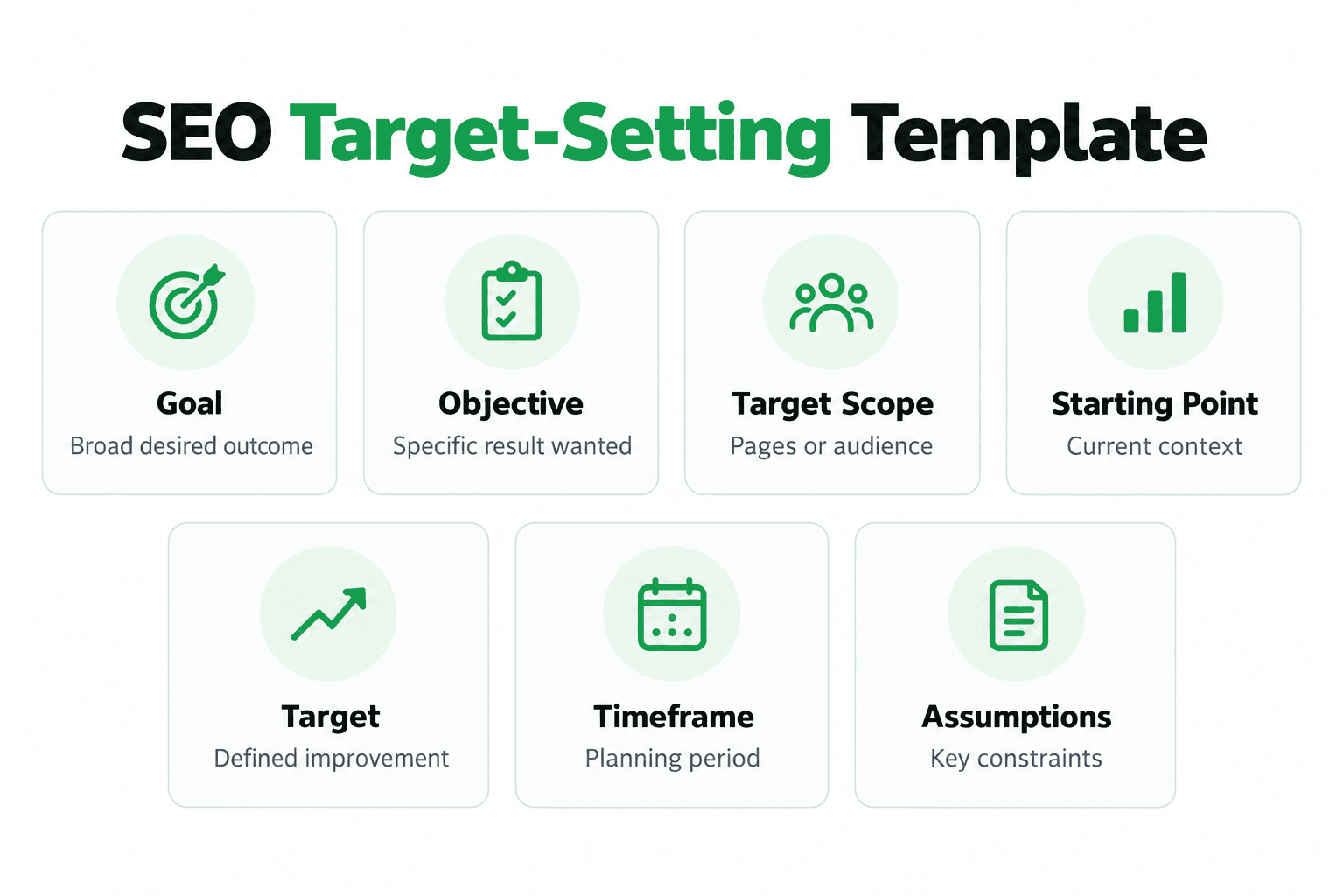
| Field | What to Define |
|---|---|
| Goal | Broad desired organic-search outcome |
| Objective | Specific result the website wants |
| Target Scope | Pages, audience, or relevant search area |
| Starting Point | Current situation or available baseline |
| Target | Defined improvement or milestone |
| Timeframe | Intended planning period |
| Assumptions | Important constraints and uncertainties |
A hypothetical completed version could look like this:
Goal: Attract more relevant visitors through organic search.
Objective: Improve discovery of the company's main service pages.
Target Scope: Three priority service pages in the company's primary market.
Starting Point: Pages are published and receiving limited organic discovery.
Target: Increase relevant organic visits to those pages from the current baseline.
Timeframe: Six months.
Assumptions: Search demand remains reasonably stable and the business has resources to support ongoing SEO improvements.
The worksheet defines the destination.
The strategy used to pursue that destination and the reporting used to evaluate progress are separate steps.
Frequently Asked Questions
What are SEO targets?
SEO targets are defined outcomes or milestones connected to a website's organic-search objectives. They help clarify what the website is trying to achieve, where the target applies, and over what planning period.
What is the difference between SEO goals and SEO objectives?
A goal is usually a broad desired outcome, while an objective is a more clearly defined result that supports that goal. A target can make the objective more actionable by specifying the desired outcome, scope, or timeframe. Organizations may use these terms differently, so consistency is more important than one universal definition.
What is an example of a realistic SEO target?
A hypothetical example could be: “Increase relevant organic visits to our priority service pages during the next six months.” Whether that target is realistic depends on the website's current position, search demand, competition, resources, and other circumstances.
How many SEO targets should a website have?
There is no universal number. A smaller set of meaningful, clearly defined targets is usually easier to prioritize than a long list of overlapping or weakly defined objectives. The right number depends on the size of the website, available resources, and how many distinct outcomes genuinely matter.
How long should an SEO target take to achieve?
There is no standard timeframe that applies to every website. Planning periods should reflect the website's current situation, competition, search opportunity, and available resources. A timeframe can guide planning, but it cannot guarantee when rankings, traffic, indexing, or other search outcomes will occur.
Are SEO targets the same as SEO KPIs?
No. A target describes the outcome the website wants to achieve. A KPI is a metric that may later be used to assess progress toward that target. For a deeper explanation of performance measurement and SEO KPIs, see RankCrow's SEO Progress article.
Final Thoughts
Effective SEO targets are not simply ambitious numbers.
They are clear, realistic outcomes connected to a website's actual needs and circumstances.
Define what matters, make the target specific, consider the website's starting situation, choose a reasonable planning timeframe, and account for uncertainty.
A good target gives SEO work direction without pretending to guarantee the result.