
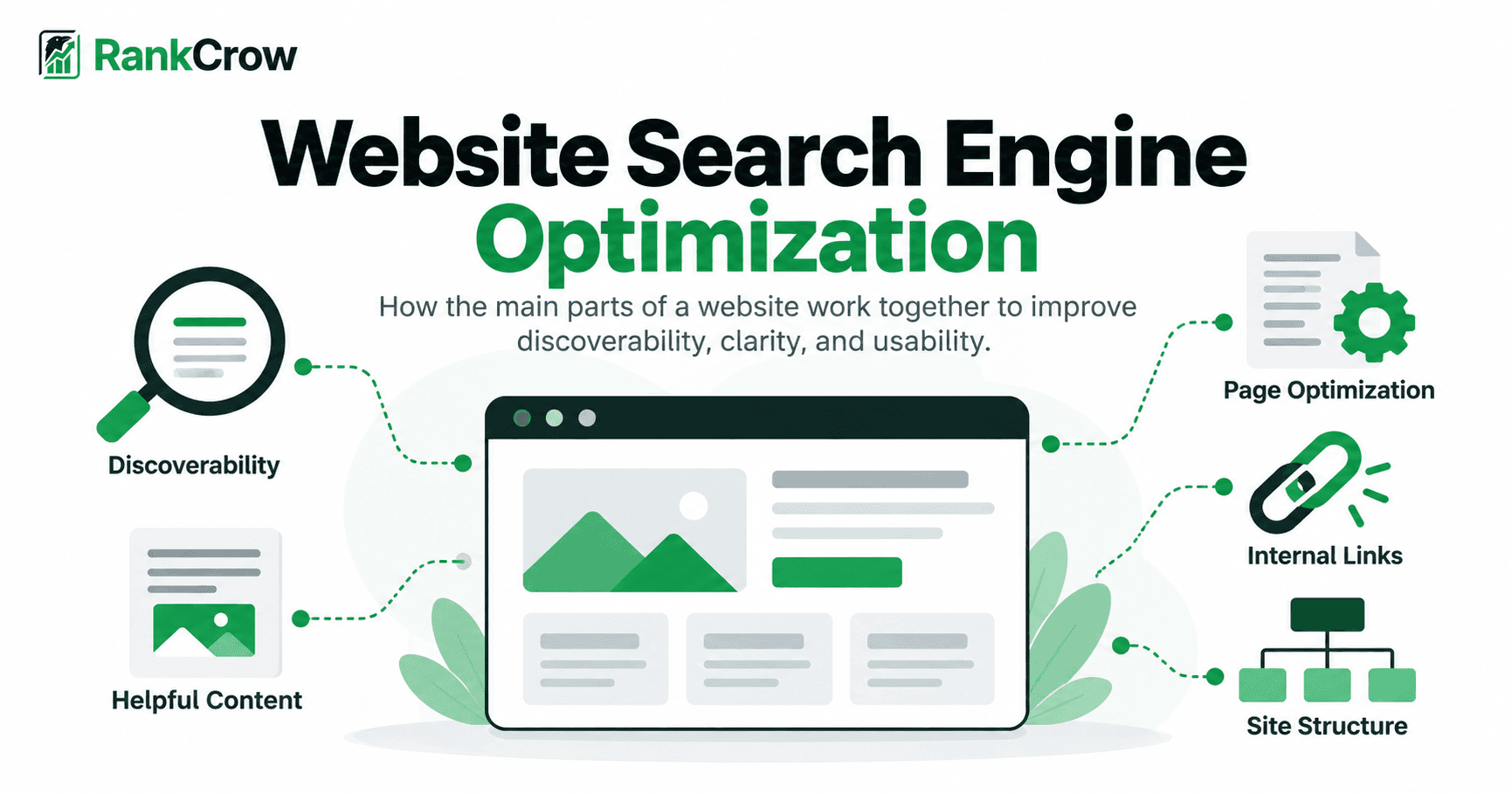
A website can have useful content and still struggle in search if important pages are difficult to discover, unclear in purpose, weakly connected, or missing useful page-level elements.
That is why website search engine optimization is broader than adding keywords to a few pages or installing an SEO plugin.
It involves making sure search engines can discover and understand the pages that matter, while those pages provide useful information and a clear experience for the people searching for them.
If the wrong pages are indexed, important pages are buried, or content does not match what people are searching for, simply publishing more content may not solve the problem.
This article explains the main areas to review when optimizing an existing website and how those areas work together.
What Is Website Search Engine Optimization?
Website search engine optimization is the process of improving a website so search engines can more easily discover and understand its important pages while those pages provide relevant and useful experiences for people searching for them.
It can involve several connected areas, including:
- technical accessibility;
- content;
- site organization;
- individual page elements;
- internal links;
- images;
- search appearance;
- page experience.
SEO is not one setting that can be switched on for an entire website.
A site may have technically accessible pages but weak content. Another may have excellent content but poor internal connections. A page may have a strong title but still fail to satisfy the searcher’s actual need.
Effective website SEO comes from improving the right areas together.
Why Website SEO Matters
Search engine optimization helps create a stronger foundation for organic discovery.
When priority pages are accessible, clearly organized, relevant to real search needs, and easy to understand, search engines have better information to work with when discovering and evaluating those pages.
Website SEO can help:
- make useful content easier to discover;
- make individual pages clearer to search engines and users;
- connect pages with relevant search needs;
- improve how pages communicate their purpose in search results;
- support qualified organic discovery;
- create a stronger foundation for long-term search visibility.
SEO can also contribute to organic website traffic by helping relevant pages become discoverable for searches related to what they offer.
That does not mean SEO guarantees more traffic.
Search demand, competition, relevance, website quality, and how search systems evaluate a page can all affect whether it receives impressions, clicks, or organic visits.
The useful goal is not simply “more traffic.” It is helping the right pages become discoverable by people whose searches match what those pages provide.
How Search Engines Interact With Your Website
Before a page can perform in search, several different stages may be involved.
Discovery and Crawling → Indexing → Search Results and Ranking
These stages should not be treated as the same thing.
Search engines use automated crawlers to discover pages. Links are one important way those crawlers can find new URLs.
A page being crawlable does not guarantee that it will be indexed.
A page being indexed does not guarantee that it will rank prominently.
And an optimized page does not guarantee organic traffic.
That distinction matters because website SEO is not about forcing search engines to index or rank every URL. It is about making pages intended for search accessible, understandable, relevant, and useful.
For a deeper explanation of discovery and indexing, see the Search Engine Indexing Guide. For a broader technical troubleshooting review, see the Technical SEO Issues Guide.
The Main Areas to Optimize Across a Website
There is no single setting that “does SEO” for an entire website.
Instead, website search engine optimization involves reviewing several connected areas.

Make Important Pages Discoverable and Indexable
Pages intended to appear in organic search should be accessible to search engines.
That means reviewing areas such as:
- crawlable internal paths;
- indexability;
- robots directives;
- XML sitemaps;
- canonicalization;
- duplicate URL versions.
An XML sitemap can help search engines discover URLs, but submitting one does not guarantee that every URL will be crawled or indexed.
Robots.txt and noindex also serve different purposes.
Robots.txt is mainly used to manage crawler access. It is not the same as telling a search engine not to index a page.
A supported noindex directive is intended to prevent indexing, but the crawler needs to be able to access the page to see that directive.
Canonicalization is another area that is often misunderstood.
A rel="canonical" annotation expresses your preferred representative URL, but Google may select a different canonical.
The practical goal is to make pages intended for search accessible and technically clear without assuming that any individual technical signal guarantees indexing.
Give Every Important Page a Clear Purpose
Before thinking about keyword placement, ask what the page is actually supposed to do.
For each important page, consider:
- Who is this page for?
- What question, need, or problem does it address?
- What information or action does the visitor expect?
- Does another page already serve the same need?
This is one of the most useful ways to prevent unnecessary content overlap.
You usually do not need several thin pages created only to target small variations of the same phrase.
If one useful page can satisfy the same search intent clearly, creating multiple near-identical pages may make the website harder to manage and can create unnecessary overlap between your own content.
Keywords should help clarify topic and intent, not dictate awkward page creation.
For more detail, see How to Use Keywords for SEO.
Create Helpful and Original Content
Technical optimization cannot make weak content genuinely useful.
Important pages should provide information that is:
- useful;
- original;
- accurate;
- readable;
- relevant to the searcher’s need;
- clearly organized;
- updated when necessary.
There is no useful SEO rule that says every article must reach a specific word count.
A short page can be enough when the search need is simple.
A longer page may be appropriate when the topic requires more explanation.
The goal should be to cover the subject well enough to help the reader without stretching the page simply to make it longer.
For a deeper look at content planning and optimization, see the Content SEO Guide.
Organize the Website Clearly
A website becomes easier to navigate when related pages have understandable relationships.
Useful organization can include:
- logical page hierarchy;
- meaningful categories;
- descriptive URLs;
- clear navigation;
- related internal links;
- avoiding isolated important pages.
This helps users understand where they are and where they can go next.
It can also help search engines discover pages and understand how different parts of the website relate to each other.
Website organization does not need to follow a made-up formula such as “every page must be within three clicks of the homepage.”
The important question is whether key URLs are easy to reach and whether their relationships make sense.
Optimize Titles and Search Snippets
The page title is one of the clearest page-level elements you can review.
A useful page title should normally be:
- descriptive;
- relevant;
- concise;
- specific to the page;
- written for people.
The supplied <title> element can influence the title shown in search, but search engines may use other information when generating a displayed title link.
That means you should optimize the title carefully without assuming the exact text will always be shown.
The meta description should summarize the page naturally and give searchers a useful idea of what the page contains.
Google may use the supplied meta description when it is helpful, but it can also generate snippets from page content.
A meta description should therefore be written for clarity rather than treated as a guaranteed displayed snippet or a guaranteed ranking boost.
For a broader page-level optimization framework, see the On-Page SEO Guide.
Use Headings to Make Content Easy to Follow
Headings help break content into understandable sections.
H1 → H2 → H3
A logical structure such as this can make a page easier to scan and maintain.
The hierarchy should reflect how the ideas relate to each other.
That does not mean SEO depends on a magical number of headings or that a page will fail simply because its heading structure is not perfect.
Use headings primarily to improve organization, readability, and accessibility.
Connect Related Pages With Internal Links
Internal links help users move between useful pages on the same website.
They can also help crawlers discover URLs and understand relationships between related content.
Good internal links should have a reason to exist.
A reader learning about website SEO, for example, may benefit from a deeper guide on internal linking. In that case, linking to the SEO Internal Linking Strategy Guide is useful.
Internal links work best when:
- the destination is genuinely relevant;
- the anchor text describes what the reader can expect;
- the link appears naturally in context;
- important pages are not left isolated.
There is no universal number of internal links that every page must contain.
The goal is usefulness and context, not hitting a quota.
Optimize Images in Context
Images can support both usability and search understanding when they are relevant to the content.
Useful image optimization can include:
- choosing meaningful images;
- placing them near relevant text;
- writing descriptive ALT text where appropriate;
- avoiding keyword stuffing in ALT attributes;
- keeping image performance reasonable.
ALT text should describe the image naturally when a text alternative is useful.
It should not be treated as another place to repeat target keywords. For a deeper look at image optimization, see the Image Optimization SEO Guide.
Use Structured Data When It Fits the Page
Structured data can give search engines more explicit information about the content of a page.
When supported and implemented correctly, it can make qualifying content eligible for supported search features.
That does not mean schema markup guarantees rankings or rich results.
Not every page needs every schema type.
Structured data should match the actual content on the page and use a relevant supported format. For practical implementation examples, see the Schema Markup Examples Guide.
Improve the Overall Page Experience
SEO does not stop when someone clicks a search result.
The page should also be practical to use.
Relevant page-experience considerations can include:
- Core Web Vitals;
- HTTPS;
- mobile usability;
- intrusive interstitials;
- excessive distracting advertising;
- ease of accessing the main content.
There is no single page-experience signal that determines rankings.
Core Web Vitals are used by Google’s ranking systems, but strong scores do not guarantee top rankings.
A page can be technically fast and still provide a weak experience if the content is irrelevant, confusing, or difficult to use.
Think of Core Web Vitals as one part of a broader usable experience rather than a standalone SEO solution.
How to Do Search Engine Optimization for Your Website
If you are wondering how to do search engine optimization for your own website, start with the pages that matter most.
This is not a complete SEO campaign workflow. It is a page-review framework for deciding where to look first.
Start with pages that:
- serve important user needs;
- represent important topics, services, or products;
- are intended to receive organic search traffic.

Can search engines access the page?
Can the page be indexed?
Does the page clearly satisfy a useful search need?
Are its title, content, and page-level elements clear?
Is it connected to relevant pages internally?
Does it provide a good usable experience?
Can its performance be monitored afterward?
This gives you a practical starting point without turning website optimization into a rigid campaign sequence.
How Website SEO Areas Work Together
Different website search engine optimization techniques are more useful when they support each other.

Useful content is stronger when users and crawlers can actually discover it.
Internal links are more helpful when they connect genuinely related pages.
A well-written title cannot rescue a page that fails to satisfy the searcher’s need.
Excellent Core Web Vitals do not guarantee strong search performance if the page itself is irrelevant.
And a sitemap can help with URL discovery, but it cannot compensate for poor content.
The important lesson is that website SEO works as a connected system.
Improving one area can help, but the strongest foundation comes from making sure the important parts of the website support each other.
Common Website SEO Mistakes
Some recurring mistakes can weaken otherwise useful optimization.
- writing for search engines instead of readers;
- forcing keywords into sentences;
- creating several near-identical pages for small keyword variations;
- leaving important pages without useful internal links;
- accidentally applying noindex to pages intended for search;
- assuming sitemap submission guarantees indexing;
- treating an SEO tool score as a Google ranking score;
- expecting one SEO change to guarantee rankings or traffic.
The broader lesson is to avoid treating individual SEO checks as guarantees.
How Website SEO Can Support Organic Traffic
SEO can help relevant pages become more discoverable for people searching for related information, products, or services.
Relevant Search Need → Useful and Eligible Page → Search Visibility → Search Result Impression → Potential Click → Organic Visit
Each stage matters.
A page cannot earn a search click if it is not eligible to appear.
A search impression does not guarantee a click.
And more traffic is not automatically more valuable if the visitors are not relevant to the website’s purpose.
Search engine optimization can therefore contribute to organic website traffic, but it should not be treated as a traffic-generation guarantee.
The better goal is relevant discovery.
Where RankCrow Fits Into Website SEO
Website SEO includes both sitewide decisions and page-level implementation.
Many important checks still need to be reviewed on individual URLs.
RankCrow is a free page-level SEO analyzer that can help review an individual page for supported SEO checks.
Depending on the page, that review can include areas such as titles and meta descriptions, headings and hierarchy, content and readability checks, keyword presence and density indicators, internal and external links, images and ALT usage, canonical and indexability-related signals, HTTPS, viewport configuration, structured-data detection, and social metadata.
RankCrow can help identify page-level areas that may deserve attention.
It does not crawl an entire website, track rankings, provide backlink analysis, automatically fix SEO issues, or replace Google Search Console.
The RankCrow SEO Score is an audit indicator based on RankCrow’s own page-level checks. It is not a Google score, ranking factor, ranking probability, or traffic prediction.
Measure Results Over Time
SEO changes do not always produce an immediate visible effect.
Some changes may be reflected relatively quickly, while others can take much longer to show measurable search impact.
Not every change will produce a noticeable result.
Useful performance signals can include:
- impressions;
- clicks;
- search queries;
- pages receiving impressions;
- CTR interpreted in context;
- average position interpreted cautiously;
- organic landing-page traffic;
- relevant conversions or business outcomes.
There is no universal “good CTR” that applies to every page.
There is also no fixed number of days after which rankings should improve.
The SEO Progress: How to Track and Measure SEO Performance guide explains how to evaluate changes over time without relying on one metric.
Frequently Asked Questions
What is website search engine optimization?
Website search engine optimization is the process of improving a website so search engines can more easily discover and understand relevant pages while those pages satisfy useful search needs for visitors. It can involve technical accessibility, content, organization, internal linking, page-level optimization, images, structured data, and page experience.
How do I do search engine optimization for my website?
Start with the pages that matter most. Check whether they are accessible and indexable, whether each page has a clear purpose, whether the content satisfies a real search need, and whether titles, headings, internal links, images, and page experience are useful and clear. Then monitor real search performance over time.
Can SEO increase website traffic?
SEO can help pages become more discoverable for relevant searches and can therefore contribute to organic traffic. Traffic growth is not guaranteed. Results can depend on search demand, relevance, competition, website quality, and how search systems evaluate individual pages.
What are the main benefits of search engine optimization?
SEO can support organic discoverability, help relevant audiences find useful pages, improve the clarity of search presentation, encourage better website organization and content practices, and create a stronger foundation for long-term organic visibility.
Does submitting a sitemap guarantee Google will index my website?
No. A sitemap can help search engines discover URLs, but submitting one does not guarantee that every submitted URL will be crawled or indexed.
How long does website SEO take to work?
There is no universal timeline. Google notes that some changes may be reflected within hours, while others can take several months. Not every SEO change will produce a noticeable search-result effect.
Final Thoughts
Effective website search engine optimization is not about finding one trick.
It is about making pages intended for search accessible, relevant, understandable, connected, useful, and easy to experience.
Search engines need to be able to discover and interpret the right pages.
Those pages need clear purposes and useful content.
Titles, headings, internal links, images, structured data, and other page-level elements should support that content rather than distract from it.
Website organization should connect those pages in a way that makes sense, and the experience should remain usable once someone arrives.
These areas work together.
If you want to review an individual URL, RankCrow’s free page-level SEO analyzer can help identify supported SEO signals that may deserve attention.