
What Is Internal Linking?
Internal links are easy to overlook because they feel simple. You add a link from one page to another, and the job seems finished.
But a good SEO internal linking strategy is more deliberate than that.
Internal links help visitors move through your website, discover related information, and understand how different pages connect. They also help search engines find pages and interpret relationships between different parts of a site.
A useful internal linking strategy is therefore not about placing as many links as possible. It is about connecting relevant pages in ways that make the website easier to navigate and easier to understand.
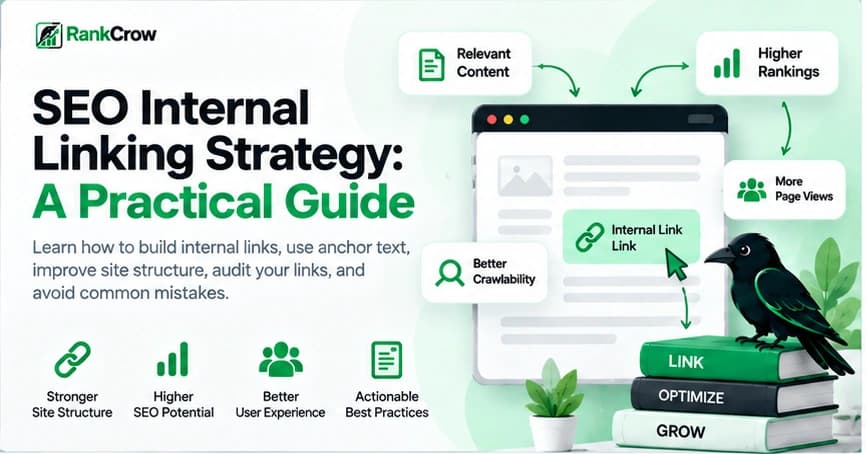
Internal linking is the practice of linking one page on a website to another page on the same website.
For example, a guide about SEO audits might link to a Technical SEO guide because technical issues are an important part of an audit. Both pages belong to the same website, so that connection is an internal link.
Internal links can appear in navigation menus, article content, category pages, breadcrumbs, related-content sections, footers, and other parts of a site.
The most useful internal links are usually the ones that help someone continue naturally from one topic to another.
If a reader is learning about SEO content, a link to an On-Page SEO guide may be useful. A random link to an unrelated page inside the same paragraph would not provide the same value.
That is the basic idea behind internal linking SEO: use links to create meaningful relationships between pages rather than treating linking as a mechanical SEO task.
Why Internal Linking Matters for SEO
Internal links can support both users and search engines.
For users, they create paths through the website. Someone who lands on one article can discover a more detailed guide, a related topic, or the next logical step.
For search engines, internal links can help with discovery and understanding. Google's link guidance says that every page you care about should have a link from at least one other page on your site, and it recommends descriptive anchor text that helps people and Google understand the destination. See Google's link best practices.
Internal links can also help communicate how different pages relate to each other. Google explains that it analyzes linkages between pages to understand site structure and can use those relationships to infer the relative importance of pages. See Google's site structure guidance.
For example, RankCrow currently has guides covering On-Page SEO, Technical SEO, SEO Content, and SEO Audits. Linking these guides where the topics naturally overlap creates a clearer learning path.
That does not mean every page should link to every other page. The goal is relevance.
A strong SEO internal linking strategy should help search engines understand page relationships and relative importance while helping visitors find useful supporting information.
Internal links do not guarantee rankings, and they should not be presented as a shortcut to higher positions. They are one part of a wider SEO system.
Internal Links vs External Links
Internal and external links serve different purposes.
An internal link points to another page on your own website. An external link points to a page on another website.
For example, linking from this guide to RankCrow's Technical SEO Guide is an internal link. Linking to official Google Search Central documentation is an external link.
Both types can be useful. Internal links help connect your own content. External links can provide supporting evidence, official documentation, original research, or additional context that your own site does not provide.
The key difference in internal vs external links is not whether one type is automatically better. It is where the link leads and what purpose it serves.
A healthy article can contain both.
How to Build an SEO Internal Linking Strategy
A practical SEO internal linking strategy starts with structure, but it should also give you a repeatable process for deciding what to link, where to link it, and why.
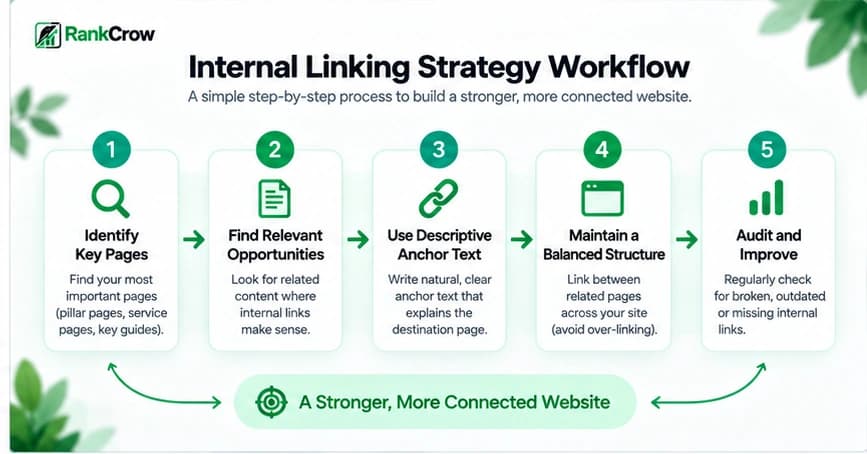
1. Identify priority pages
Decide which evergreen guides, service pages, category pages, or other important resources deserve strong visibility within the site.
2. Group related topics
Organize pages into logical topic relationships so links are based on real relevance rather than keyword overlap alone.
3. Find contextual link opportunities
Review existing pages and identify sections where another page genuinely helps the reader continue learning.
4. Choose descriptive anchor text
Use concise wording that sets a clear expectation for the destination without forcing the same exact-match phrase every time.
5. Link from relevant older pages
When a new resource is published, update older related pages so the new page is not isolated.
6. Review new and old content together
Internal linking works best as an ongoing editorial habit rather than a one-time launch task.
7. Audit and recheck
Review broken, redirected, outdated, weak, or unnecessary links and verify important changes after updates.
For RankCrow, topic relationships may include On-Page SEO, Technical SEO, Content SEO, SEO Audits, internal linking, crawling and indexing, and image SEO. Each topic can have supporting pages around it.
An SEO Audit guide can link to Technical SEO because technical checks are part of an audit. A Content SEO guide can link to On-Page SEO because content structure, titles, headings, and metadata overlap with page-level optimization.
Important evergreen guides may deserve links from several relevant articles, listing pages, and hub pages. More specialized pages may need fewer links.
The objective is not to follow a fixed linking formula. Use internal links to help search engines understand page relationships, help important pages remain discoverable, and help users move naturally through related topics.
Internal Linking Structure
Your internal linking structure describes how pages connect across the site.
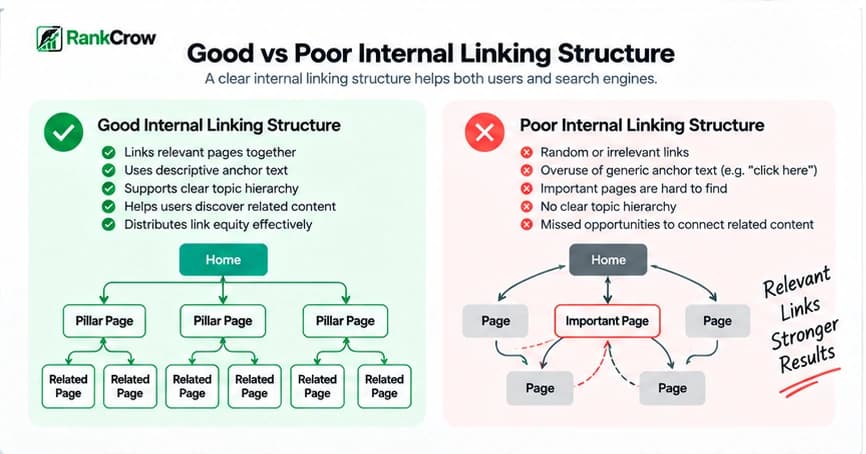
A weak structure often has isolated pages, unnecessary depth, repeated links with little context, or important content that is difficult to reach.
A better structure makes important pages accessible through normal navigation and relevant contextual links.
For example, an SEO Guides hub can link to individual guides. Those guides can then link to related guides where appropriate.
A simple learning path might look like this:
SEO Guides Hub → On-Page SEO → Internal Linking Strategy → SEO Audit → Technical SEO
That does not mean users must follow one fixed path. The point is to create several sensible routes between related content.
One important principle is to avoid leaving valuable pages isolated. An important page should receive at least one internal link from another relevant page.
If a page has no internal links pointing to it, visitors may struggle to discover it and search engines may have fewer contextual signals about how it fits into the site.
How to Use Internal Anchor Text
The clickable text used in a link is called anchor text.
An internal anchor should usually give the reader a reasonable idea of what they will find after clicking.
Useful examples include:
- Technical SEO guide.
- SEO audit checklist.
- SEO content strategy.
These phrases provide context.
Vague anchors such as “click here,” “read more,” or “this page” can sometimes make sense in interface elements, but inside editorial content they often provide less information.
Google's link guidance recommends descriptive, reasonably concise, relevant anchor text that helps people and Google understand the linked page.
Descriptive does not mean you need to use an exact-match keyword every time.
If several articles link to the same page, the anchor text can vary naturally depending on the surrounding sentence. A Technical SEO guide might be linked as “technical SEO issues,” “technical SEO guide,” or “technical problems that affect crawling.”
Natural variation is usually better than forcing the same phrase into every link.
Internal Linking Best Practices
Good internal linking best practices are mostly about relevance, clarity, and usefulness.
Internal links SEO work best when they support the structure of the site and the needs of the reader at the same time.
- Add internal links where they genuinely help the reader understand the topic or continue learning.
- Use descriptive anchor text rather than generic wording where practical.
- Link important pages from relevant content instead of relying only on menus or footers.
- Review older content when new resources are published.
- Update important internal links when URLs change instead of leaving unnecessary redirect chains in place.
- Avoid forcing links into paragraphs where there is no meaningful relationship.
- Do not turn every repeated keyword into another link to the same destination.
- Keep important editorial links current and useful.
How Many Internal Links Per Page?
There is no universal answer to how many internal links per page you should use.
Google's current link guidance does not provide a magical ideal number of links for every page.
That means rules such as “five links per 1,000 words” or “never use more than 100 links” should not be treated as universal SEO formulas.
A better approach is to add as many internal links as genuinely help readers navigate related content while keeping the page clear and usable.
A short page may need only a few internal links. A long educational guide covering several related topics may naturally contain more.
The right number depends on context.
If every other sentence contains a link, the page may become distracting. If a detailed guide contains no useful paths to related content, you may be missing opportunities to help the reader.
Use judgment instead of a fixed quota.
Multiple Internal Links to the Same Page
Another common question is whether multiple links to the same destination are a problem.
The search phrase seo multiple links to same page often leads people to assume there must be a penalty or strict rule.
There is no need to treat multiple internal links to the same URL as inherently harmful.
A page might be linked in the main navigation and again contextually inside an article. That can be completely reasonable.
The important question is whether each link has a useful purpose.
If the same destination is linked repeatedly within a short section without helping the reader, the page can feel cluttered. If the links appear naturally in different contexts, there may be no problem at all.
Usefulness is the better standard.
How to Perform an Internal Link Audit
An internal link audit reviews how pages connect across a website and identifies links or structures that may need attention.
An internal linking audit should look beyond simple link counts.
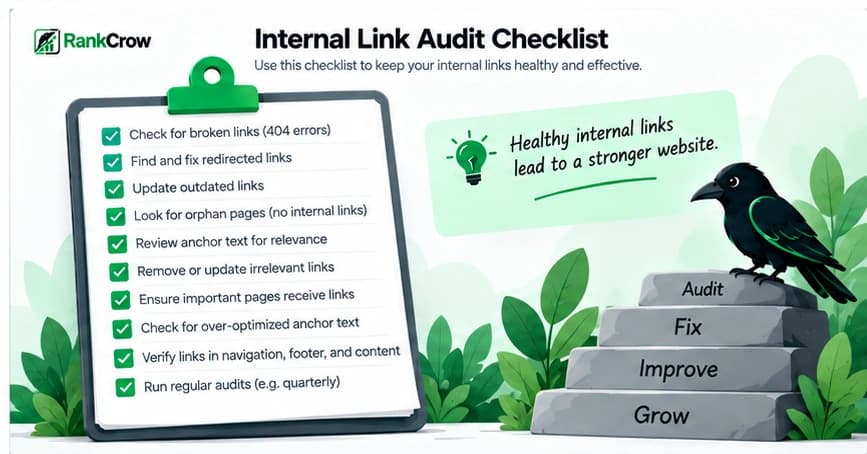
A useful internal link audit can review:
- Broken links that no longer resolve correctly.
- Outdated internal URLs that should point directly to current preferred destinations.
- Redirected internal URLs that can be updated where practical.
- Weakly linked important pages.
- Orphan or near-orphan pages that lack meaningful contextual links.
- Poor, vague, or repetitive anchor text.
- Irrelevant links that do not help the reader.
- Important pages with insufficient contextual support from related content.
- Navigation depth where relevant to the site structure.
A page may technically have one internal link but still be difficult to discover because that link appears deep inside an unrelated section. Context matters.
RankCrow can help review page-level link information alongside other supported on-page and technical SEO signals.
It should not be described as a sitewide orphan-page crawler, backlink database, link graph, automatic link-opportunity finder, PageRank simulator, or AI link-suggestion system unless those capabilities are actually implemented.
Common Internal Linking Mistakes
Adding Links Only for SEO
One common mistake is adding links only for SEO and ignoring whether they help the reader.
Repeating Exact-Match Anchor Text
Another mistake is using the same exact-match anchor text everywhere.
Publishing New Pages Without Updating Old Content
Some sites publish useful new pages without updating older related content to link to them.
Leaving Broken or Old Links
Broken or outdated internal links are another problem.
Linking Through Unnecessary Redirects
Redirected internal URLs may remain in old articles long after the destination has changed. Redirects can be necessary, but where practical, important internal links should point directly to the current preferred URL.
Over-Linking Repeated Keywords
If a page mentions “SEO audit” eight times, that does not mean all eight instances need to link to the same guide.
Weak Site Structure
A valuable page may exist but receive little contextual support from the rest of the site.
The solution is not random linking. The solution is to connect pages where the relationship makes sense.
Internal Linking Example
Imagine a website has four guides: On-Page SEO, Technical SEO, SEO Content, and SEO Audit.
The SEO Audit guide explains that audits review technical issues, content quality, page-level optimization, and internal linking. That creates several natural linking opportunities.
When the audit guide discusses page-level optimization, it can link to the On-Page SEO Guide.
When it discusses crawling, canonicals, robots.txt, and sitemaps, it can link to the Technical SEO Guide.
When it discusses content quality and search intent, it can link to the SEO Content Guide.
Those links help readers move to deeper explanations without forcing all of that detail into one article.
The related guides can also link back to the SEO Audit guide when audit methodology is relevant.
That creates a useful topical cluster.
This is a better internal linking model than adding links simply because two pages contain similar keywords.
How RankCrow Helps With Internal Linking
RankCrow can support part of the internal-linking review process by analyzing page-level SEO signals.
The RankCrow Free SEO Analyzer can review supported link information alongside areas such as internal links, external links, nofollow information, headings, canonical signals, indexability, and the overall SEO Score.
This can help identify page-level areas that deserve attention.
For example, when reviewing a page, you can examine whether relevant internal and external links are present and then manually decide whether additional contextual links would help the reader.
RankCrow should not be treated as a complete sitewide internal-link architecture platform.
A practical workflow is: analyze the page, review its link context, make useful improvements, and then re-analyze.
For broader page-level optimization, RankCrow's On-Page SEO Guide explains how links work alongside titles, headings, content, images, and metadata.
For broader page-level fundamentals like titles and headings, see RankCrow's SEO Optimization Tips guide.
The Technical SEO Guide covers crawling, canonicals, robots.txt, sitemaps, and related technical issues.
The SEO Audit Guide explains how link review fits into a wider website audit.
The SEO Content Guide shows how content strategy and search intent can guide the creation of pages worth linking together.
Review Your Page With RankCrow
Analyze supported page-level links, headings, indexability, canonical signals, and other SEO checks in one place.
Internal Linking Checklist
Use this checklist when reviewing new or existing pages.
Internal Linking Checklist
A strong internal linking system should feel natural when someone actually uses the website.
Frequently Asked Questions
What is internal linking?
Internal linking is the practice of linking one page on a website to another page on the same website. It helps visitors discover related content and helps search engines understand relationships between pages.
Why are internal links important for SEO?
Internal links can help search engines discover pages, understand site structure, and interpret relationships between related content. They also improve navigation for users.
How many internal links should a page have?
There is no universal ideal number. Add links where they genuinely help readers navigate to useful related content while keeping the page clear and easy to use.
What is internal anchor text?
Internal anchor text is the clickable text used in a link pointing to another page on the same website. It should usually describe the destination naturally and clearly.
Are multiple internal links to the same page bad for SEO?
Not inherently. A page may be linked from navigation and also from contextual content. The main concern is avoiding unnecessary repetition that creates clutter or provides no additional value.
What should an internal link audit check?
An internal link audit can review broken links, outdated URLs, redirects, poor anchor text, weakly linked pages, irrelevant links, important pages lacking contextual links, and overall site structure.
Should every page have internal links?
Important pages should generally be reachable through internal links from relevant parts of the site. The exact number and placement depend on the role of the page and the website's structure.
Final Thoughts
A strong SEO internal linking strategy is not about inserting links everywhere.
It is about creating useful connections.
Start by understanding how your pages relate to each other. Make important content easy to reach. Use descriptive anchor text. Link where another page genuinely helps the reader.
Avoid arbitrary link-count formulas. Review old content when new pages are published. Audit links periodically and fix problems that affect navigation or clarity.
Internal links work best when they support the structure of the website rather than being added as isolated SEO tactics.
As RankCrow's content library grows, internal linking can help connect related guides into a clearer learning path for both visitors and search engines.
You can explore the RankCrow SEO Guides library or use the RankCrow Free SEO Analyzer to review supported page-level SEO signals before making changes.
Ready to Review Your Page?
Use RankCrow to review supported page-level SEO signals and identify areas that may deserve attention.
Key Takeaways
- Internal links should help readers move naturally between related pages.
- Important pages should receive internal links from other relevant pages on the site.
- Descriptive anchor text is more useful than vague labels such as “click here.”
- There is no universal ideal number of internal links per page.
- A good strategy connects topic relationships instead of forcing links around keywords.
- Internal link audits should review broken, outdated, redirected, weak, or irrelevant links.
- RankCrow can help review page-level link information, but it is not a sitewide link-graph or orphan-page crawler.