
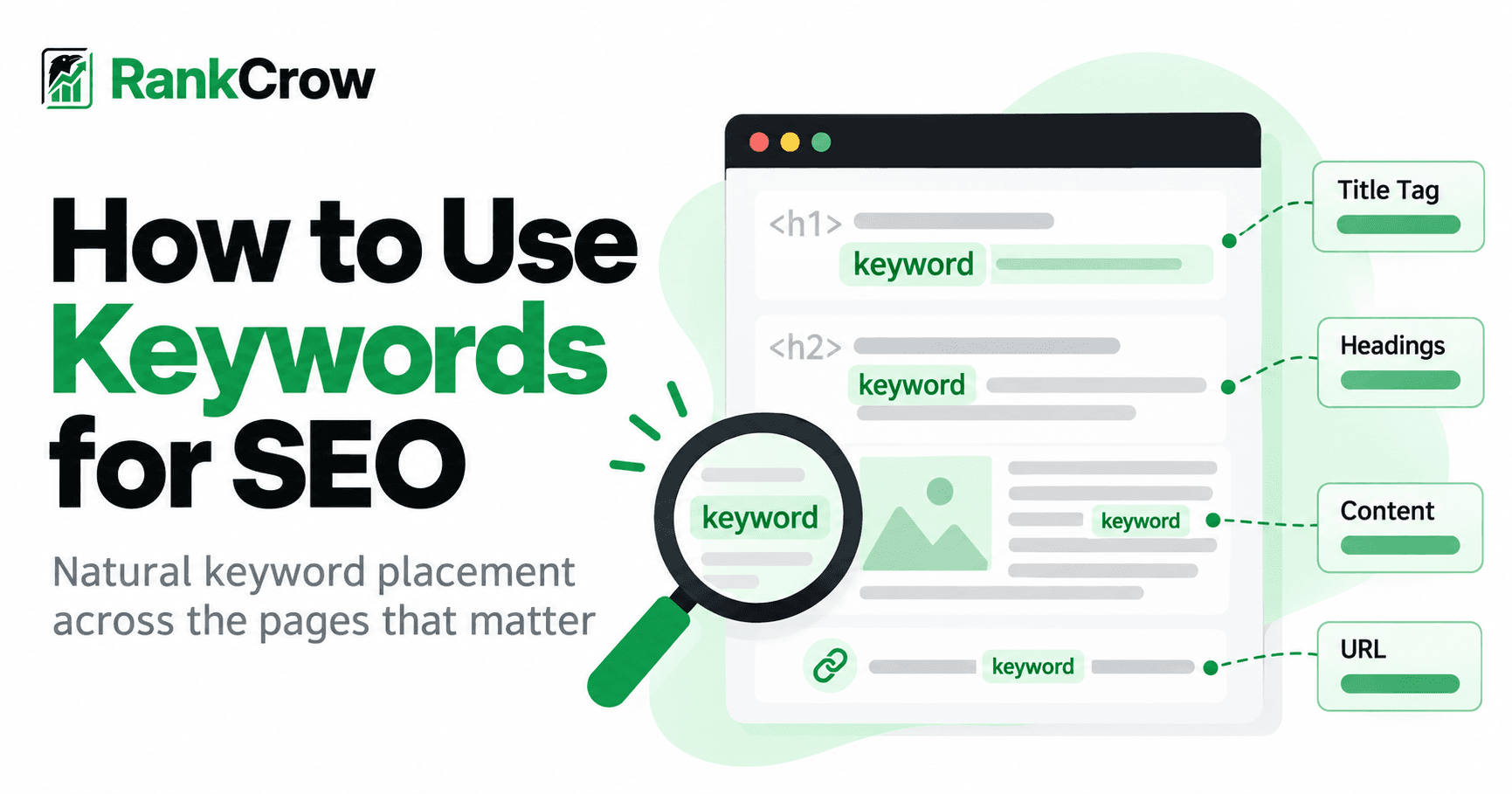
You have chosen a keyword for a page. Now comes the part that causes most of the confusion: where should you actually use it?
Should it be in the title? The H1? Every heading? The first paragraph? Image alt text? How many times should you repeat it?
Learning how to use keywords for SEO is not about finding as many places as possible to insert the same phrase. A better approach is to make the page's topic clear, satisfy the search intent, and use the keyword where it naturally helps describe the content.
Google recommends using the words people would use to find your content in prominent places such as the title and main heading, and using descriptive text for links and images where appropriate. That is guidance about clarity and relevance—not a formula for repeating keywords across every possible HTML element. See Google's Search Essentials.
Use keywords to clarify what the page is about—not to manufacture relevance through repetition.
What Does It Mean to Use Keywords for SEO?
Using keywords for SEO means applying the words and concepts connected with a page's search intent in places where they help users and search engines understand the page.
Suppose you are creating a page about image optimization for SEO. Your primary topic might be image optimization seo.
That does not mean every paragraph needs to repeat that exact phrase. A useful page would naturally discuss concepts such as image size, file formats, descriptive alt text, dimensions, compression, and page performance because those subjects genuinely belong to the topic.
Primary keyword: the main search query or topic the page is intended to address.
Secondary or related terms: closely connected language, variations, subtopics, and concepts that help explain the subject properly.
SEO tools and teams may use labels such as primary, secondary, or related keywords differently. Here, they are simply a practical way to organize one main topic and the language needed to cover it well.
Keywords help describe the topic. They do not replace the topic.
Start With Search Intent Before Placing Keywords
Before deciding where to place a keyword, make sure the page actually answers what the searcher appears to want.
A keyword cannot rescue the wrong page.
For example, imagine someone searches how to optimize images for SEO. They are likely looking for instructions they can apply.
A page that spends most of its time defining what an image is, even if it repeats “optimize images for SEO” throughout the copy, would still fail to answer the practical question.
Understand the search need first. Build the page around that need. Then use the keyword where it helps describe the answer.
Different wording does not always mean different intent. Two keywords can look different while still representing essentially the same search need. Creating a separate page for every small wording variation can therefore produce unnecessary overlap.
RankCrow's Keyword Cannibalization SEO article explains that issue in more depth.
Where Should You Use Keywords on a Website?
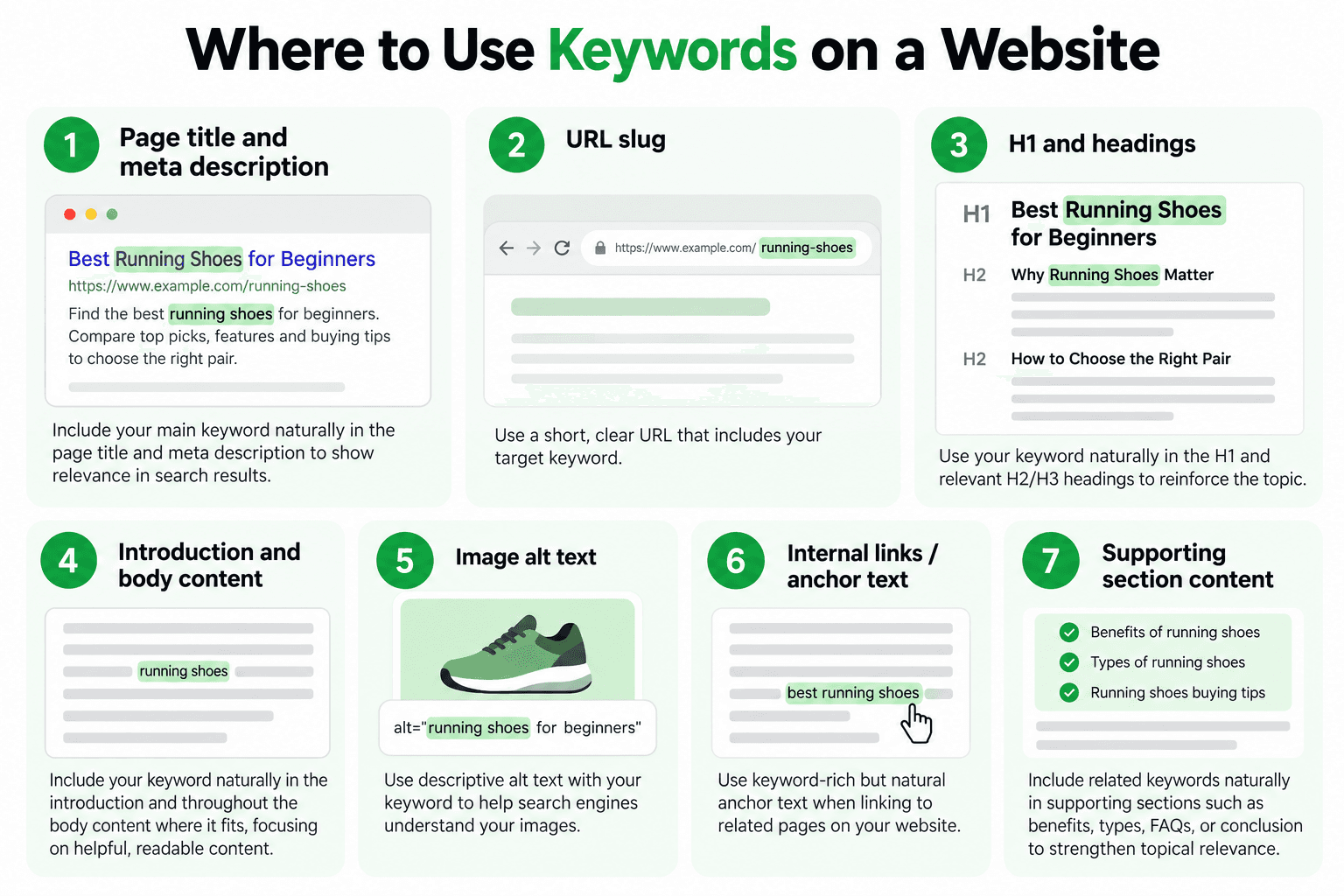
There is no single HTML field where adding a keyword suddenly “optimizes” the page. Instead, several parts of a webpage help communicate what the content is about.
SEO Title / Title Element
The page title is one of the clearest places to communicate the main subject. For example, How to Optimize Images for SEO is more descriptive than Our Image Guide.
The primary keyword does not always need to appear word-for-word or at the beginning. The title should first describe the page accurately and make sense to someone deciding whether the result is relevant.
Google recommends descriptive and concise title text and warns against keyword stuffing in titles. Google may also create search-result title links from multiple sources rather than always displaying the HTML <title> exactly as written. See Google's title link guidance.
For the technical side of titles, headings, links, and other markup, see RankCrow's HTML SEO Guide.
H1
The main heading should make the page's subject immediately understandable. If your primary keyword fits naturally, using it—or a natural close version of it—in the H1 often makes sense.
You do not need to distort normal English simply to reproduce an awkward search query exactly.
Introduction
Establish the topic early. If a reader lands on a page about using keywords for SEO, they should not have to read several paragraphs before discovering that the article is actually about keyword placement.
That does not mean the exact keyword must appear within the first 50, 100, or any other arbitrary number of words. The goal is simply to make the subject clear early enough that the introduction matches the reader's expectation.
H2 and H3 Headings
Headings should describe the sections beneath them. This naturally creates opportunities to use relevant keywords and related terminology.
Use keywords in headings when they improve the structure and accurately describe what follows. Do not create headings solely to insert another phrase.
Main Body Content
The body is where the page actually earns its usefulness. Instead of thinking “Where can I repeat my keyword again?”, ask what information someone needs to fully understand or act on the topic.
If you answer the question properly, relevant terminology will usually appear naturally. Those terms belong there because the topic requires them—not because every related phrase needs to meet a quota.
URL
A short, descriptive URL can reflect the main topic of the page. For this article, /blog/how-to-use-keywords-for-seo is clearer than a vague URL such as /blog/article-427.
You do not need to add several keyword variations to the slug. Keep it readable, descriptive, and stable.
Meta Description
The meta description can summarize what the page offers and may naturally contain wording related to the search. However, do not treat it as another place where an exact-match keyword must be inserted several times or as a direct Google ranking factor.
Google says snippets are primarily created from page content, although it may use the meta description when that description better represents the page. See Google's snippet guidance.
Write the meta description as useful search-result copy—not as a keyword field.
Images and Alt Text
Alt text should describe an image according to its purpose and context. If a keyword genuinely describes the image, its presence may be natural.
Keyword-related wording belongs there only when it genuinely describes what the image communicates. Do not treat every alt attribute as a keyword-placement field.
For deeper image-specific guidance, see RankCrow's Image Optimization SEO Guide.
Internal Links and Anchor Text
Anchor text helps users understand what they will find after clicking a link. Descriptive wording is more useful than generic text such as “click here,” but that does not mean every internal link pointing to the same page should use the exact same keyword phrase.
Google recommends links that are crawlable and anchor text that helps people and Google understand the destination. See Google's crawlable-links guidance.
RankCrow's SEO Internal Linking Strategy Guide covers internal-link planning in greater depth.
How to Incorporate Keywords Naturally
Natural keyword usage becomes much easier when you stop writing around the keyword and start writing around the question.
Consider this sentence: Internal links help users and search engines discover related pages. The wording is direct and useful.
Now imagine rewriting it purely to insert a target phrase: SEO internal linking keywords are important because SEO internal linking keywords help improve SEO internal linking.
The second sentence communicates less even though it repeats more “SEO” language.
A useful workflow is to draft the answer first, then review whether the page clearly reflects the terminology people use to search for the topic.
Use natural variations when repeating the same phrase would make the writing awkward. For example, throughout an article about how to use keywords for SEO, normal language might include use SEO keywords, keyword placement, primary keyword, related terms, keyword usage, page topic, and search intent.
If a sentence sounds like it exists only because you wanted another keyword occurrence, rewrite or remove it.
How Many Keywords Should You Use for SEO?
There is no universal number of keywords that every page needs. You do not need exactly five keywords per page, and you do not need to hit a fixed keyword-density percentage.
Google does not publish a universal keyword-density target that webpages should aim for.
One clear primary search intent or topic, supported by closely related terms and subtopics where they help answer that intent.
A short service page may require only a small set of relevant concepts. A detailed guide may naturally cover many more related phrases because the subject requires more explanation.
The number of terms should follow the scope of the topic and what readers need to know—not a quota produced by a keyword tool.
Using Keywords in Blog Posts
Using keywords in blogs follows the same principle, but the page often gives you more room to answer supporting questions.
Start by deciding what the searcher needs from the post. Then structure the article around the real questions required to answer that need.
A useful editing process is to confirm the primary topic, build sections around genuine subquestions, place the keyword naturally in descriptive locations, use related terminology where relevant, and finally remove repetitions that make the writing feel mechanical.
If your work starts moving beyond keyword placement and into broader content optimization, RankCrow's What Is SEO Content? Guide covers that wider context.
SEO Keyword Examples: From Keyword to Useful Page
A practical example makes this easier to see. Imagine a page targeting image optimization seo.
The page might naturally discuss:
- image file size and compression;
- descriptive alt text;
- image dimensions;
- modern image formats;
- page loading performance.
Those topics are not being included because a keyword tool demanded five secondary keywords. They are included because someone learning about image optimization would reasonably need them.
The primary keyword gives the page a central direction. Related concepts help the page answer that topic properly.
This is the difference between covering a subject and stuffing terminology.
Exact-Match Keywords vs. Natural Variations
Search queries are not always grammatically clean. Someone might search how to add keywords in website for seo. You do not need to repeat that exact wording throughout your content.
Natural English such as how to add keywords to your website for SEO communicates the same topic much better.
Likewise, where to place keywords on a website can fit naturally even if a keyword-research tool reports the phrase where to place keywords for website.
Do not damage grammar or readability simply to preserve exact-match wording. The objective is to answer the same underlying search intent clearly.
Keyword Stuffing: What to Avoid
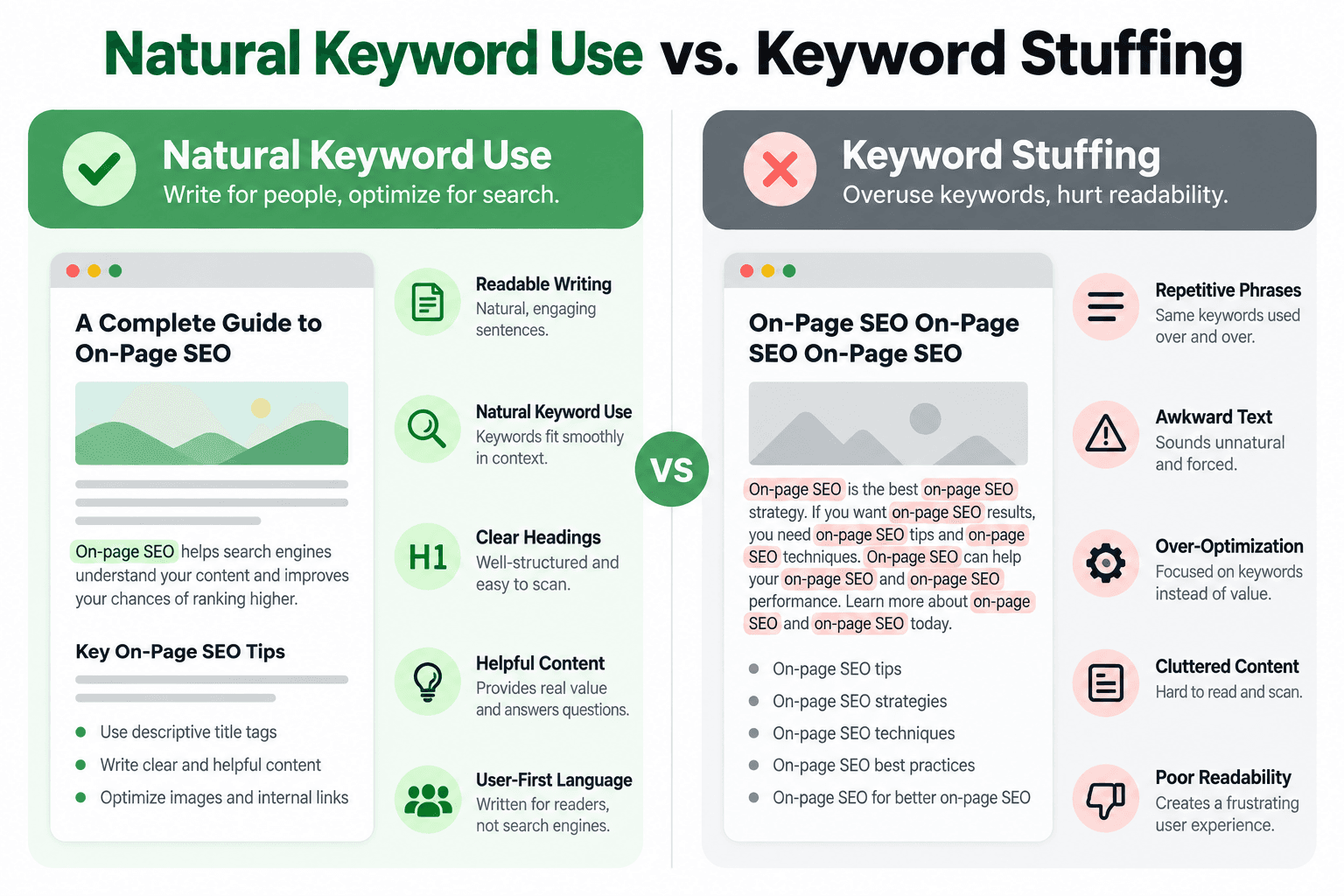
Google describes keyword stuffing as filling a webpage with keywords or numbers in an attempt to manipulate rankings. These terms may appear unnaturally, out of context, in groups or lists, or through excessive repetition. See Google's spam policies.
In practice, watch for patterns such as:
- repeating the same exact phrase when it adds nothing;
- headings written only to insert another keyword;
- irrelevant keyword variations;
- repetitive or manipulated alt text;
- unnatural exact-match anchor text;
- blocks of related phrases with no useful explanation.
There is no useful percentage where content suddenly changes from “safe” to “stuffed.”
Would you still write this phrase here if SEO tools were not counting it?
If yes, it probably belongs. If no, reconsider it.
A Practical Keyword-Placement Checklist
Before publishing or updating a page, review it against these questions:
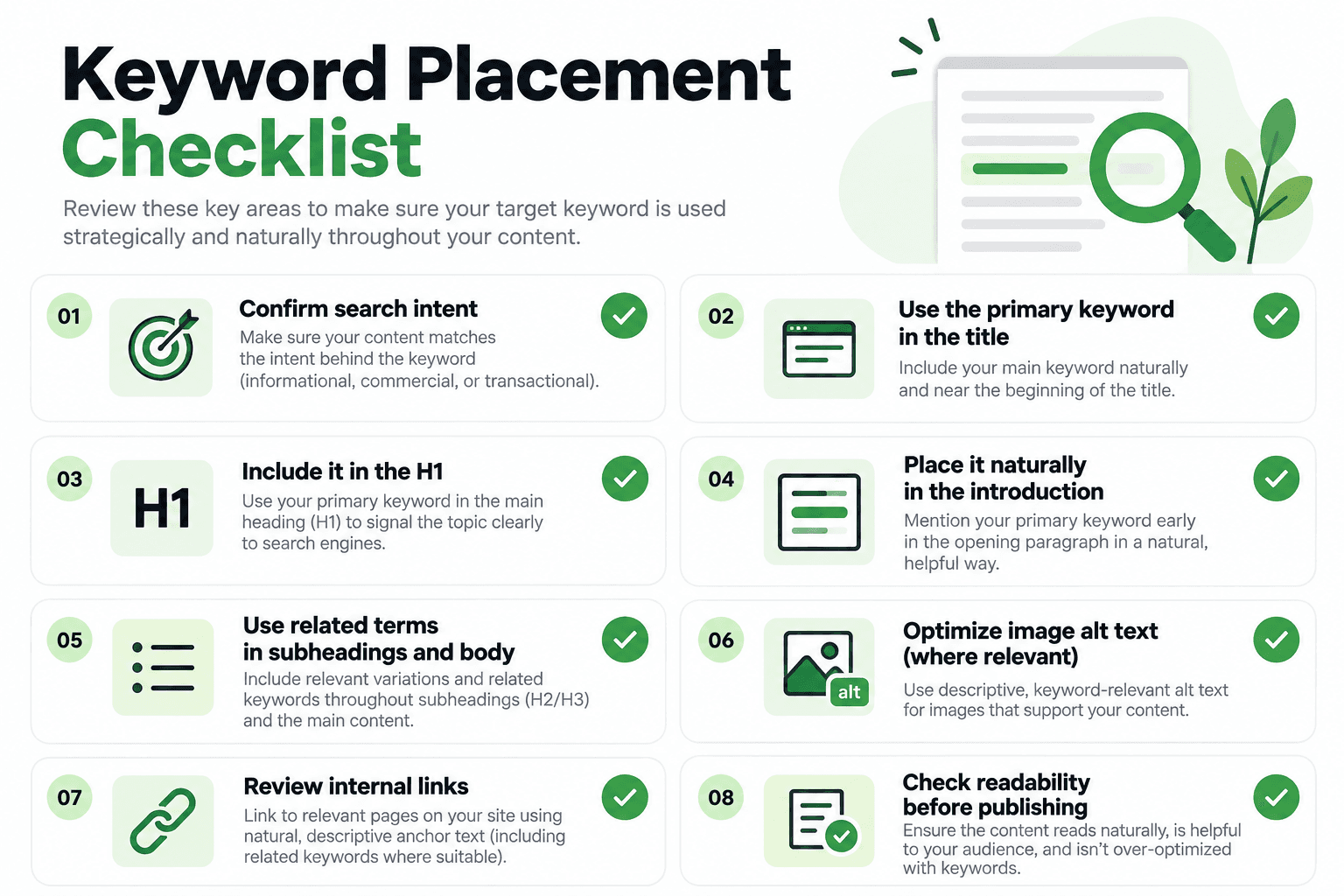
- Does the primary keyword match the page's actual search intent?
- Is the topic clear from the title and H1?
- Does the introduction establish the subject without unnecessary delay?
- Are H2 and H3 headings descriptive rather than created merely for keywords?
- Does the body fully answer the intended question?
- Are related terms used because they improve the explanation?
- Is the URL short and descriptive?
- Does the meta description summarize the page naturally?
- Does image alt text describe the image rather than act as a keyword field?
- Are internal-link anchors useful and natural?
- Have unnecessary repeated phrases been removed?
This is a review checklist, not a scoring formula. A page can pass every item and still need better content if it does not actually satisfy the searcher.
Where RankCrow Fits Into Keyword Usage
Once you have written or updated a page, RankCrow can help review page-level signals connected with keyword implementation.
The Free SEO Analyzer can inspect areas such as titles, meta descriptions, headings, page content, keyword presence and density, internal and external links found on the page, images and alt text, canonical and indexability signals, viewport configuration, HTTPS, structured-data detection, and other supported page-level checks.
That can help you spot practical issues—for example, a missing title, confusing heading structure, weak image attributes, or unusual keyword usage.
RankCrow does not choose the best keyword automatically, provide keyword search volume or difficulty data, perform backlink analysis, crawl an entire website, automatically fix SEO, provide AI recommendations in the Free analyzer, or guarantee rankings.
The RankCrow SEO Score is a RankCrow page-analysis metric, not a Google ranking score.
Use the RankCrow Free SEO Analyzer as a review tool after you have made the underlying content decisions—not as a replacement for search intent or useful writing.
Frequently Asked Questions
How do I use keywords for SEO?
Start with one clear page topic and search intent. Use the primary keyword or a natural variation in important descriptive locations such as the title, H1, introduction, relevant headings, and body content where it genuinely fits. Support it with related terminology needed to answer the topic properly.
Where should I place SEO keywords on a website?
Useful locations can include the SEO title, H1, introduction, relevant headings, body content, a descriptive URL, meta description, appropriate image alt text, and contextual internal-link anchor text. Not every location needs an exact-match phrase.
How many keywords should I use for SEO?
There is no universal number that works for every page. Focus on one clear primary topic or intent, then use closely related terms and subtopics as needed to explain that subject properly.
Do I need to use the exact keyword everywhere?
No. Search queries can be awkward, and repeating the same exact phrase can harm readability. Use natural variations when they accurately express the same topic and intent.
Should keywords be added to every image alt text?
No. Alt text should describe the image according to its purpose and context. Include keyword-related wording only when it genuinely describes what the image communicates.
Is keyword density important for SEO?
A fixed keyword-density target is not a useful universal rule. Google does not publish one universal percentage that every page should aim for. Concentrate on relevance, search intent, clear writing, and enough topic coverage to answer the user's question without unnecessary repetition.
Final Thoughts
The most useful way to approach keywords is not to ask “How many times can I fit this phrase into the page?”
What is this page supposed to help someone understand or do, and where does the keyword naturally help describe that answer?
Pick a clear topic. Match the search intent. Use the primary keyword where it improves clarity. Bring in related language when the subject genuinely requires it. Remove wording that exists only to satisfy a keyword count.
That gives you a page written around a real need rather than a collection of phrases arranged for a search engine.
Once the page is ready, you can use RankCrow to review its page-level SEO signals and catch implementation issues before moving on.