
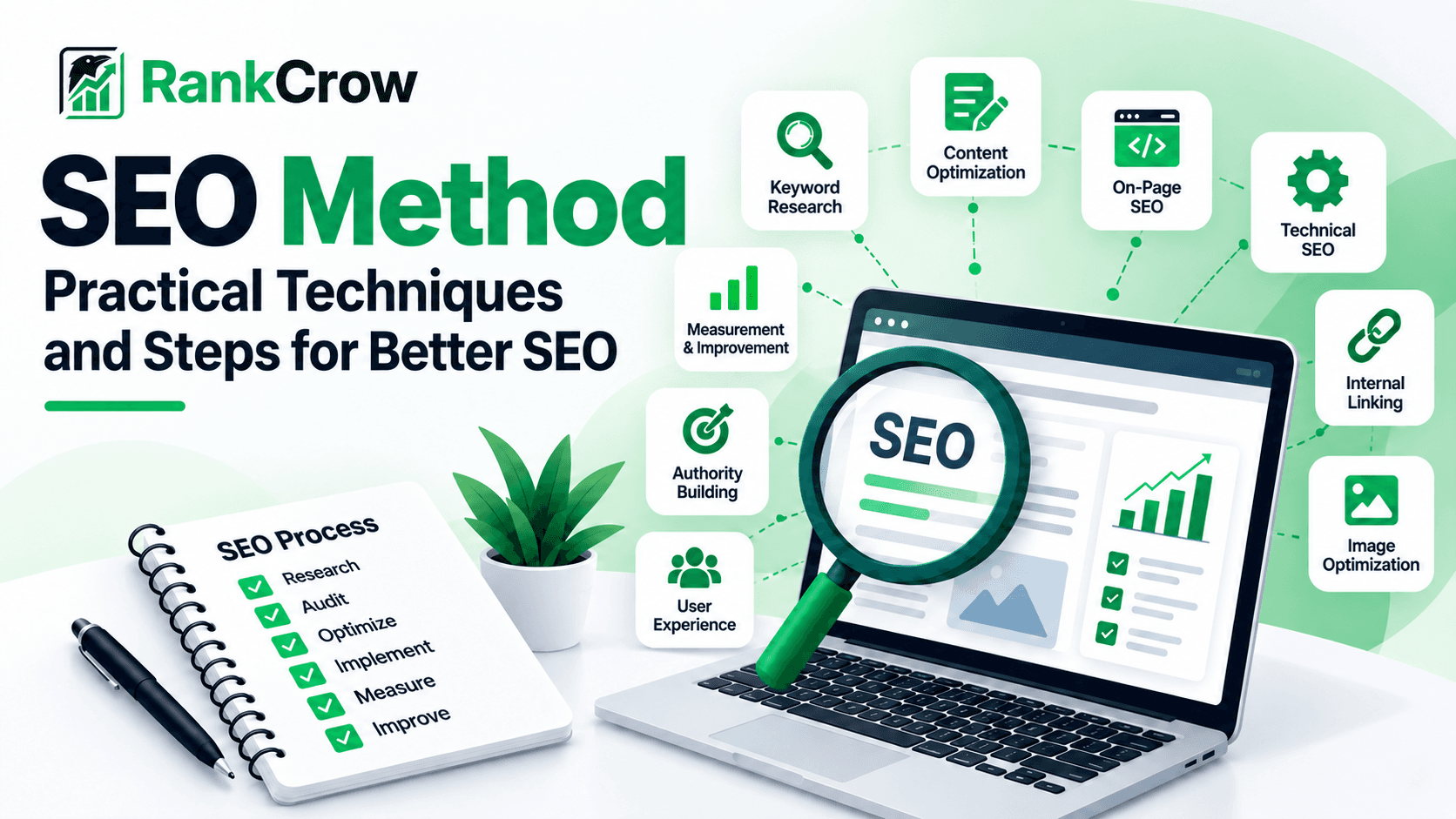
SEO does not depend on one trick, one tool, or one optimization.
A practical SEO method is an approach used to improve a website or webpage so it can be easier to crawl, understand, use, and discover through organic search. Some methods focus on content. Others deal with on-page optimization, technical accessibility, internal linking, user experience, authority, or measurement.
The important point is that these methods work together. Adding keywords will not solve an indexing problem. Technical improvements will not make weak content useful. Internal links cannot compensate for a page that does not satisfy search intent.
Good SEO usually comes from choosing the right method for the right problem and applying those methods in a sensible order.
What Is an SEO Method?
An SEO method is an approach or practice used to improve some part of a website's organic-search performance.
For example, improving page titles is a method of on-page optimization. Strengthening internal links is another method. Reviewing crawlability and indexability is a technical SEO method. Improving an outdated article is a content-focused method.
The terminology can become confusing because people often use method, technique, tactic, strategy, and process as if they mean the same thing.
- An SEO method is a general approach used to improve SEO.
- An SEO technique or tactic is a more specific action within a method.
- An SEO strategy is the broader plan that connects goals, priorities, and actions.
- An SEO process is the sequence used to carry out the work.
For example, improving internal linking may be one SEO method. Adding a contextual link from an older article to a newly published page is a specific tactic within that method.
Organic SEO techniques are most useful when they support a clear purpose. The goal is not to collect as many tactics as possible. It is to improve the areas that actually need attention.
Why SEO Requires More Than One Method
SEO covers several different parts of a website, so one method rarely solves every problem.
A technically inaccessible page will not become easier to index simply because more keywords are added to the content. A technically healthy page can still struggle if the content does not satisfy the searcher's intent.
A useful article may also be harder to discover if it has poor internal linking, weak page structure, or unclear titles and headings. Similarly, an optimized page does not automatically earn strong rankings.
Effective SEO therefore usually combines methods covering search intent, content quality, on-page optimization, technical SEO, internal linking, usability, authority, and ongoing measurement.
Practical SEO Methods That Work Together
The following methods cover some of the main areas involved in improving a webpage or website. They are not separate formulas. They support one another.
Start With Search Intent and Keyword Research
Before optimizing a page, understand what people are trying to find. Search intent helps determine whether the user wants to learn, compare, solve a problem, find a specific website, or take an action.
Keyword research can then help identify the main query and related terminology people use around that topic. The goal is not to place an exact phrase a certain number of times.
Use keyword research to understand the topic, likely intent, related questions, common terminology, and gaps the page may need to address. A page should be built around the reader's need first.
Create Helpful, Focused Content
A strong SEO method starts with useful content. That means answering the actual query instead of simply creating a long page.
Useful content should be focused, clear, original, accurate, and detailed enough to solve the problem. Longer content does not automatically mean better SEO.
For a deeper explanation of content structure and optimization, readers can continue to RankCrow's Content SEO Guide.
Improve On-Page SEO
On-page SEO helps make the purpose and structure of a webpage clearer. Important elements can include the SEO title, H1, supporting headings, meta description, content organization, internal links, images, alternative text, and the page URL where relevant.
Headings should organize the content logically rather than being added only to insert keywords. Meta descriptions can help explain a search result to users, but they should not be treated as a direct Google ranking factor.
For a deeper breakdown, continue to RankCrow's On-Page SEO Guide.
Strengthen Technical SEO
Good content still needs to be accessible. Technical SEO methods help search engines reach, understand, and process important pages correctly.
Common areas to review include crawlability, indexability, canonical signals, robots directives, HTTPS, mobile viewport, structured data where appropriate, sitemap inclusion, and basic page accessibility.
Crawling is not the same as indexing, and indexing is not the same as ranking. A canonical is also a signal rather than an absolute guarantee of the URL a search engine will select.
For deeper technical coverage, see RankCrow's Technical SEO Issues Guide, Search Engine Indexing Guide, and Schema Markup Examples Guide.
Build Useful Internal Connections
Internal links connect related pages on the same website and help visitors move between useful resources. They can also help establish relationships between pages.
Link to relevant pages, use descriptive anchor text, connect related topics naturally, and avoid leaving important pages isolated. There is no universal number of internal links that guarantees better rankings.
RankCrow's SEO Internal Linking Strategy Guide covers the deeper implementation details.
Optimize Images Where They Matter
Images can improve understanding, but they should also be handled carefully. Useful image optimization can include appropriate dimensions, reasonable file sizes, meaningful filenames where practical, and descriptive alt text for meaningful images.
Alt text should describe the image where appropriate. It should not be used as a place to repeat keywords unnaturally.
Readers who want a deeper treatment can continue to RankCrow's Image Optimization SEO Guide.
Improve User and Search Experience
A page should not only be understandable to search engines. It should also be comfortable for people to use.
Useful improvements may include readable text, clear navigation, logical page structure, mobile usability, reasonable loading performance, clear buttons and links, and avoiding intrusive elements.
Not every user-experience metric should be treated as a direct ranking factor. The practical goal is simpler: make the page easier to use.
Build Authority Beyond the Page
Some SEO methods happen outside the page itself. Off-page work can include earning relevant links, creating useful resources people want to reference, legitimate promotion, building reputation, and increasing awareness of valuable content.
The goal should not be to chase backlink numbers or use manipulative link schemes. More backlinks do not automatically mean better SEO.
Measure Results and Refine the Approach
SEO is iterative. After changes are implemented, review what happens.
Useful measurements can include organic impressions, clicks, click-through rate in context, landing-page performance, query visibility, conversions where relevant, and page-level technical issues.
Google Search Console can also help review search queries, impressions, clicks, and indexing information.
What Does the SEO Process Look Like?
The process of SEO becomes easier to understand when the methods are placed into a simple workflow.
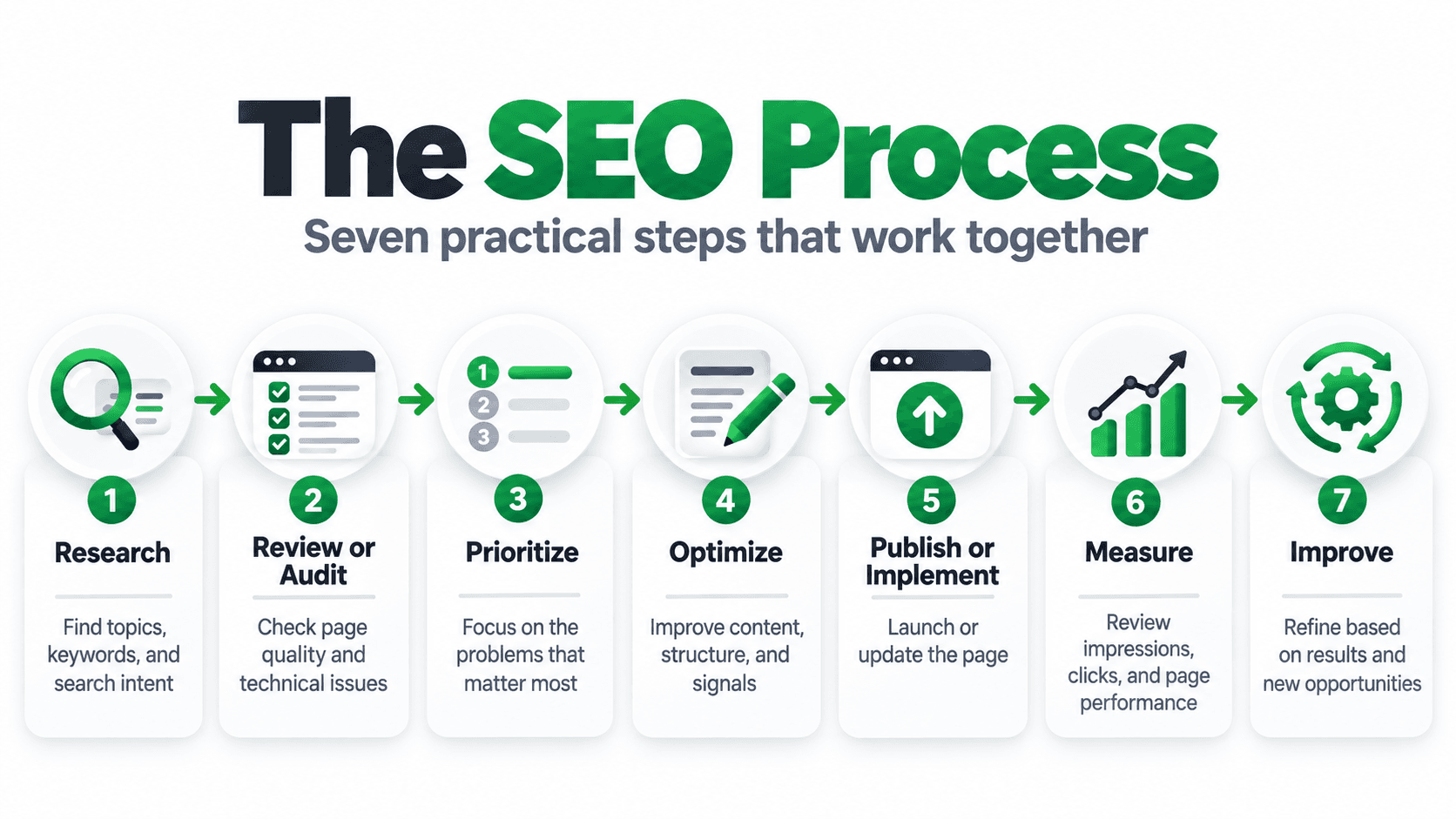
Research
Understand the audience, topic, search intent, and queries.
Review or Audit
Examine the page or website for problems and opportunities.
Prioritize
Decide which issues matter most and should be handled first.
Optimize
Apply the methods that match the problems you found.
Publish or Implement
Make the changes live without creating unnecessary duplicate pages.
Measure
Review what happens after the changes.
Improve
Refine the page based on results and new information.
These steps of SEO are intentionally simple. The purpose is not to create a complicated checklist. It is to show how individual methods fit into a repeatable process.
For a deeper look at the review stage, see RankCrow's SEO Audit Guide.
Turning SEO Methods Into a Strategy
Using random tactics is not the same as having an SEO strategy. A strategy connects what you want to achieve with the methods you will use to get there.
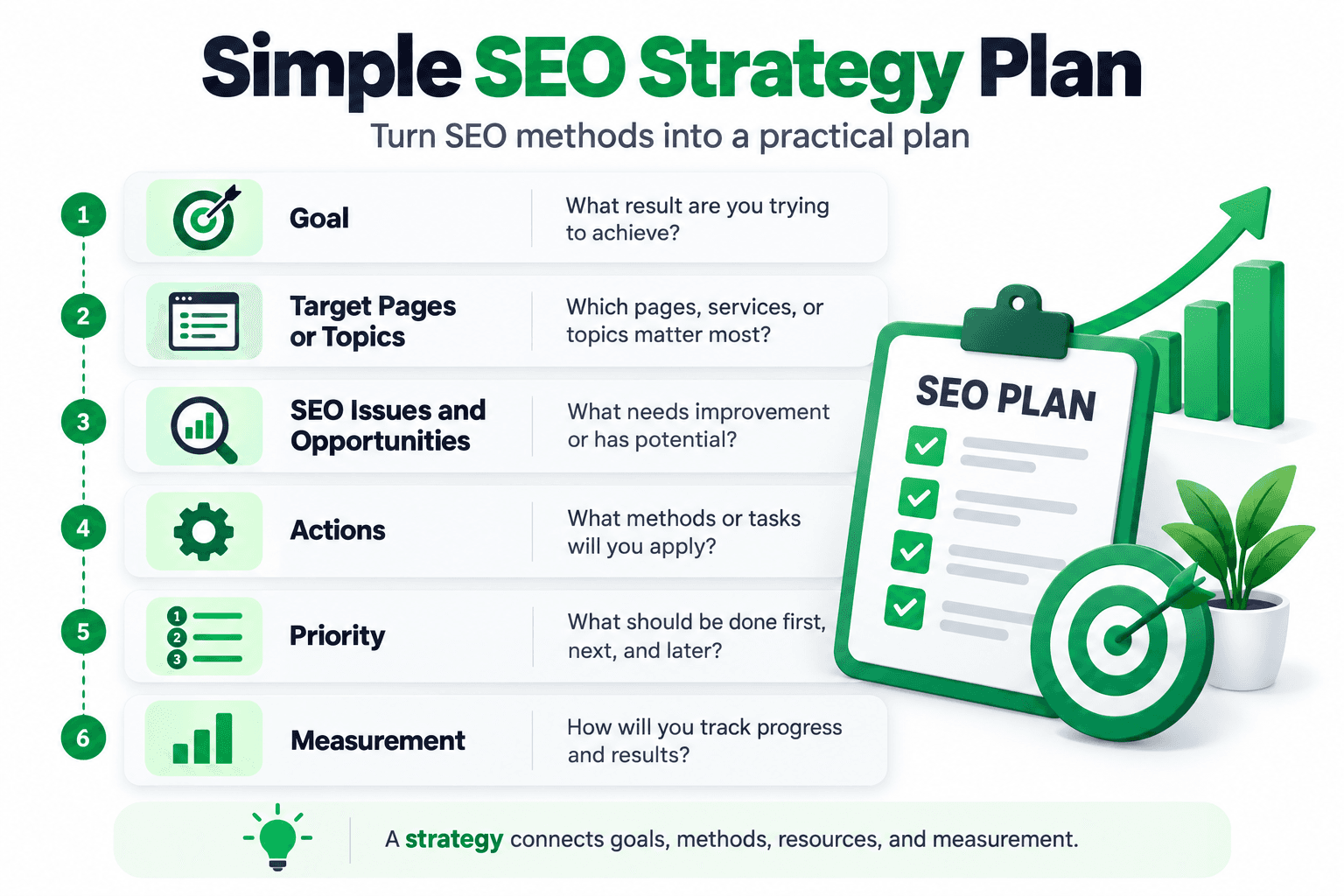
A practical SEO strategy plan can connect:
For example, a website may want to improve organic visibility for an important service page. The strategy could identify the target audience, review search intent, evaluate the existing page, improve content and on-page elements, strengthen internal links, fix technical issues, and monitor search performance afterward.
A simple SEO strategy template can include the goal, target pages or topics, issues and opportunities, actions, priority, and measurement. The framework should support the website's actual objective rather than force every project into the same checklist.
SEO Methods vs. Ranking Factors: What's the Difference?
SEO methods and SEO ranking factors are not the same thing.
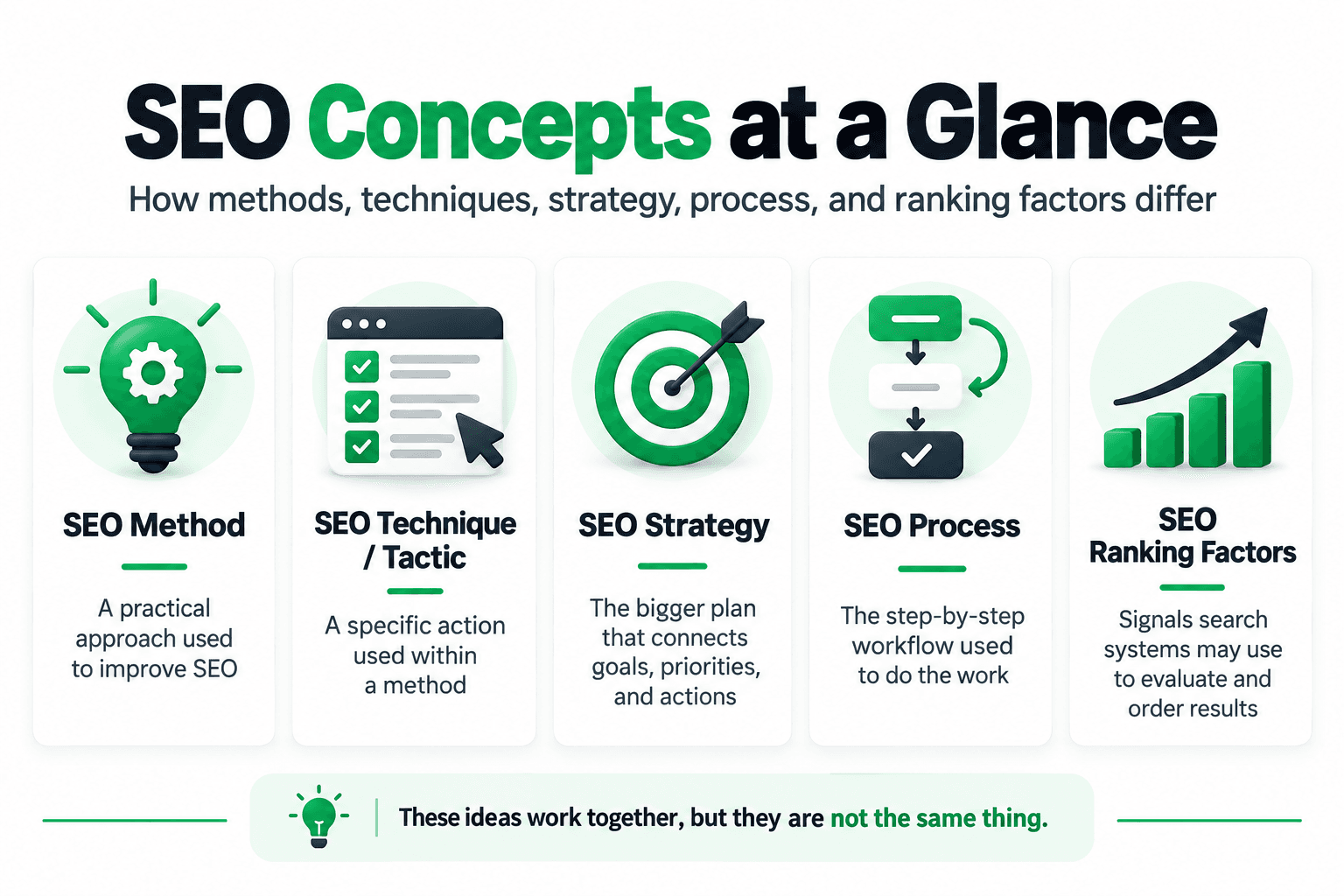
An SEO method is something you do, such as improving content, strengthening internal links, fixing crawlability problems, or improving page structure.
Ranking systems and signals relate to how search engines evaluate information and determine results. These ideas should not be reduced to a simple one-to-one relationship.
Improving a page title is an SEO method. That does not mean there is one isolated title signal that can be manipulated to guarantee a position.
The same caution applies to content length, keyword usage, backlinks, structured data, or an SEO score. A better approach is to focus on useful, accessible, relevant pages rather than trying to reverse-engineer rankings through a checklist.
What About White Hat SEO Techniques?
The phrase white hat SEO techniques is commonly used to describe sustainable optimization practices that focus on improving websites rather than manipulating search systems.
In practical terms, that means creating genuinely useful content, improving accessibility, making site structure clearer, strengthening relevant internal links, improving technical health, earning legitimate links, and avoiding manipulative shortcuts.
It also means avoiding practices such as keyword stuffing, link spam, cloaking, scraped or repackaged low-value content, and scaled publishing designed mainly to manipulate rankings.
These methods still do not guarantee rankings. They simply provide a more sustainable foundation for long-term SEO work.
Where RankCrow Fits Into the Process
SEO involves several methods, and page-level issues can be easy to miss when reviewing a URL manually.
RankCrow is a free page-level SEO analyzer that can help review important on-page and technical signals for an individual webpage.
- title and meta description
- headings and heading hierarchy
- content, word count, and readability
- keyword presence and density
- internal and external links
- image alt text
- canonical and indexability signals
- robots directives
- HTTPS and viewport
- structured-data detection
- Open Graph and Twitter Card metadata
- SEO Score
RankCrow's SEO Score is a page-analysis metric. It is not a Google ranking factor.
RankCrow does not replace deeper SEO investigation. It is a practical starting point for reviewing an individual page and identifying signals that may need attention.
Analyze a Page with RankCrow →Frequently Asked Questions
What is an SEO method?
An SEO method is an approach or practice used to improve some part of a website's organic-search performance. Examples include content improvement, on-page SEO, technical SEO, internal linking, image optimization, and measurement.
What are the main methods used in SEO?
Common methods include search-intent research, keyword research, content improvement, on-page SEO, technical SEO, internal linking, image optimization, usability improvements, authority building, and ongoing measurement.
What is the difference between an SEO method and an SEO strategy?
An SEO method is an approach used to improve a specific area. An SEO strategy is the broader plan connecting goals, priorities, methods, resources, and measurement.
What is the process of SEO?
A simple SEO process can include research, review or audit, prioritization, optimization, implementation, measurement, and continued improvement.
Are SEO methods the same as ranking factors?
No. SEO methods are actions or approaches used to improve a website. Ranking systems and signals relate to how search engines evaluate information and determine search results.
Final Thoughts
There is no single SEO method that solves every problem. Effective SEO usually combines several approaches.
Start by understanding search intent. Create useful content. Improve on-page elements. Make sure important pages can be crawled and indexed. Strengthen internal relationships between pages. Improve usability. Measure what happens, and continue refining the work.
The goal is not to collect as many SEO tactics as possible. It is to choose the methods that solve the problems your website actually has.
If you want a practical starting point, run an important page through the RankCrow Free SEO Analyzer and review the on-page and technical signals that may need attention.