
Do You Need SEO for a New Website?
Yes, but that does not mean you need every advanced SEO tactic on day one. For a new website, the first goal is to create a solid foundation that makes the site useful to visitors and understandable to search engines.
If you have ever asked, “Do I need SEO for my website?” the useful question is not whether you need a large SEO campaign. It is whether the website is being built in a way that avoids preventable problems from the beginning.
Early SEO planning can help you make better decisions about which pages to create, how those pages should be organized, what each page should cover, how visitors move through the site, and whether search engines can crawl and index the pages you want to appear in search.
It is also easier to choose a clean URL such as example.com/services/web-design before launch than to change an unclear URL later and deal with redirects and updated internal links.
What Makes a New Website SEO-Friendly?
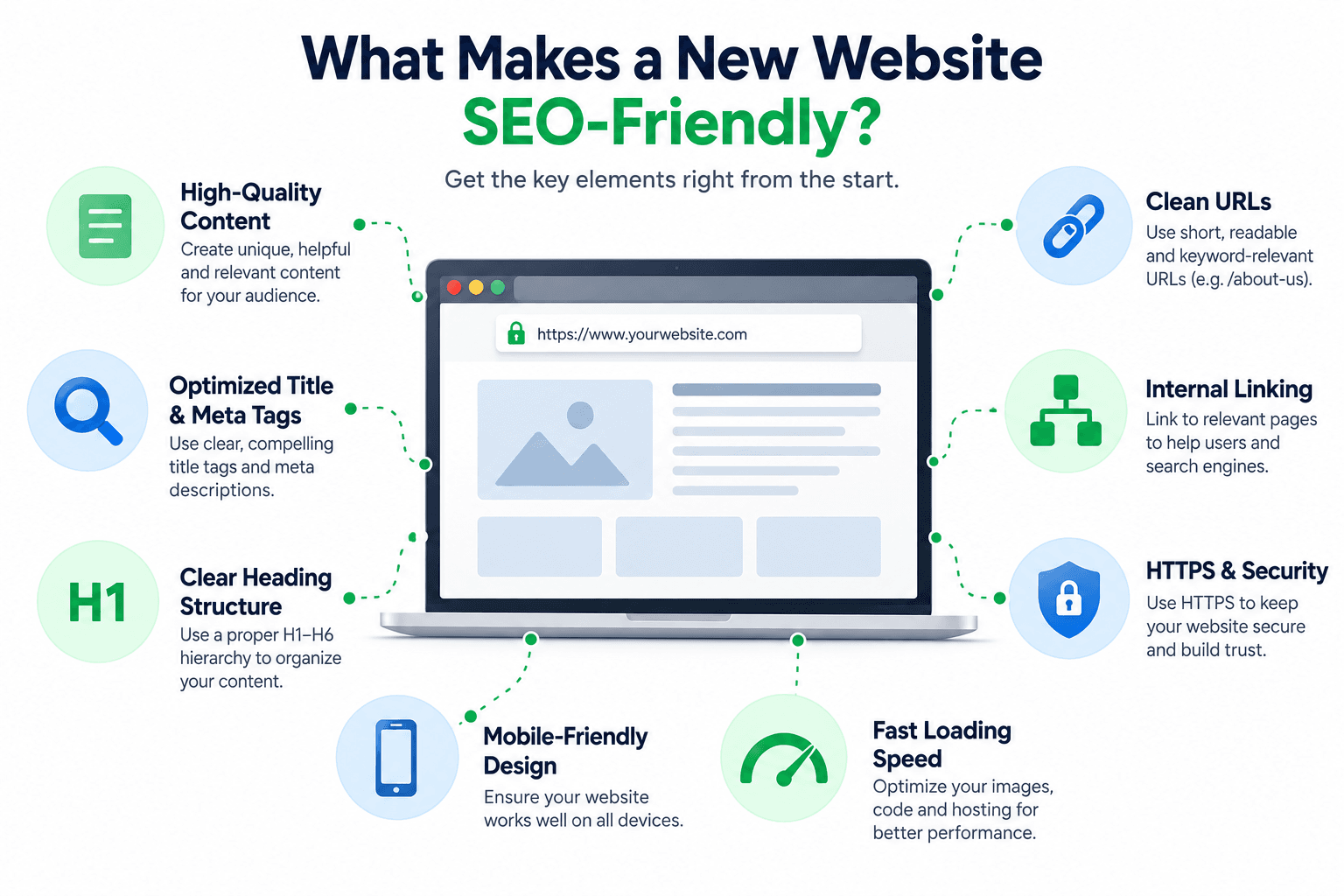
An SEO-friendly website is not simply a website with keywords added to every page. It is a site with a clear structure, useful content, sensible navigation, and technical settings that do not create unnecessary barriers for users or search engines.
A strong SEO-ready website usually starts with:
- a logical page hierarchy
- crawlable navigation
- useful content for important pages
- clear titles and headings
- descriptive URLs
- relevant internal links
- correct indexability settings
- a usable mobile experience
- HTTPS
- appropriately optimized images
- reasonable page performance
You do not need a perfect website before launch. You do need to make sure the basic structure and technical setup are sound enough that you are not creating avoidable SEO problems from the start.
SEO Requirements for a New Website
The SEO requirements for a new website begin before individual title tags or meta descriptions. Start by deciding how the site should be organized and what each important page needs to accomplish.
Plan a Clear Site Structure
A clear structure makes it easier for visitors to understand the website and move between related pages. It also gives search engines clearer relationships between different sections of the site.
A small business website, for example, might use a simple structure such as:
- Homepage
- About
- Services
- Individual service pages
- Blog or resources
- Contact
An ecommerce website may instead organize products through categories, subcategories, and individual product pages.
Whatever structure you use, important pages should be reachable through navigation or useful internal links. For more detail, see RankCrow's SEO Internal Linking Strategy.
Understand Search Intent Before Creating Pages
Every important page should have a clear purpose. Before creating it, ask who the page is for, what problem it solves, and what someone visiting that page should be able to learn or do.
Avoid creating several near-identical pages simply because different keyword variations exist. Create a page when there is a genuine reason for that page to exist and enough useful information to make it distinct.
Create Useful Content for Important Pages
A new website commonly needs useful content for its homepage, main service, product or tool pages, About page, contact or support pages, relevant trust or legal pages, and informational content where it genuinely helps the audience.
Avoid launching important pages with thin placeholder copy just to fill space. Each page should explain its subject clearly enough to be useful on its own.
For a deeper look at planning and creating useful search-focused content, read What Is SEO Content?
New Website SEO Checklist Before Launch
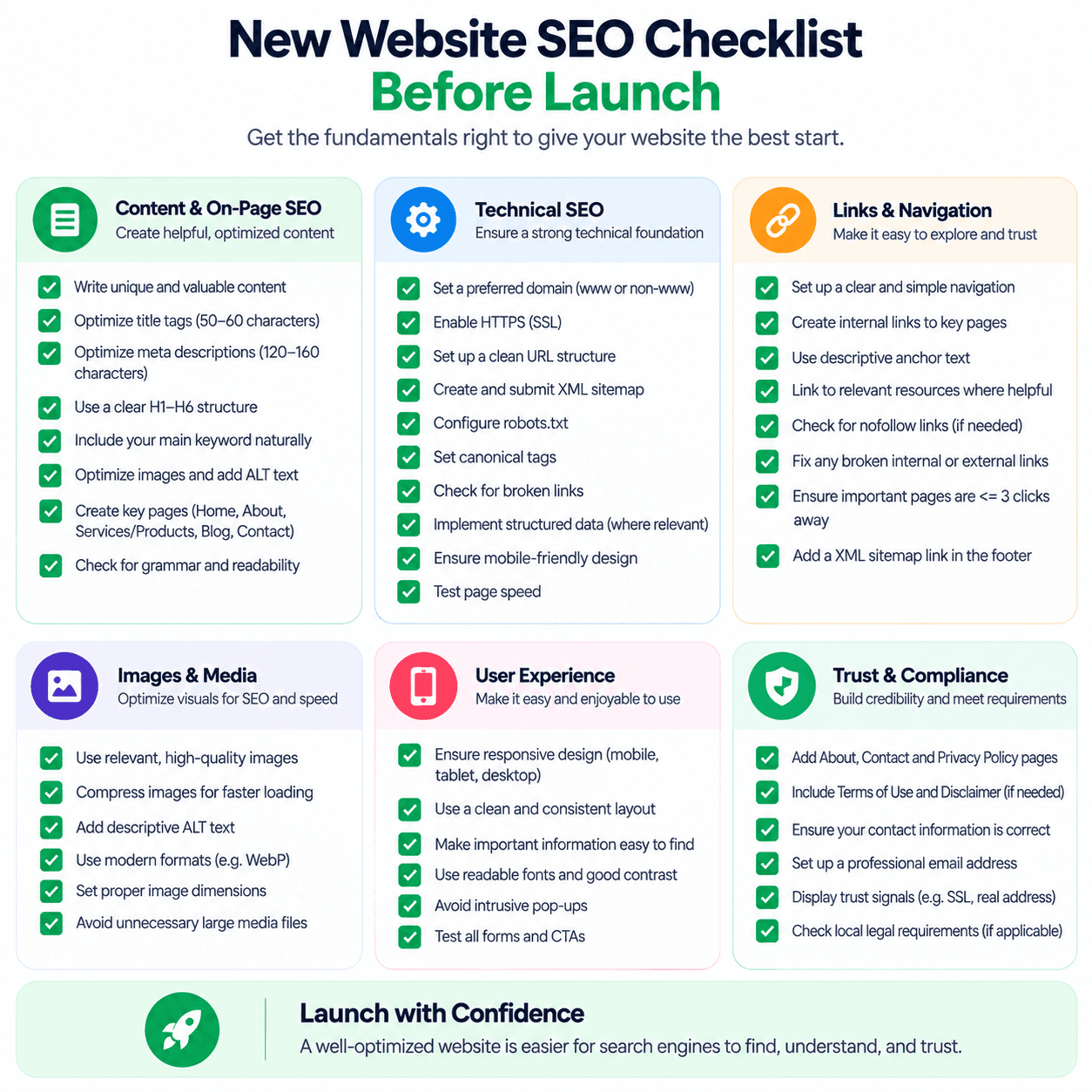
Before making the website public, review both the visible content and the technical setup. This can catch simple mistakes before search engines and visitors encounter them.
Content and On-Page Checks
- Give important pages unique and descriptive titles.
- Write useful meta descriptions.
- Use a clear H1 for the main page topic.
- Keep the H2 and H3 hierarchy logical.
- Make sure important content is complete and matches the page purpose.
- Add useful internal links.
- Add appropriate alt text to meaningful images.
- Remove placeholder text, test content, and unfinished sections.
RankCrow's On-Page SEO Guide explains these page-level elements in more detail.
Technical Checks
- Review important URLs before they become permanent.
- Check canonical tags.
- Remove accidental noindex directives from pages you want indexed.
- Review robots.txt for unintended crawling blocks.
- Maintain an XML sitemap with appropriate canonical URLs.
- Make sure HTTPS works correctly.
- Check the viewport and mobile experience.
- Test important navigation and internal links.
- Look for broken links and unexpected 404 errors.
- Validate structured data where you use it.
Remember that a canonical tag is a preference signal, not an absolute guarantee of which URL a search engine will select. Structured data can also make content eligible for supported search features, but it does not guarantee that a rich result will appear.
Don’t Forget Homepage SEO
Homepage SEO deserves attention because the homepage often introduces the website, its main purpose, and its most important sections.
Review the homepage title, meta description, H1, main content, and navigation. A visitor should be able to understand what the website offers and find the next relevant page without unnecessary confusion.
Do not try to make the homepage target every keyword related to the business. Some topics deserve their own service, product, category, or informational pages.
Create SEO-Friendly URLs from the Start
URLs are easier to manage when you establish a clear pattern before publishing the site. Good URLs are generally descriptive, human-readable, reasonably concise, stable, and consistent with the site structure.
For example:
example.com/blog/seo-for-new-website
Learning how to create SEO-friendly URLs does not mean forcing keywords into every path. The URL should describe the page naturally and remain practical for the website to maintain.
Avoid changing established URLs without a good reason. When a URL genuinely needs to change, handle the old URL properly and update relevant internal links rather than leaving broken paths behind.
Get the On-Page SEO Basics Right
Once the structure and page purpose are clear, review the basic on-page elements of every important page.
Title Tags
Write a clear title that accurately describes the page. Important pages should have useful, distinct titles rather than generic labels or repetitive keyword strings.
Meta Descriptions
Write a concise description that helps explain the page to someone scanning search results. A meta description is not a direct Google ranking factor, and search engines may show different text when it better matches a particular query.
Headings
Use a clear H1 for the main topic and supporting H2 or H3 headings to organize the page logically. Headings should improve readability rather than exist only to hold keywords.
Content
Make the content useful for the person who lands on the page. Answer the important questions, remove unnecessary filler, and avoid stretching content simply to reach a particular word count.
Images
Use images that support the page, appropriate dimensions, sensible file sizes, and useful alt text for meaningful images. RankCrow's Image Optimization SEO Guide covers image SEO in more detail.
Internal Links
Link related pages when the connection is useful to the reader. Descriptive internal links can help visitors discover additional information and help search engines understand relationships between pages.
Technical SEO Basics for a New Website
You do not need to master advanced technical SEO before launching a small website, but several technical SEO basics should be checked before important pages become public.
HTTPS
Use HTTPS throughout the public website so data between visitors and the site is transferred securely. Check that important internal links and canonical URLs use the intended HTTPS version.
Mobile Usability
Test the website on smaller screens. Text should remain readable, navigation usable, forms functional, and important content accessible without awkward horizontal scrolling.
Robots.txt and Meta Robots
Robots.txt controls crawler access, while a noindex directive tells supported search engines not to index a page when they can access and process that directive. These are different mechanisms and should not be treated as interchangeable.
Canonical URLs
Review canonical tags so important pages point to the intended preferred URL. A canonical is a signal used in canonicalization; it is not a guarantee that a search engine will always select the URL you specify.
XML Sitemap
Maintain an XML sitemap containing the canonical URLs you want search engines to discover and consider for indexing. A sitemap can help discovery, especially on a new website, but submitting one does not guarantee that every URL will be crawled or indexed.
Page Performance
Avoid unnecessary page weight, oversized media, and obvious performance problems. The practical goal is a site that loads reliably and remains stable and usable for visitors.
Structured Data
Use structured data when it accurately describes the visible content and the page is eligible for the markup being used. Structured data does not guarantee a rich result or higher rankings.
For deeper technical guidance, see Technical SEO Issues and Schema Markup Examples.
How to Help Google Find Your New Website
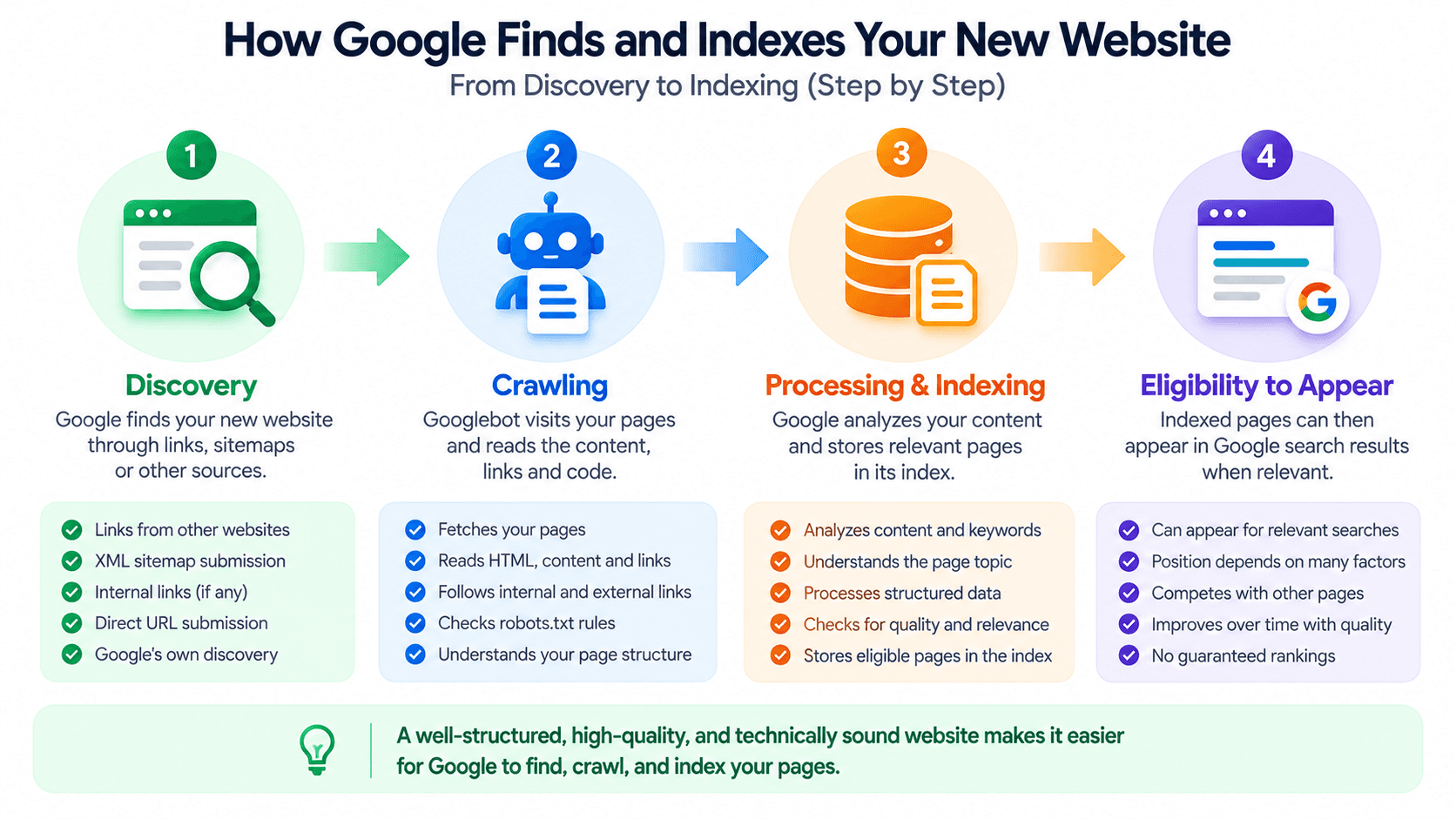
Publishing a website does not mean every page immediately appears in Google Search. Search engines first need to discover URLs, crawl accessible pages, process their content, and decide whether those pages should be indexed.
Discovery
Search engines learn that a URL exists.
Crawling
A crawler attempts to access the page and its resources.
Processing and Indexing
Search systems process the page and may add it to their index.
Eligibility to Appear and Rank
An indexed page may become eligible to appear for relevant searches.
To help discovery, make sure important pages are connected through useful internal links. Maintain an XML sitemap and submit it through Google Search Console.
Search Console's URL Inspection tool can also help you inspect an important URL and, where appropriate, request indexing.
Sitemap submission does not guarantee indexing. Requesting indexing does not guarantee indexing either, and being indexed does not guarantee rankings.
Search engines need time to discover, crawl, and process new pages. There is no universal timeframe in which every new website or URL will be indexed.
For a detailed explanation of this process, read RankCrow's Search Engine Indexing Guide.
Check Your Pages Before Publishing
Before publishing an important page, review it as a complete page rather than checking only one element at a time. A title may look fine while the page still has an incorrect canonical, missing alt text, weak heading structure, or an accidental indexing directive.
A structured review is useful here. If you want a broader framework for examining SEO issues, read What Is an SEO Audit?
RankCrow is a free page-level SEO analyzer that helps you review important SEO signals on an individual page and identify areas that may need attention.
Depending on the page, RankCrow can help review:
- title and meta description
- content and word metrics
- headings and heading hierarchy
- keyword presence and density information
- internal, external, and nofollow links
- images and ALT text
- canonical and indexability signals
- robots directives, robots.txt, and sitemap signals
- viewport and HTTPS
- Open Graph and Twitter Card metadata
- detected structured data
- SEO Score
Treat an SEO Score as an analysis aid rather than a Google ranking factor or a prediction of where a page will rank. Review the actual findings and fix the issues that matter for the page.
You can analyze a page with RankCrow before launch and review it again after meaningful changes.
What to Do After Your New Website Goes Live
Launch is the beginning of the SEO process, not the end. Once the website is public, monitor what is actually happening and improve the site based on real issues and useful opportunities.
Check Discovery and Indexing
Use Search Console to see whether important pages are being discovered and indexed. Investigate unexpected exclusions rather than assuming every unindexed page has the same cause.
Monitor Performance
Over time, review impressions, clicks, queries, and pages in Search Console. Early data may be limited on a new website, so use it as information rather than expecting an immediate pattern.
Fix Actual Problems
Prioritize real problems such as broken pages, accidental indexing restrictions, incorrect canonicals, weak content, navigation issues, or important pages that are difficult to reach.
Publish Useful Supporting Content
Add new content when it serves a real audience need and fits the website's subject. Avoid publishing large numbers of thin pages simply to cover more keyword variations.
Improve Internal Linking
As the website grows, revisit older pages and connect them to useful newer resources. This helps visitors discover related information and reduces the chance of useful pages becoming isolated.
Keep Important Pages Accurate
Update content when information changes or when a page can be made clearer and more useful. Do not change pages merely to make them look artificially fresh.
Measure and Improve
SEO for a new website is an ongoing process of publishing, monitoring, learning, and improving. There is no fixed timeframe in which a new website is guaranteed to achieve a particular ranking.
Common New Website SEO Mistakes
Many new-site SEO problems are not advanced problems. They are basic issues that were missed during planning, development, or launch.
- leaving an accidental noindex directive on important pages
- blocking important pages or resources unintentionally
- using weak or duplicate page titles
- launching thin placeholder pages
- creating multiple pages for minor keyword variations
- using unclear or unstable URLs
- failing to connect related pages with internal links
- forgetting to maintain an XML sitemap
- ignoring the mobile experience
- expecting immediate rankings after launch
- changing published URLs without properly handling the old URLs
For a broader breakdown of issues you may encounter, see Common SEO Problems and How to Fix Them.
Final New Website SEO Checklist
Use this final checklist before launch and revisit it after major website changes.
Give every important page a clear purpose.
Use a logical site structure and navigation.
Publish useful, complete content on important pages.
Write clear and unique page titles and meta descriptions.
Use a logical H1, H2, and H3 heading structure.
Create descriptive and stable URLs.
Add useful internal links between related pages.
Optimize meaningful images and write useful alt text.
Check that important pages do not contain an accidental noindex directive.
Review robots.txt for unintended crawling restrictions.
Check canonical URLs on important pages.
Use HTTPS across the website.
Make sure the site works well on mobile devices.
Maintain an XML sitemap containing appropriate canonical URLs.
Use structured data where it accurately represents the page.
Check for broken links and unexpected 404 errors.
Set up Google Search Console and monitor discovery and indexing.
Review important pages individually before and after launch.
Frequently Asked Questions
Do I need SEO for my new website?
Yes. SEO for a new website starts with creating a clear structure, useful content, descriptive titles and URLs, sensible internal links, and technical settings that allow important pages to be crawled and considered for indexing. You do not need every advanced SEO tactic before launch.
When should I start SEO for a new website?
Start during planning and development rather than waiting until after launch. Site structure, URLs, navigation, content, mobile usability, canonical settings, and indexability are easier to review before a website has accumulated published pages and external references.
How do I make my new website appear on Google?
Make important pages accessible through useful internal links, ensure they are not unintentionally blocked from indexing, maintain an XML sitemap, and use Google Search Console to monitor discovery and indexing. Sitemap submission and indexing requests can help Google discover or revisit URLs, but they do not guarantee indexing or rankings.
What are the basic SEO requirements for a new website?
The basics include a logical site structure, useful content, clear titles and headings, descriptive URLs, internal links, appropriate image alt text, HTTPS, mobile usability, correct canonical and indexability settings, sensible crawler access, an XML sitemap, and ongoing monitoring after launch.
How long does SEO take for a new website?
There is no universal timeframe. Search engines need time to discover, crawl, process, and potentially index new pages, while search performance is influenced by many factors. Avoid treating any fixed number of days, weeks, or months as a guaranteed ranking timeline.
Build the Foundation First
SEO for a new website does not need to begin with complicated tactics. Start with the foundation: a clear site structure, useful pages, sensible URLs, strong on-page basics, appropriate internal links, and technical settings that do not prevent search engines from accessing and understanding important content.
Then launch, monitor what happens, fix genuine problems, and improve the site as you learn more about your visitors and search performance.
The goal is not to make every page perfect before publishing. It is to avoid preventable mistakes and give the website a strong, maintainable starting point.
Before publishing an important page, you can run it through the RankCrow Free SEO Analyzer to review its page-level SEO signals and identify areas that may need attention.