
A website does not perform well in search simply because it has good content, a few keywords, or technically clean pages. Different parts of SEO solve different problems, and those parts need to support one another.
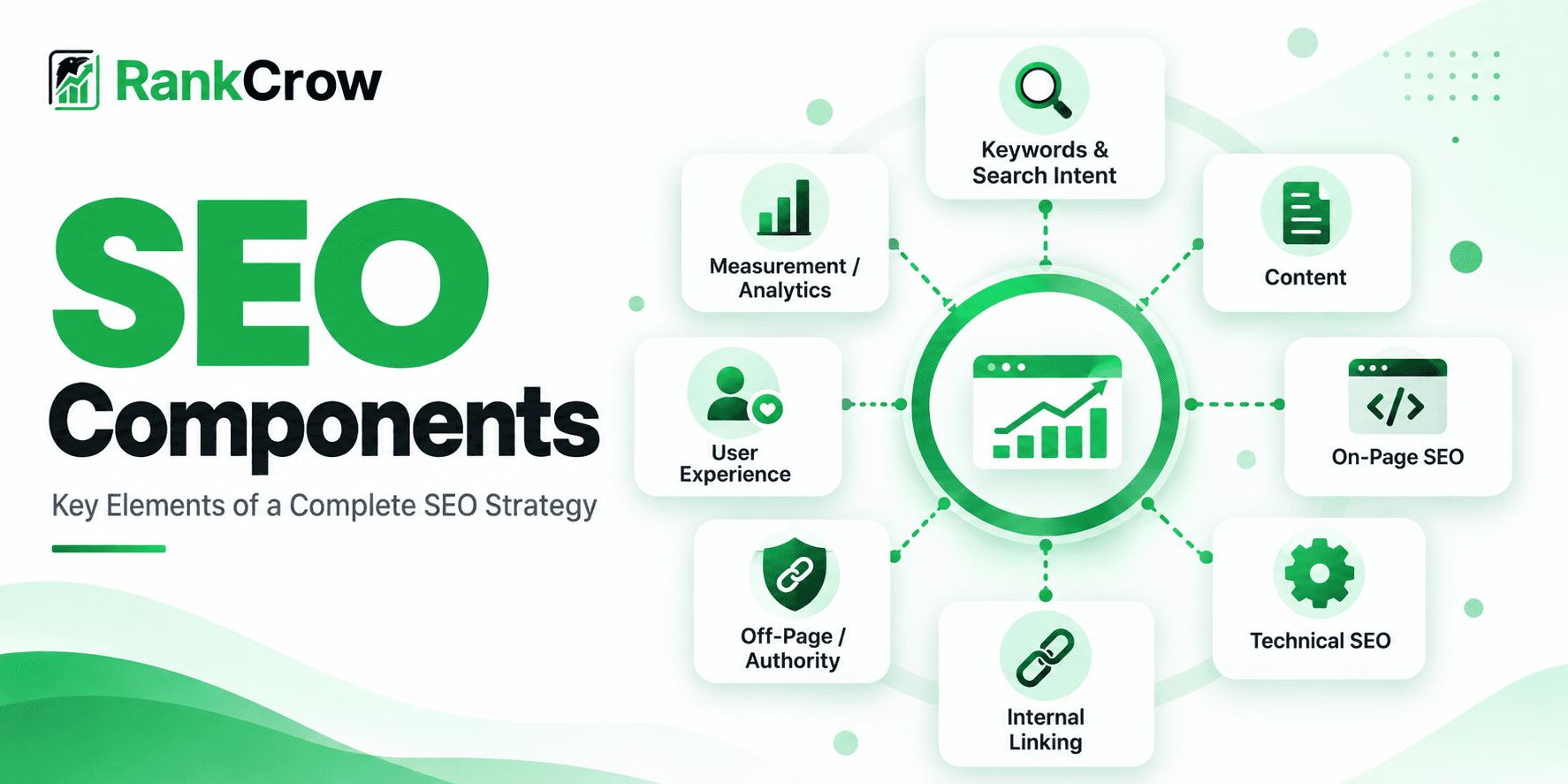
The main SEO components include on-page SEO, technical SEO, content and search intent, keywords and topics, internal linking, off-page SEO, search experience and usability, and measurement.
You may also hear these areas described as the components of SEO, SEO parts, SEO elements, or elements of SEO. The terminology varies, but the basic idea is the same: SEO is a connected system rather than one isolated optimization.
What Are the Main SEO Components?
There is no single official list that every SEO professional must follow, but most practical SEO work can be organized into a small number of major areas.
| SEO Component | Main Role |
|---|---|
| On-page SEO | Helps users and search engines understand individual pages |
| Technical SEO | Supports crawlability, indexability, accessibility, and technical page health |
| Content and search intent | Helps pages answer the user's actual need |
| Keywords and topics | Connects content with relevant search demand and language |
| Internal linking | Creates useful relationships between pages |
| Off-page SEO | Builds external references, reputation, and visibility beyond the site |
| Search experience and usability | Makes pages easier to use and understand |
| Measurement | Helps identify what is working and what needs improvement |
These components overlap. A page title is an on-page element, but it also affects how clearly a page communicates its topic. Internal links are part of site structure, but they also help users discover related content. Technical SEO can help a page become accessible to search engines, but that alone does not guarantee indexing or prominent search visibility.
SEO components are not the same as SEO ranking factors. SEO components are broad areas of work. Ranking factors or ranking signals relate to how search systems evaluate and order results. The two concepts should not be treated as interchangeable.
For example, technical SEO is a component of SEO. That does not mean "technical SEO" itself is one single confirmed Google ranking factor. A useful strategy focuses on the parts of a website you can improve instead of trying to reduce search performance to a fixed checklist of factors.
On-Page SEO
On-page SEO focuses on the optimization of individual webpages. Its purpose is to make each page easier for users and search engines to understand.
Common on-page elements include:
- page titles;
- headings;
- content structure;
- topic relevance;
- meta descriptions;
- images and ALT text;
- internal and external links;
- page-level keyword usage.
A page about emergency plumbing, for example, should make that purpose clear through its title, H1, supporting content, and page structure.
That does not mean repeating the same phrase everywhere. The goal is clarity, not keyword stuffing.
A meta description can help describe a page clearly in search results, but it should not be treated as a guaranteed ranking lever.
For a deeper explanation, see RankCrow's On-Page SEO Guide.
RankCrow's free page-level SEO analyzer can help review supported signals such as titles, meta descriptions, headings, content signals, links, images/ALT, canonical and indexability signals, and schema detection on an individual page.
It is a page-level analysis tool, not a full-site crawler or ranking guarantee.
Technical SEO
Technical SEO focuses on the technical conditions that help search engines access, process, and understand website pages correctly.
Important technical SEO elements can include:
- HTTPS;
- robots directives;
- indexability;
- canonical signals;
- robots.txt;
- XML sitemap context;
- structured data;
- search-engine accessibility and crawlability;
- technical HTML setup.
Crawling, indexing, and appearing prominently in search are different stages and outcomes. A page can be crawled without being indexed, and an indexed page is not guaranteed to appear prominently for a query.
Technical cleanliness also cannot compensate for content that fails to satisfy the searcher.
A rel="canonical" annotation is a canonicalization signal, not an absolute directive. Google may choose a different canonical URL based on the signals it evaluates.
For a deeper technical breakdown, see RankCrow's Technical SEO Issues Guide.
For crawling and indexing context, see RankCrow's Search Engine Indexing Guide.
Structured Data as a Technical SEO Element
Structured data can help search engines understand specific information on a page more explicitly.
Depending on the page, that may include information about articles, organizations, breadcrumbs, products, local businesses, and other supported entities.
Structured data does not guarantee a rich result. It can make a page eligible for certain enhanced search features where supported, but eligibility is different from guaranteed display.
For implementation examples, see RankCrow's Schema Markup Examples Guide.
Content and Search Intent
Content is one of the most visible SEO components, but more content is not automatically better SEO.
Useful content should solve the reader's problem. That means understanding search intent before deciding what the page should contain.
A person searching "how to change a canonical tag" has a different need from someone searching "what is canonicalization in SEO."
The first query is more action-oriented. The second is educational. A strong page should match that difference.
Useful SEO content usually has:
- a clear purpose;
- relevant information;
- logical structure;
- enough detail to answer the question;
- original explanation;
- readable language;
- a clear relationship to the topic.
One of the most practical SEO principles is simple: Create the amount of content needed to answer the user well, not the amount needed to reach an arbitrary word count.
A 900-word page can be better than a 2,500-word page if it answers the query more clearly.
For deeper planning, see RankCrow's Content SEO Guide.
Keywords, Topics, and Search Intent
Content answers the need; keyword research helps identify how that need is expressed in search.
Keywords still matter because they show how people describe their needs, but they work best when they help define the topic rather than control every sentence.
A practical keyword process can include:
- identifying the main topic;
- checking relevant search demand;
- understanding the intent behind the query;
- reviewing related phrases;
- creating content around the user's actual need.
A page should not be built around repeating one exact phrase a certain number of times.
For example, an article targeting "SEO components" may naturally also use expressions such as components of SEO, SEO parts, SEO elements, or elements of SEO.
Keywords help define the topic. They do not replace useful content.
More repetition does not automatically improve rankings. More keywords in a heading do not automatically make a heading better, and fixed keyword density is not a useful substitute for good writing.
Internal Linking and Site Structure
Internal linking connects one page of a website to another. It is an important part of SEO because individual pages do not exist in isolation.
Useful internal links can help:
- users discover related content;
- create clear relationships between pages;
- connect supporting articles with important destination pages;
- reduce isolated or orphaned content;
- make site navigation more logical.
Imagine a website with a strong service page that is never linked from the navigation, related services, blog content, or other important pages.
The page may still exist, but the site structure is doing very little to support it.
Internal linking helps build context around that page. The goal is not to add as many links as possible. Links should exist because the destination is genuinely useful to the reader.
For a deeper approach, see RankCrow's SEO Internal Linking Strategy Guide.
Off-Page SEO and Authority
Not every important SEO signal exists on your own website. Off-page SEO covers reputation and signals that come from outside the site.
Examples may include:
- links from other websites;
- brand mentions;
- digital PR;
- industry references;
- legitimate external reputation.
Links can be valuable because they may help search engines discover pages and understand relationships between sites.
But backlink count by itself is not a complete measure of quality. Relevant, legitimate references are not equivalent to random links from unrelated websites.
A site's external reputation cannot be reduced to one backlink count or a third-party authority score.
"Authority" here is a general SEO concept, not a single Google score or a third-party metric that Google uses directly.
Off-page SEO should therefore focus on genuine reputation and useful relationships rather than simply increasing a link count.
Search Experience and Page Usability
SEO should not produce pages that are technically optimized but unpleasant to use.
A strong page also considers how easily a visitor can read, understand, and navigate the content.
Useful page-experience considerations can include:
- readable text;
- clear headings;
- logical layout;
- mobile usability;
- simple navigation;
- relevant images;
- accessible content;
- clear calls to action where appropriate.
Not every usability improvement should be interpreted as a direct Google ranking factor.
Good SEO should produce pages that are understandable and useful, not merely technically optimized.
Images are a good example. A useful image can improve understanding, but it should still be relevant, properly implemented, and supported with descriptive ALT text where appropriate.
For deeper guidance, see RankCrow's Image SEO Guide.
Measurement and Ongoing Improvement
SEO does not end when a page is published.
Measurement helps you observe whether search visibility and user engagement are moving in the expected direction.
Useful tools may include:
- Google Search Console;
- analytics platforms;
- page-level SEO analyzers;
- indexing reports;
- search-query data;
- landing-page performance.
Search Console may show that a page is receiving impressions for a group of queries you did not initially target. That can suggest new search language, content gaps, or opportunities worth investigating.
Likewise, a page may receive impressions but very few clicks. That may justify reviewing the title, search intent, page positioning, or content relevance.
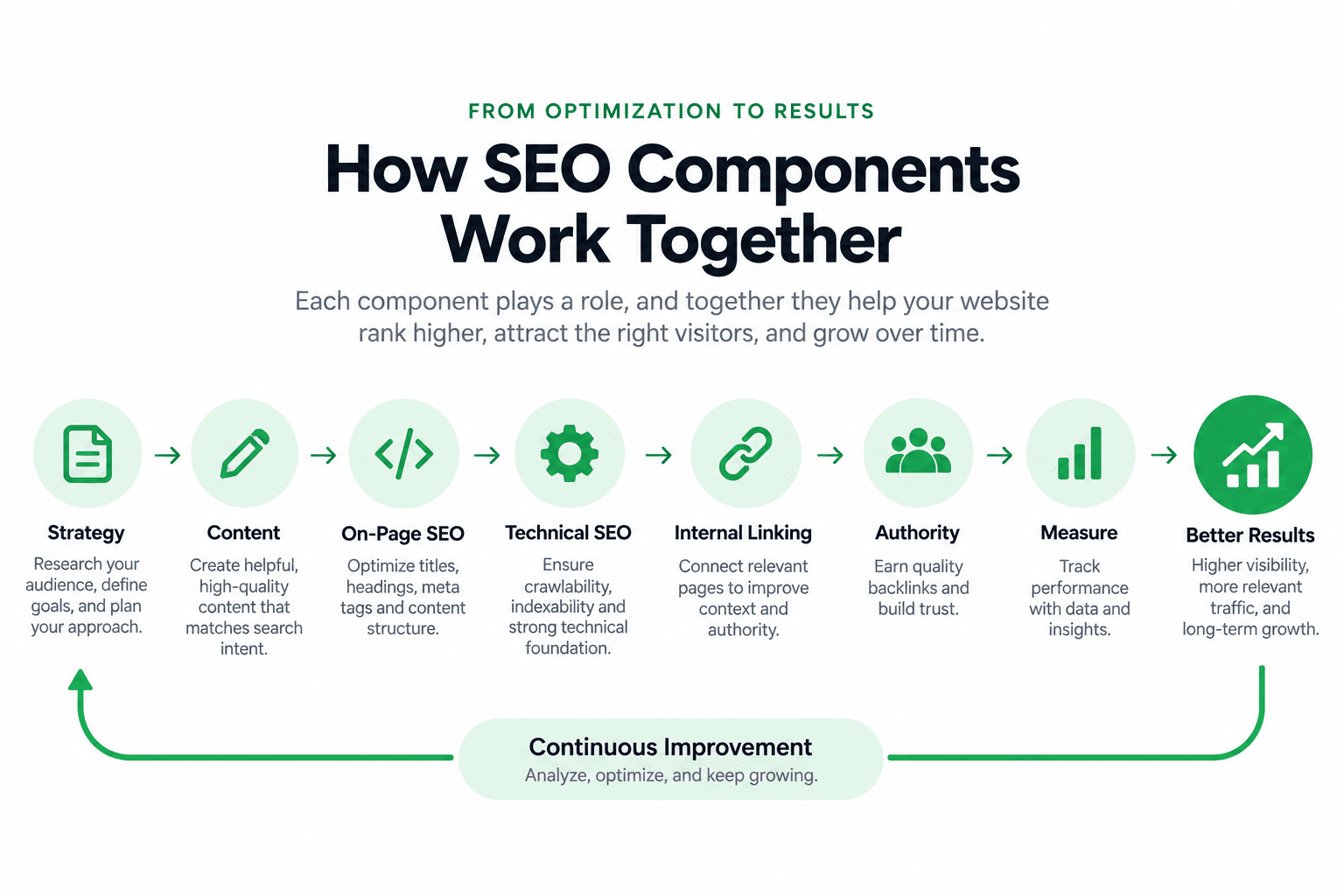
This is part of the process of SEO:
Do not assume one metric tells the whole story. A ranking change, impression increase, or click increase can happen for many reasons. Use several signals together before making conclusions.
For a deeper look at the review process, see RankCrow's SEO Audit Guide.
RankCrow can support this process by helping review supported page-level SEO signals when you are investigating what may need improvement. It does not track rankings or automatically fix issues.
How the SEO Components Work Together
The biggest mistake is treating SEO as a set of independent tasks.
Consider a service page. The content may be excellent, but the page can still struggle if:
- search engines cannot access it properly;
- the title does not clearly describe the service;
- the page is poorly linked internally;
- the search intent is mismatched;
- the site has weak external reputation;
- nobody measures its performance after publication.
Problems in one area can also affect other parts of the SEO system, which is why it helps to understand common SEO problems before treating issues in isolation.
The opposite is also true. A technically strong page will not automatically perform well if the content fails to answer the searcher's question.
Example: How One Page Uses Several SEO Components
Imagine a page targeting emergency water heater repair.
Content: Explain the service, urgency, common problems, and what customers should expect.
On-Page SEO: Use a clear title, heading structure, descriptive page copy, and relevant internal links.
Technical SEO: Make sure the page is indexable, accessible, secure, and technically configured correctly.
Keywords and Intent: Focus on people actively looking for urgent repair rather than people researching how water heaters work.
Internal Linking: Link from relevant plumbing-service pages and related content.
Off-Page SEO: Build genuine business reputation and relevant external references.
User Experience: Make contact information easy to find and the page easy to use on mobile.
Measurement: Review how the page appears in search, which queries generate impressions, and whether people reach the page.
No single part replaces the others. The strength comes from coordination.
Frequently Asked Questions
What are the main components of SEO?
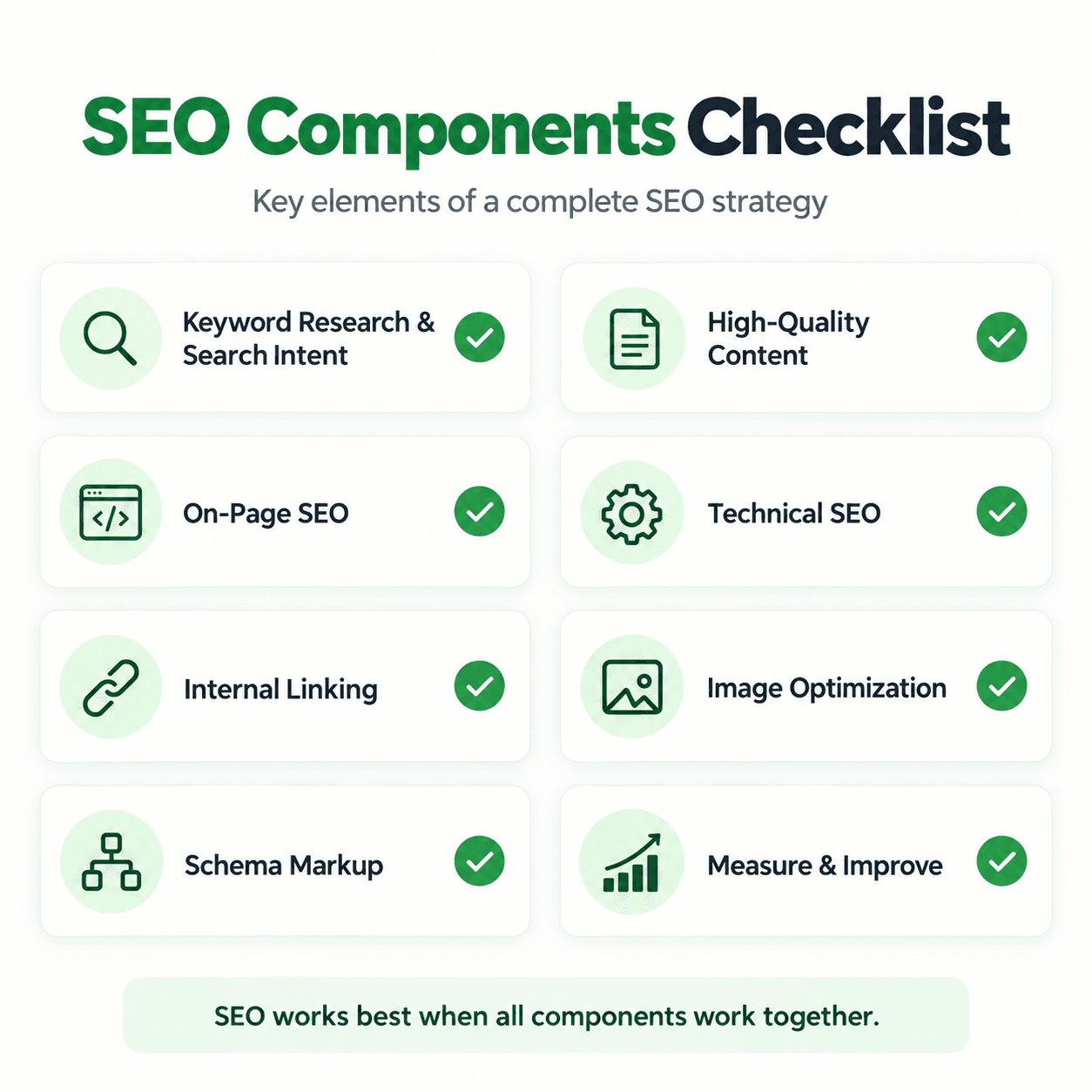
A practical SEO framework usually includes on-page SEO, technical SEO, content and search intent, keyword and topic targeting, internal linking, off-page SEO and authority, user experience, and measurement. These areas work together rather than operating as isolated tasks.
What are the three most common parts of SEO?
A common high-level way to group SEO is into on-page SEO, technical SEO, and off-page SEO. That is a useful simplified model, but a complete strategy also needs content, search intent, internal linking, user experience, and measurement.
Are SEO components the same as ranking factors?
No. SEO components are broad categories of SEO work. Ranking factors or ranking signals relate to how search systems evaluate and order results. The two concepts should not be treated as interchangeable.
Which SEO component should I work on first?
There is no universal answer. Start with the biggest current limitation. If important pages cannot be indexed, start with technical SEO. If content does not answer the query, improve content and intent. If targeting is unclear, review on-page SEO. If useful pages are isolated, improve internal linking.
Is technical SEO more important than content?
Not universally. Technical SEO and content solve different problems. Strong technical SEO cannot make weak content useful, while excellent content may struggle if search engines cannot properly access or index the page. Both need to support each other.
Can one SEO component compensate for all the others?
No. A very strong component can help, but major weaknesses elsewhere can still limit search performance. Good backlinks cannot fully compensate for content that misses search intent, and excellent content cannot fix a page that is blocked from indexing.
Building a Complete SEO Strategy
The most useful way to think about SEO components is as parts of one connected system.
- Content answers the searcher's need.
- On-page SEO explains the page.
- Technical SEO helps keep the page accessible and understandable.
- Internal links connect it with the rest of the website.
- Off-page signals support external reputation.
- User experience makes the page practical to use.
- Measurement shows what to improve next.
No individual component guarantees rankings.
SEO becomes stronger when these elements support one another and improve over time.
RankCrow's free page-level SEO analyzer can help review supported on-page and technical signals on an individual webpage while you work on the broader SEO strategy.