
SEO problems can make it harder for search engines to understand, crawl, index, or evaluate a page. They can also create a poor experience for visitors.
Some issues are technical, while others involve content, page structure, internal links, images, or basic on-page SEO. The important part is not simply finding a long list of problems. It is identifying which issues matter most and fixing them in the right order.
What Are SEO Problems?
SEO problems are issues that can affect how a webpage is discovered, crawled, understood, indexed, or presented in search results.
They can range from simple on-page issues, such as a missing title tag, to technical problems, such as incorrect canonicalization or indexing directives.
An SEO problem does not automatically mean a page will lose rankings. The impact depends on the specific issue, the page, the search intent, and how search engines interpret the affected content.
Separate problems that can prevent crawling or indexing from issues that simply make an otherwise functional page less useful.
Common SEO Problems to Check
A useful SEO review should cover the main elements that influence page understanding, usability, discoverability, and indexability.
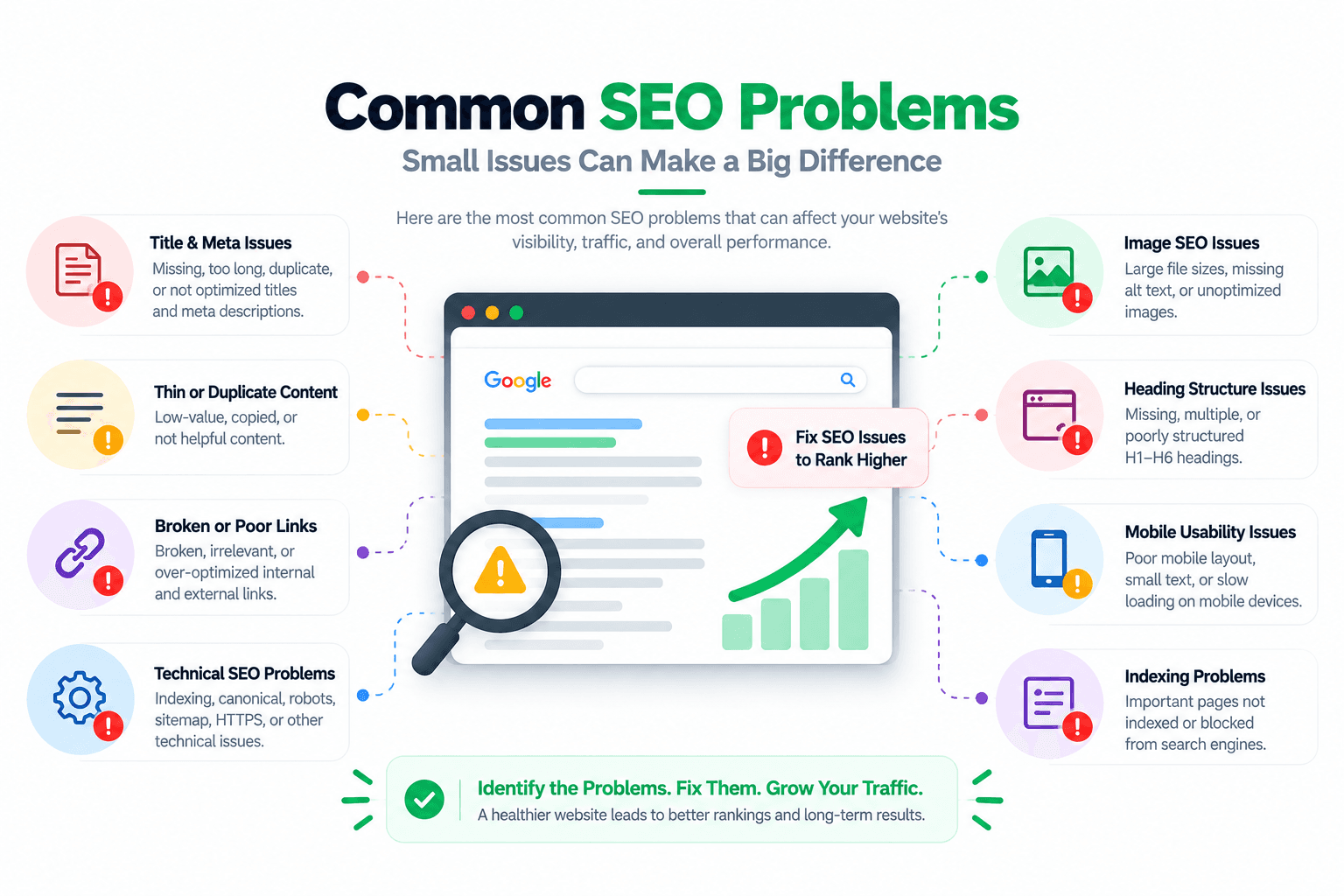
Missing or Weak Title Tags
The title tag helps search engines and users understand what a page is about. A missing, duplicated, vague, or poorly written title can make the page less clear.
Review whether the title accurately describes the page and aligns with the main search intent.
For a deeper look at title tags and other on-page elements, see the On-Page SEO Guide.
Missing or Poor Meta Descriptions
Meta descriptions help describe a page in search results. They are not a direct Google ranking factor, but a useful description can help users understand the result before visiting.
Avoid stuffing keywords into the description. Instead, summarize the page accurately and make the value of the result clear.
Poor Heading Structure
Headings create a hierarchy that helps readers scan a page and helps search engines understand its structure.
Check that the H1 clearly represents the main topic and that H2 and H3 headings follow a logical hierarchy.
Thin or Unhelpful Content
A page can have a high word count and still fail to satisfy the visitor. Thin or unhelpful content is better understood as content that does not provide enough useful information for the page's purpose.
Review whether the page answers the user's question, provides useful context, and gives visitors a clear next step.
Learn more in the SEO Content Guide.
Duplicate Content
Duplicate or substantially similar content can make it harder for search engines to determine which version of a page should be surfaced.
Duplicate content is not automatically a Google penalty. The practical goal is to make the preferred version of substantially similar pages clear and avoid unnecessary duplication.
For technical causes and solutions, see the Technical SEO Issues Guide.
404 Errors and Broken Pages
A 404 response tells users and search engines that a requested resource was not found. A 404 itself is not an automatic SEO penalty.
Problems arise when important internal links point to broken URLs, users repeatedly encounter dead pages, or valuable resources disappear without an appropriate replacement.
Review important links and remove or update broken references where appropriate.
See the Technical SEO Issues Guide for a broader technical review.
Poor Internal Linking
Internal links connect related pages and help visitors discover useful information. They also help search engines understand relationships between pages.
Important pages should not be isolated without a clear reason. Use descriptive, natural anchor text and link where the additional page genuinely helps the reader.
For a deeper strategy, read the Internal Linking Strategy Guide.
Image SEO Problems
Images can create SEO and accessibility problems when they are unnecessarily large, poorly described, missing alternative text, or presented without useful context.
Review image file sizes, dimensions, formats, descriptive alt text, and surrounding content.
The Image Optimization SEO Guide covers these areas in more detail.
Indexing and Canonical Issues
A page can exist on a website without being indexed. Crawling, indexing, and ranking are separate stages.
Review robots directives, noindex settings, canonical URLs, internal links, XML sitemaps, and other signals that influence discoverability.
A canonical is an important signal, but it is not a guaranteed directive that Google must follow. Similarly, a sitemap can help discovery but does not guarantee indexing.
For the fundamentals, see the Search Engine Indexing Guide.
Mobile and Page Experience Problems
Pages should work well across common screen sizes and provide a usable experience for visitors.
Check mobile layout, text readability, interactive elements, page loading behavior, intrusive elements, and overall usability.
A page that technically works but is difficult to use can still provide a poor experience.
Common SEO Mistakes to Avoid
Some SEO problems come from implementation errors. Others come from the way SEO work is approached. These are common mistakes worth avoiding:
- Keyword stuffing: adding keywords repeatedly instead of writing naturally for the reader.
- Ignoring search intent: creating content that does not satisfy what the searcher actually wants.
- Creating unnecessary duplicate pages: publishing multiple substantially similar URLs without a clear purpose.
- Ignoring internal linking: leaving useful related pages disconnected.
- Publishing without basic on-page checks: skipping titles, headings, links, images, and other fundamental page elements.
- Making SEO changes without monitoring: changing important elements without checking what happens afterward.
- Treating every SEO issue equally: spending the same effort on a minor optimization and a problem that can affect crawling or indexing.
How to Find SEO Problems on a Page
You do not need to start with every possible SEO signal. A structured page-level review is often a better starting point.
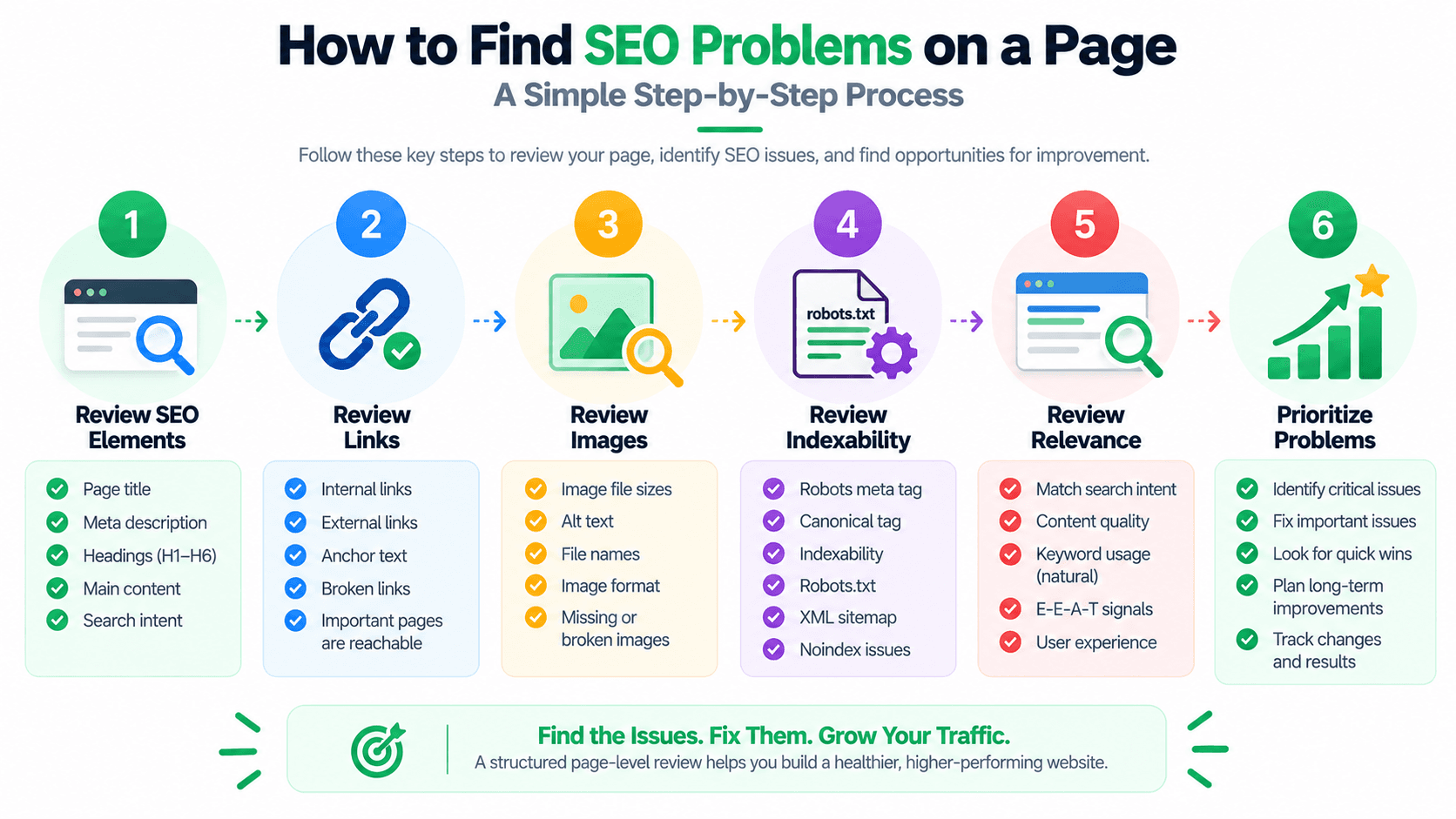
Step 1: Review the Primary SEO Elements
Check the page title, H1, meta description, headings, main content, and search intent.
Step 2: Review Links
Check internal links, external links, anchor text, and whether important destinations are reachable.
Step 3: Review Images
Check image relevance, alt text, dimensions, file size, and page performance.
Step 4: Review Indexability
Check whether the page can be crawled and whether indexing directives or canonical signals create unexpected problems.
Step 5: Review Relevance
Ask whether the page actually satisfies the search intent and provides useful information for the visitor.
Step 6: Prioritize the Problems
Once problems are identified, group them by impact:
- Critical: issues that can interfere with crawling, indexing, or serious usability.
- Important: issues that weaken relevance, structure, or discoverability.
- Optimization: improvements that make an already functional page better.
This prioritization approach is also useful when working through a broader SEO audit. See the SEO Audit Guide for a structured audit workflow.
RankCrow Integration
RankCrow is a free page-level SEO analyzer that helps you review important SEO signals on an individual page and identify areas that may need attention.
Instead of treating an SEO review as one large checklist, you can use a page-level analysis to organize the initial review of a specific URL.
The analyzer is designed for the page or URL you provide. It should be treated as a practical starting point for reviewing SEO signals rather than a replacement for deeper technical investigation.
How to Fix SEO Problems
Once problems are identified, avoid fixing them randomly. Start with issues that have the greatest potential impact on the page.
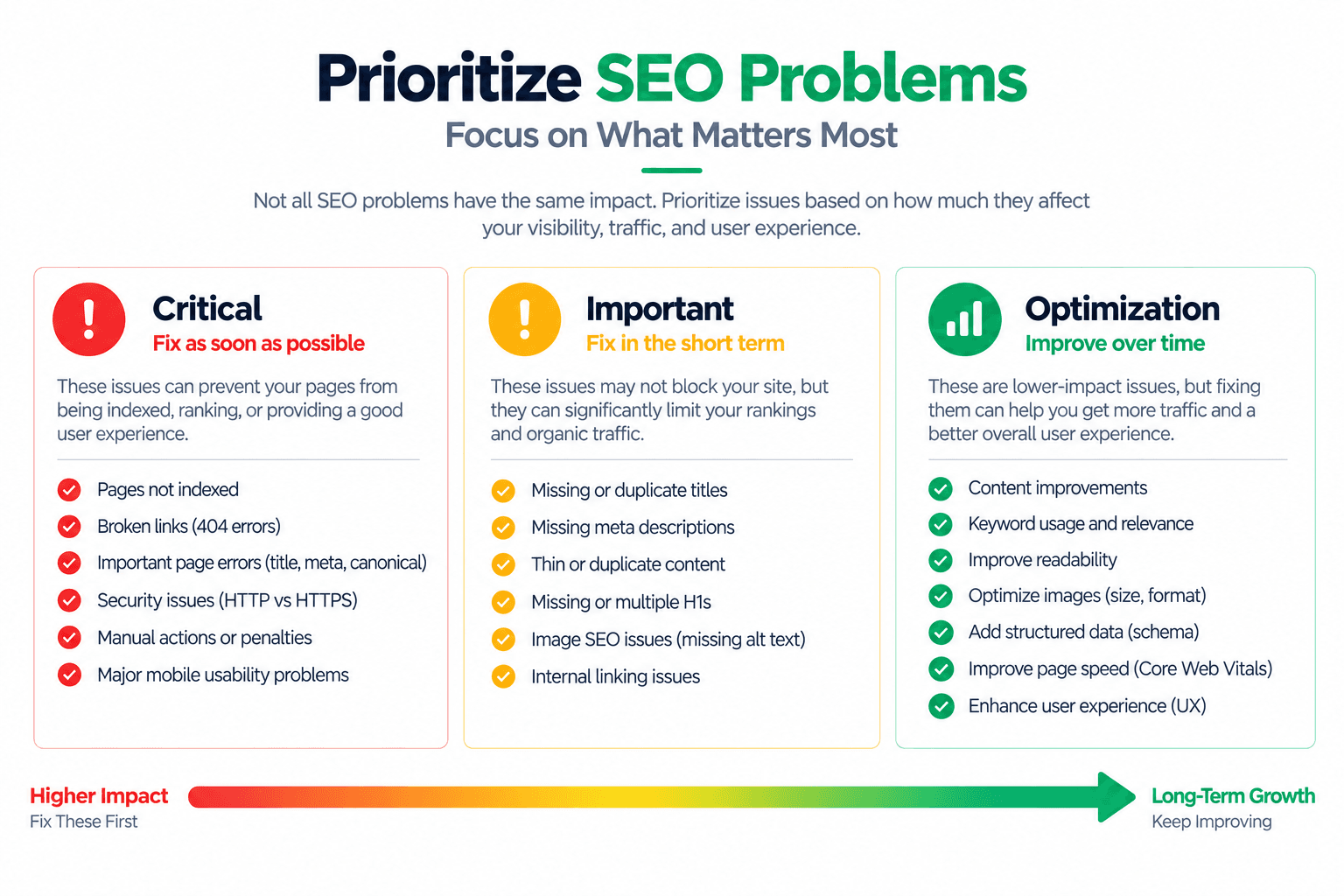
Critical
Fix issues that can interfere with crawling, indexing, or serious usability.
Important
Improve weak relevance, structure, discoverability, and content quality.
Optimization
Refine elements that are already functional but could provide a better experience.
This approach keeps SEO work focused. A minor metadata improvement should not take priority over a page that cannot be properly crawled or indexed.
After making important changes, review the page again and monitor how it performs over time.
Frequently Asked Questions
What are the most common SEO problems?
Common SEO problems include weak title tags, poor heading structure, unhelpful content, duplicate content, broken links, poor internal linking, image issues, indexing problems, canonical issues, and mobile usability problems.
How do I find SEO problems on a website?
Start by reviewing important pages individually. Check titles, headings, content, links, images, indexability, canonical signals, and search intent. A page-level SEO analyzer can help organize this initial review.
Can SEO problems hurt rankings?
Some SEO problems can affect how pages are crawled, indexed, understood, or experienced by users. However, there is no universal ranking penalty for every SEO issue. The impact depends on the specific problem and page.
Does duplicate content hurt SEO?
Duplicate content is not automatically a Google penalty. However, substantially similar pages can create unnecessary duplication and make it harder to determine which version should be surfaced.
Do 404 errors hurt SEO?
A 404 response is not automatically an SEO penalty. Broken links and missing important pages can still create usability and discoverability problems, so important broken URLs should be reviewed and handled appropriately.
Conclusion
SEO problems are easier to address when they are identified, prioritized, and fixed systematically.
Start with issues that can affect crawling, indexing, usability, or the usefulness of the page. Then move through content, structure, internal links, images, and other optimization opportunities.
You do not need to obsess over every minor issue. A practical SEO process is about finding the problems that matter, fixing them properly, and reviewing important pages regularly.
If you want to start with a specific page, use RankCrow's free page-level analyzer to review its important SEO signals and identify areas that may need attention.