
People still search for Google Places SEO, even though Google now manages local business information through Google Business Profile, Google Search, and Google Maps.
So when someone wants to “optimize Google Places,” the practical goal today is to make sure Google and potential customers can clearly understand the business: who it is, what it offers, where it operates, and how people can contact or evaluate it.
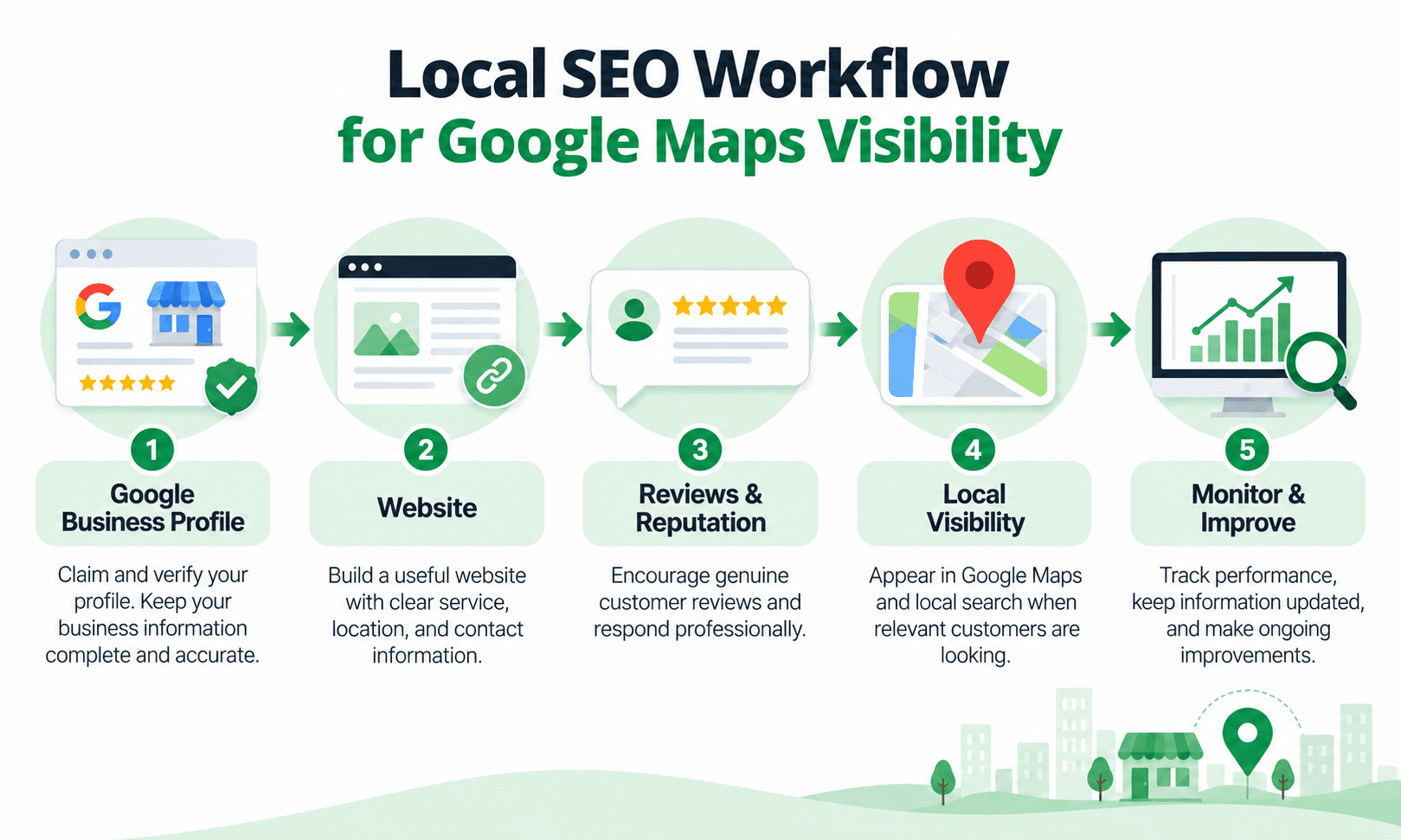
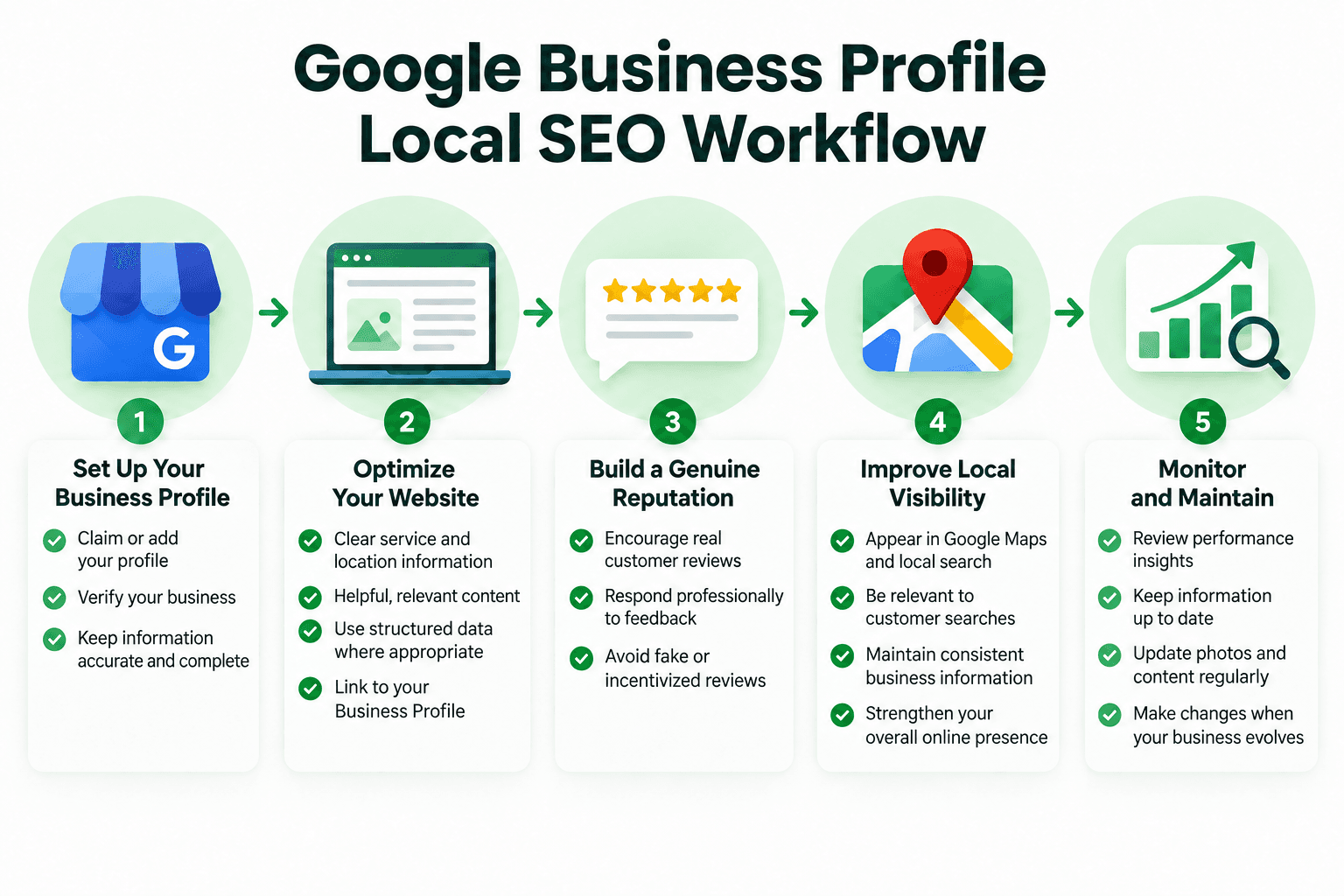
That usually means working on several connected areas rather than chasing one ranking trick. An accurate Business Profile, a useful website, genuine customer reviews, consistent business information, and regular maintenance all contribute to a stronger local-search presence.
This article explains what Google Places SEO means today, how Google Maps and website SEO work together, what local businesses can improve, and which shortcuts are better avoided.
What Is Google Places SEO?
Google Places SEO is a legacy phrase commonly used for improving a local business's visibility in Google's local-search ecosystem.
Today, that work generally involves:
- Google Business Profile;
- Google Maps;
- Google Search;
- the business website;
- customer reviews;
- other relevant information Google can find about the business online.
Google's current system for eligible local businesses is Google Business Profile. Businesses can add or claim a profile, verify it where required, and manage how their information appears across Google Search and Maps. Google's Business Profile documentation explains the current process.
Google Places is the older term people still search for.
Google Business Profile is the current terminology to use when discussing profile management and optimization.
The name has changed, but the user need behind the search is still clear: improve how a legitimate local business is represented and discovered in Google's local results.
How Google Maps and SEO Work Together
Google Maps and SEO are related, but they are not the same thing.
Website SEO focuses on pages: their content, structure, relevance, links, technical health, and usefulness to searchers.
Local visibility adds business-specific information and geography to that picture.
Google's current local-ranking guidance describes local results through relevance, distance, and popularity, while its detailed explanation uses prominence for how well known a business is. You can review the current Google local ranking guidance.
Relevance
Relevance is how closely a Business Profile matches what someone is searching for.
Complete and detailed business information can help Google understand the business and match it to relevant searches.
For example, a dental clinic should accurately represent itself as a dental practice and clearly describe the services it genuinely provides.
The goal is not to insert every possible keyword. It is to make the business easy to understand.
Distance
Distance considers how far a potential result is from the person searching.
If the searcher does not provide an exact location, Google uses the location information available to it.
A business cannot simply optimize away genuine geographic distance.
A stronger Business Profile and website can improve controllable parts of the local presence, but they cannot make a real business location physically closer to every searcher.
Prominence
Prominence is about how well known or established a business appears.
Google says this can be informed by factors such as websites linking to the business and customer reviews. Positive ratings and reviews can support local prominence, but they do not create a guaranteed Maps position.
Google also states that there is no way to request or pay for a better organic local ranking.
Website optimization can therefore support a broader local-search presence, but website SEO alone does not guarantee Maps or local-pack placement.
How to Optimize Your Google Business Profile
For most local businesses, practical local optimization starts with an accurate and legitimate Google Business Profile.
Accuracy should come before tactics.
Claim and Verify the Legitimate Business Profile
If the business is eligible, add or claim the correct Business Profile and complete the verification process Google provides.
Verification methods can vary, so avoid relying on an old tutorial that assumes every business follows the same process. Follow the options Google presents for that specific profile.
Verification helps establish that the profile is being managed by an authorized representative. It is not a guarantee of higher rankings.
Keep Business Information Complete and Accurate
Review the information customers depend on, including:
- the real business name;
- address or service area, where appropriate;
- phone number;
- website;
- opening hours;
- other relevant business details.
Google recommends keeping Business Profile information complete and accurate. The objective is not to fit extra keywords into these fields. It is to represent the real business correctly.
Choose Accurate Business Categories
Choose categories that genuinely describe what the business does.
Do not add unrelated categories simply because they appear commercially attractive or seem easier to rank for.
Categories should help customers and Google understand the actual business. More categories do not automatically mean better visibility.
Keep Hours and Important Details Updated
A profile should change when the business changes.
Review it when:
- normal opening hours change;
- holiday or special hours apply;
- contact information changes;
- the address or service area changes;
- other important customer-facing information changes.
Accurate information is useful for local search, but more importantly, it prevents customers from acting on outdated details.
Add Useful Business Photos
Genuine photos can help potential customers understand the business before they visit or make contact.
Depending on the business, useful images may include:
- the storefront;
- interior;
- products;
- services;
- facilities;
- team members where appropriate.
Photos can make a profile more informative and useful, but uploading more photos does not guarantee a higher Google Maps position.
Encourage Genuine Customer Reviews
Businesses can encourage real customers to leave honest feedback. The important part is that reviews reflect genuine experiences.
Google prohibits fake engagement and does not allow incentives such as payments, discounts, free goods, or services in exchange for reviews. Its current reviews and user-contributed content policies provide the relevant guidance.
Ask genuine customers for honest feedback without controlling the rating or wording.
Businesses can also respond professionally to reviews where appropriate.
Optimize Your Website for Local Search
The website connected to the Business Profile is another important part of the broader local-search presence.
It should make the business easy to understand for both potential customers and search engines.
A useful local business website should clearly communicate:
- who the business is;
- what it offers;
- where it operates;
- how people can contact it;
- what each important service or location page is about.
Write Clear Page Titles and Headings
Page titles and headings should describe the page naturally.
For example, a service page can mention the real service and relevant location when that information genuinely helps identify what the page offers.
Avoid: Best Plumber Dallas | Cheap Plumber Dallas | Plumber Near Me | Emergency Plumber Dallas
That is not clearer simply because it contains more search terms. Write titles and headings that help people understand the page immediately.
Create Useful Service Content
Important services deserve useful explanations.
A good service page can answer questions such as:
- what the service includes;
- who it is for;
- what customers commonly want to know;
- relevant limitations;
- how to enquire or book.
Avoid creating separate thin pages for every small keyword variation.
If several phrases describe the same customer need, one useful page may be better than several near-duplicates.
For deeper planning, RankCrow's SEO content strategy Guide explains how to organize useful search-focused content without creating unnecessary overlap.
Make Genuine Location Information Clear
If geography matters to the business, communicate it accurately.
That may include:
- a genuine business location;
- legitimate service areas;
- useful information for customers in those areas;
- appropriate contact details.
Do not manufacture:
- fake branches;
- fake addresses;
- misleading service locations;
- doorway-style pages for places where the business does not genuinely operate.
A local SEO strategy should represent the real business footprint.
Use Structured Data Where Appropriate
Structured data can help search engines understand business information on a webpage.
Where appropriate, a legitimate local business can use LocalBusiness structured data to describe details such as its business name, address, telephone number, and opening hours.
For implementation examples, see RankCrow's Schema Markup Examples Guide, including its LocalBusiness example.
Structured data can improve how business information is communicated to search engines, but it does not guarantee Google Maps or local-pack rankings.
Use Internal Links Logically
Important service pages, relevant location pages, supporting content, and conversion pages should connect naturally.
For example, a service page might link to:
- a related service;
- a useful FAQ;
- an appropriate location page;
- a contact or booking page.
RankCrow's SEO internal linking strategy Guide covers this topic in more depth.
The goal is not to maximize the number of internal links. It is to create useful relationships between pages.
Publish Local Content When It Helps Real Customers
Local content can be useful when there is a genuine reason for it to exist.
Examples include:
- service-area information;
- location-specific customer questions;
- useful local FAQs;
- information customers need before contacting the business.
Avoid producing dozens of near-identical city pages where only the place name changes.
A local page should add real value, not exist only as another keyword target.
Review the Website Side of Your Local SEO
Check an individual website page for important on-page and technical SEO signals while improving the website linked to your Google Business Profile.
Review the Website with RankCrow
RankCrow's free page-level SEO analyzer can help review individual pages on the website connected to a Google Business Profile.
Depending on the page, RankCrow can analyze supported signals such as:
- title and meta description;
- headings;
- content and keyword signals;
- internal and external links;
- images and ALT text;
- canonical and indexability signals;
- schema detection;
- other implemented page-level checks.
RankCrow does not manage Google Business Profiles, track Google Maps rankings, manage reviews, audit every local citation, or automatically fix local SEO issues.
RankCrow's role in this workflow: helping review the website-page component of a broader local-search strategy.
How to Improve Your Google Maps Visibility
If you want to improve your presence in Google Maps and local search, focus on the parts of the business's local presence you can legitimately control.
Priority 1 — Maintain an Accurate, Verified Profile
Make sure the correct business profile is being managed by authorized people and that its information reflects the business as it exists today.
Priority 2 — Strengthen Relevance
Use accurate categories, services, business details, and supporting content so customers and search systems can understand what the business genuinely offers.
Priority 3 — Build a Useful Website
The linked website should reinforce the same real-world business with clear service, location, contact, and customer information.
If the website is still being established, RankCrow's SEO for a new website article provides a broader starting point.
Priority 4 — Build a Genuine Reputation
Encourage authentic customer feedback and respond professionally where appropriate.
Reviews can contribute to local prominence, but more reviews do not guarantee a specific ranking position.
Priority 5 — Keep Core Business Information Consistent
Important sources should not unnecessarily contradict one another about key details such as business name, location, phone number, website, or operating information.
This does not mean submitting the business to every directory on the internet. The practical goal is to reduce confusing or inaccurate information about the real business.
Priority 6 — Maintain the Profile and Website
Review both when hours, services, contact information, business locations, or important website content change.
Local SEO is better treated as an ongoing maintenance process than a one-time setup.
There is no legitimate checklist that guarantees a particular Maps position.
Common Google Places SEO Mistakes
Many local SEO problems start when businesses focus on manipulating search visibility instead of accurately representing the business.
Keyword-Stuffing the Business Name
Use the legitimate real-world business name. Do not turn the business-name field into a list of services, locations, or promotional phrases simply to target more searches.
Choosing Misleading Categories
More categories are not automatically better. Choose categories that genuinely represent the business.
Using Fake or Inaccurate Locations
Do not manufacture addresses, branches, or service locations just to appear in additional local searches.
Local optimization should reflect where the business actually operates.
Buying or Manipulating Reviews
Fake reviews, paid reviews, review farms, and incentivized feedback are not legitimate SEO tactics.
Reviews should represent genuine customer experiences rather than an attempt to manufacture a rating.
Leaving Important Information Outdated
Incorrect hours, phone numbers, address details, or website information can create a poor customer experience even if the profile is otherwise well optimized.
Ignoring the Website
A Business Profile does not make the website irrelevant. The website should still clearly explain the company, services, locations, and contact options.
If the website has broader problems, RankCrow's common SEO problems article can help identify issues beyond the Business Profile itself.
Creating Thin Location Pages
Do not create dozens of nearly identical pages where only the city name changes.
A location page should have a legitimate business purpose and provide useful information for people in that area.
Treating Local SEO as a One-Time Task
Businesses evolve. Profiles and websites should be updated when the underlying business changes.
Local SEO works best when the information customers find continues to reflect reality.
How to Measure Your Local SEO Progress
Do not judge local SEO using only one ranking number.
Google currently provides Business Profile Performance data for verified profiles. Depending on the business, available metrics can include searches, views, directions, calls, website clicks, bookings, and other interactions.
Google also notes that not every metric is available to every business. You can review the current Business Profile Performance documentation.
Useful indicators may include:
- relevant Business Profile searches;
- profile views and interactions;
- website clicks;
- Search Console queries and landing pages;
- relevant organic or local traffic;
- calls or enquiries;
- bookings or leads where properly tracked.
Look at several signals together rather than treating one metric as proof of success.
For example, an increase in profile views does not automatically prove that one specific SEO change caused the increase.
Are relevant local customers increasingly finding and engaging with the business?
That keeps measurement connected to actual business outcomes rather than a vanity metric.
Frequently Asked Questions
Is Google Places still available?
Google Places is legacy terminology. Google's current local-business system is Google Business Profile, which businesses use to manage how their information appears across Google Search and Maps.
What is Google Places SEO?
Google Places SEO is an older search phrase commonly used for improving a local business's visibility across Google's local-search ecosystem. Today, that generally involves Google Business Profile, Maps, Search, the business website, customer reviews, and other relevant local information.
How do I optimize my business for Google Maps?
Start with an accurate and verified Business Profile where applicable. Use appropriate categories, keep business information current, maintain a useful website, encourage genuine reviews, and make sure the business is represented accurately across important sources.
How can I rank higher on Google Places?
There is no guaranteed shortcut. Businesses can improve controllable areas such as profile accuracy, relevance, website usefulness, and genuine reputation. Google's local results also consider distance, which a business cannot simply optimize away.
Does website SEO help Google Maps visibility?
Website SEO can support the wider local-search presence by making the business, services, locations, and website content easier to understand. However, website optimization by itself does not guarantee Google Maps or local-pack placement.
How long does Google Places SEO take?
There is no universal guaranteed timeframe. Results vary based on factors such as location, market, competition, existing local presence, website condition, profile quality, reputation, and the changes being made.
Be cautious with anyone promising a particular Maps position within a fixed number of days or weeks.
Focus on Accurate Local Visibility
People may still search for Google Places SEO, but modern local optimization is better understood through a simple framework:
Accurate Google Business Profile → Useful Website → Genuine Reputation → Consistent Information → Ongoing Improvement
The goal is not to manipulate Google Maps.
It is to make a legitimate business easier for search engines and potential customers to understand.
Businesses can improve many parts of that presence, but they cannot control every factor or guarantee a particular local ranking.
RankCrow can support the website side of this process with its free page-level SEO analyzer, helping review individual pages for important on-page and technical SEO signals while the business continues improving its broader local-search presence.