

What Is Keyword Cannibalization in SEO?
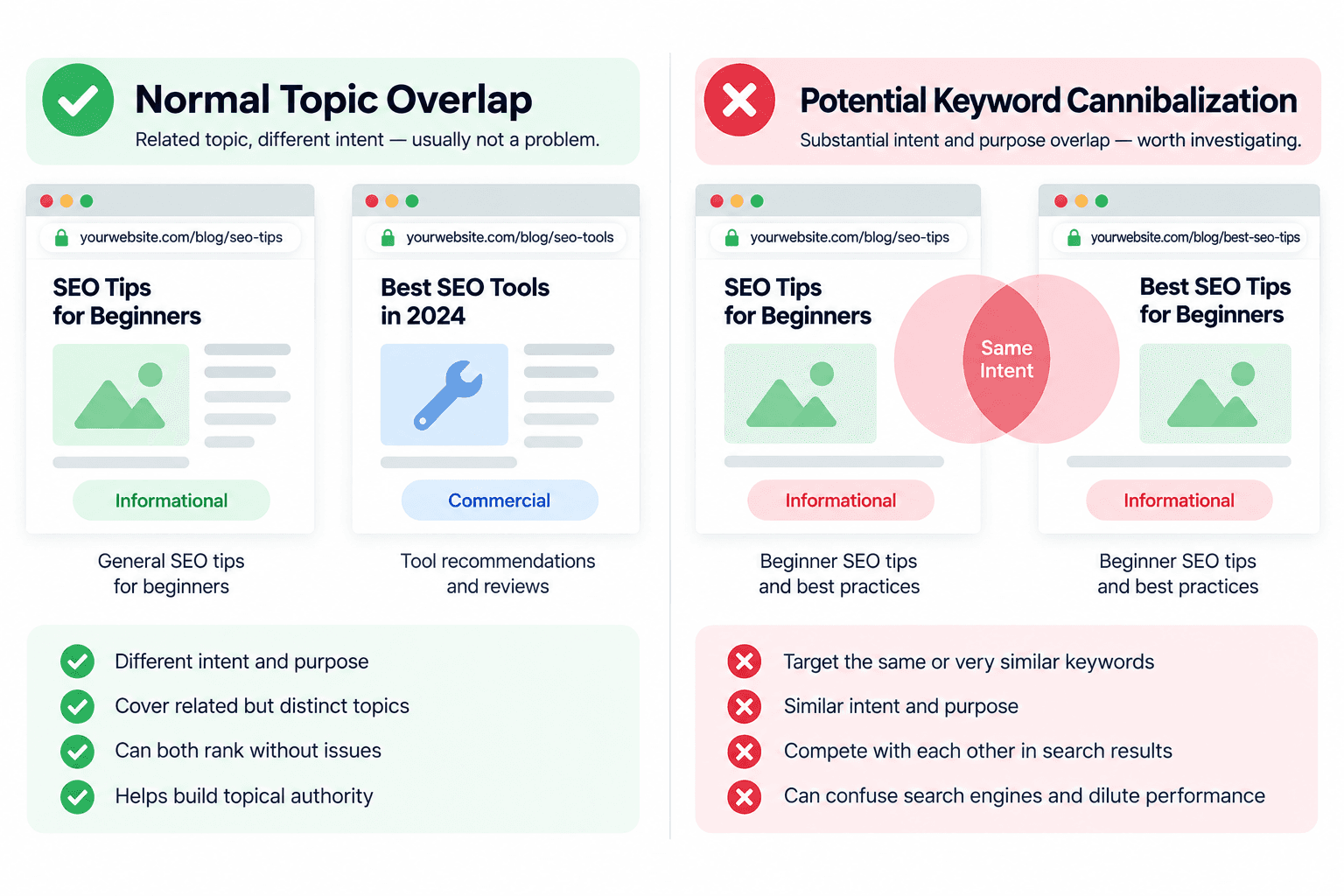
Keyword cannibalization generally refers to a situation where multiple URLs on the same website substantially overlap in the search intent or purpose they are trying to serve.
For example, imagine a website has these two articles:
- What Is Technical SEO?
- Technical SEO Checklist
Both pages discuss technical SEO, and they may appear for some of the same searches. That alone does not make them competing pages. The first explains a concept; the second helps readers take action with a checklist. Their purposes are different enough that both may be useful.
Now consider another pair:
- SEO Tips for Beginners
- Best SEO Tips for Beginners
If both articles target the same audience, answer the same questions, contain similar recommendations, and satisfy essentially the same search intent, the overlap is much more meaningful.
Content overlap goes beyond exact keywords
The same principle applies to content cannibalization. Two pages do not need to target the exact same keyword to overlap. They might use different phrases but still cover nearly identical information for the same audience and purpose.
When reviewing potential overlap, consider:
- the main topic
- search intent
- target audience
- page purpose
- information covered
- queries for which the pages appear
Think beyond individual keywords. The objective is to understand what job each URL is supposed to perform.
What Causes Keyword Cannibalization?
Publishing Similar Content Over Time
A website may have hundreds of pages created over several years. An older article can easily be forgotten when a new content idea is planned. A writer then creates a new page that covers much of the same ground.
Both articles may have looked reasonable when they were published, but together they now serve almost the same purpose.
Creating a Page for Every Keyword Variation
Keyword research tools often return several related phrases, such as:
- seo problems
- common seo problems
- seo issues
That does not mean each phrase needs its own URL. If the underlying intent is essentially the same, one strong page may be more useful than several pages created around minor keyword variations.
Search intent should guide the page strategy—not the number of keyword variations available in a research tool.
Poor Content Planning
Without a basic content map, it becomes harder to remember what each existing URL is supposed to cover. New articles can slowly move into territory already covered elsewhere, creating internal keyword cannibalization or broader content overlap.
Clear page purposes make these conflicts easier to avoid.
Overlapping Product, Service, or Category Pages
Cannibalization is not limited to Blog posts. A business might create several service pages with different URLs and slightly different titles even though each page describes essentially the same service for the same audience.
The important question remains the same: does each page provide a genuinely distinct reason to exist?
Existing Content Expands Into Another Page's Topic
Sometimes two pages begin with clearly different purposes. Later, one is expanded with new sections. After several updates, it may cover most of the subject addressed by another page.
Regular content reviews can catch this kind of gradual overlap.
Is Keyword Cannibalization Always Bad for SEO?
No—not automatically.
Multiple pages can legitimately discuss related subjects, use similar terminology, or appear for overlapping queries. Two URLs appearing for the same query does not, by itself, prove harmful cannibalization.
Potential problems are worth investigating when:
- two pages satisfy essentially the same search intent
- large parts of their content are redundant
- neither page has a clearly distinct purpose
- search visibility repeatedly shifts between very similar URLs for the same or closely related queries
- one URL appears for searches another page was specifically designed to address
- the site's internal structure does not clearly distinguish the pages
These are investigation signals, not proof on their own. There is also no need to frame keyword cannibalization as a special automatic Google penalty. The useful SEO task is to examine how your pages differ and how they actually perform.
How to Find Keyword Cannibalization
Finding potential cannibalization requires more than searching your site for repeated keywords. A practical review combines your content inventory, page intent, on-page content, and search-performance data.
1. Build a Simple Content Inventory
Start with a basic spreadsheet or document containing your important URLs. You do not need a complicated database. A few columns can reveal obvious overlaps:
| URL | Main Topic | Search Intent | Page Purpose |
|---|---|---|---|
| /blog/seo-tips | SEO tips | Informational | Beginner tips |
| /blog/best-seo-tips | SEO tips | Informational | Beginner tips |
If two rows look almost identical, those pages deserve a closer review. The inventory does not prove cannibalization; it simply helps identify possible conflicts efficiently.
2. Search Your Existing Website
A Google site: search can help you discover pages related to a topic. For example:
Review the URLs returned and look for pages with similar purposes. Treat this as a discovery method, not a complete cannibalization checker or ranking diagnostic.
3. Review Google Search Console Data
Google Search Console provides useful performance evidence. Its Performance report lets you analyze search queries and pages. For a specific query, you can filter by that query and review the Pages tab to see which URLs Google showed for it. Search Console also provides clicks, impressions, CTR, and average-position data that can help you examine performance over time. Google's Search Console documentation explains this query-and-page analysis.
Look for patterns rather than treating one appearance as proof of a problem. Search Console data also has reporting and aggregation limitations, so use it as evidence to investigate—not as an automatic cannibalization verdict.
4. Compare Search Intent
Ask a simple question:
Would a searcher reasonably need both pages?
If the answer is yes, identify what each page uniquely provides. Perhaps one is a beginner's introduction while another is a step-by-step checklist. Maybe one explains a strategy while another compares tools.
If you cannot explain the difference without stretching, the overlap deserves closer attention.
5. Compare the Pages
Open the potentially competing URLs side by side and compare:
- title
- H1
- main topic
- major sections
- intended audience
- page purpose
- internal links
- intended next action
You can also use RankCrow's free page-level SEO analyzer to inspect supported on-page signals on individual URLs during this review, including titles, meta descriptions, headings, content and keyword signals, internal links, and canonical/indexability signals.
RankCrow does not diagnose keyword cannibalization across an entire website. Cross-page diagnosis generally requires comparing multiple URLs alongside query and search-performance data.
6. Use Keyword Cannibalization Tools Carefully
A keyword cannibalization tool or keyword cannibalization checker can make larger reviews easier by surfacing URLs that appear for similar queries or showing potentially overlapping ranking patterns.
That can help you decide where to investigate first, but a tool flag is not proof that harmful cannibalization exists. If two flagged pages serve different intents and provide distinct value, their overlap may be completely reasonable.
Use tools to find candidates. Use intent, purpose, content, and performance to make the decision.
Analyze individual URLs with RankCrow while reviewing potentially overlapping pages.
How to Fix Keyword Cannibalization
There is no single fix for every situation. The right action depends on why the pages overlap and whether both URLs still have a useful purpose.
Differentiate Pages That Serve Different Intents
Do not merge two pages simply because they share keywords. Suppose you have:
- Keyword Research Guide
- Keyword Research Tools
These pages belong to the same topic cluster, but they can serve different purposes. If both deserve to exist, make those differences clear through their titles, H1s, content focus, sections, target audience, internal links, and next actions.
The goal is not to remove every shared phrase. It is to give each page a clear role.
Merge Truly Overlapping Pages
If two pages satisfy essentially the same intent and there is no meaningful reason to maintain both, consolidation may be appropriate. Choose the URL that should remain, then combine the genuinely useful information into that page.
Avoid keeping redundant sections simply because they previously existed on another URL. Also review internal links so they lead users toward the page you have chosen to keep.
Redirect an Obsolete URL When Appropriate
After genuine consolidation, an old URL may no longer need to exist. A permanent redirect can be appropriate when a page has been replaced by another relevant destination. Google recommends permanent server-side redirects such as 301 or 308 when a URL has permanently moved.
For more context on how search engines discover and process URLs, see RankCrow's Search Engine Indexing Guide.
But cannibalization does not automatically mean “add a 301.” If both URLs have legitimate independent purposes, redirecting one simply to eliminate keyword overlap can remove useful content.
Improve Internal Linking
Internal links can help readers understand the relationship between related resources and move to the page that best answers their next question. A clear SEO internal linking strategy can support this structure.
Anchor text alone should not be treated as a command that forces Google to rank one page instead of another.
Update or Retire Outdated Content
Sometimes an older article is no longer useful enough to justify a separate URL. Depending on the situation, you may update it, consolidate useful sections elsewhere, redirect it after replacement, or retire it when it no longer provides value.
Do not delete pages automatically just because another URL covers a similar keyword.
Use Canonicals Only Where They Actually Fit
Canonicalization has a specific purpose. Google uses canonicalization to select a representative URL among duplicate or very similar pages. You can indicate your preferred canonical URL, but Google may choose a different one based on its canonicalization signals. Google Search Central explains canonicalization and the signals used to indicate a preferred URL.
Canonical tags are not a universal keyword-cannibalization fix. If two pages are intended to provide different content and serve different purposes, first determine why they overlap rather than using a canonical tag to avoid making that decision.
How to Prevent Keyword Cannibalization
Preventing unnecessary overlap is usually easier than untangling a large content library later.
Maintain a Simple Content Map
Track important pages with fields such as URL, topic, search intent, target audience, page purpose, and related content. This makes it easier to see where a proposed article fits before it is published.
Check Existing Content Before Publishing
Do we already have a page that satisfies this search intent?
Ask that before creating another URL. If the answer is yes, decide whether updating the existing page would serve readers better.
This is especially useful when planning SEO for a new website, because assigning clear purposes to important pages early can reduce unnecessary overlap as the site grows.
Target Search Intent, Not Every Keyword Variation
Do not automatically create separate pages for reordered phrases, singular and plural versions, close synonyms, or minor wording variations when the underlying search intent is essentially identical.
A useful SEO content strategy should begin with what the searcher needs, then decide whether a new URL is justified.
Update Existing Content When It Makes More Sense
A new keyword opportunity does not always require a new article. If an existing page already serves the same intent, adding genuinely useful information to it may be the cleaner choice.
Build Clear Content Relationships
Related pages are not inherently a problem. A website can have several resources around the same broad topic when each one has a distinct purpose.
Plan how those pages relate to one another, link them where useful, and make it easy for readers to understand what each resource offers. That is a more sustainable way to prevent keyword cannibalization than trying to stop every keyword from appearing on more than one URL.
Keyword Cannibalization Example
Example A: Overlap Worth Investigating
URL 1: /blog/seo-tips
Title: SEO Tips for Beginners
URL 2: /blog/best-seo-tips
Title: Best SEO Tips for Beginners
Suppose both pages target beginners, contain almost identical advice, answer the same questions, and satisfy the same search intent. Maintaining both URLs may provide little additional value.
This would be a reasonable case to compare performance and decide whether the pages should be differentiated or consolidated.
Example B: Related but Legitimately Different
URL 1: /seo-guides/internal-linking-strategy
Purpose: A comprehensive explanation of internal-linking strategy.
URL 2: /blog/internal-linking-mistakes
Purpose: A practical article focused specifically on mistakes to avoid.
Both pages concern internal linking and may naturally use some of the same terminology, but their purposes are clearly different.
The lesson is simple: evaluate intent and purpose, not just repeated keywords.
Frequently Asked Questions
What is keyword cannibalization in SEO?
Keyword cannibalization generally refers to substantial overlap between multiple URLs on the same website that target the same or very similar search intent or purpose. Repeating the same keyword across pages does not automatically mean cannibalization.
Is keyword cannibalization bad for SEO?
Not automatically. Related pages can legitimately appear for similar queries. Investigate when pages substantially overlap in intent and content, lack distinct purposes, or show search-performance patterns that suggest they may be competing for the same opportunity.
How do I find keyword cannibalization?
Start with a content inventory, review related URLs, analyze query and page data in Google Search Console, compare search intent and page purpose, and use appropriate tools to identify URLs worth investigating.
How do I fix keyword cannibalization?
The appropriate fix depends on the pages. You may differentiate pages with distinct intents, consolidate genuinely redundant content, update internal links, or redirect an obsolete URL when consolidation makes that appropriate. Canonicalization can help in suitable duplicate-content situations, but it is not a universal fix.
How can I prevent keyword cannibalization?
Maintain a content map, check existing pages before publishing, plan around search intent rather than every keyword variation, update existing content when appropriate, and give related pages clearly defined purposes.
Can two pages rank for the same keyword?
Yes. Two pages appearing for the same or related queries does not by itself prove harmful keyword cannibalization. Compare their intent, purpose, content, and actual search performance before deciding whether anything needs to change.
Focus on Page Purpose, Not Just Keywords
Keyword cannibalization is not about eliminating every shared keyword from your website.
Related pages can coexist. What matters is whether each important page has a clear purpose, useful content, and a logical relationship with the rest of your site.
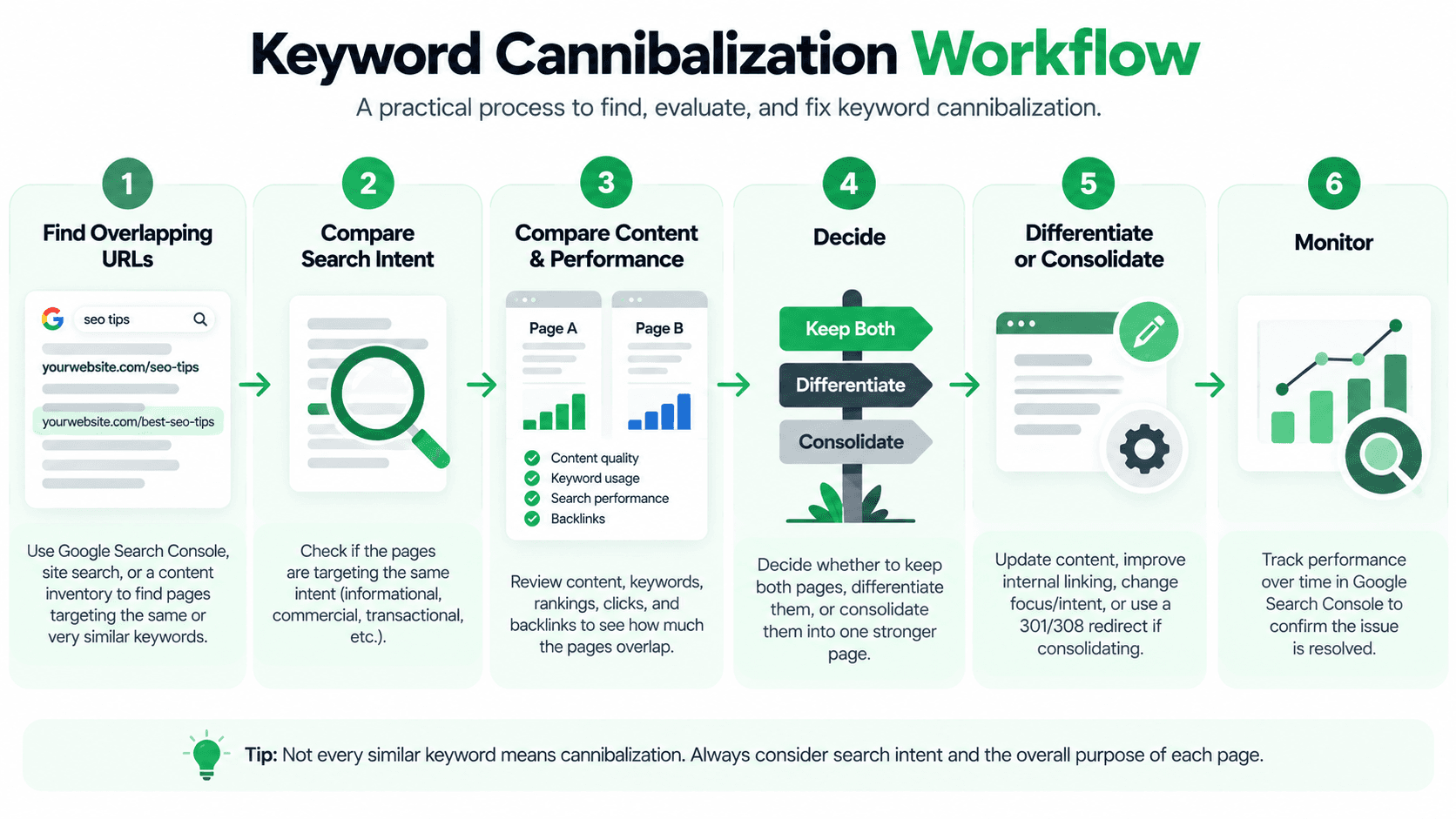
Compare → Evaluate → Differentiate or Consolidate → Update → Monitor
That framework keeps the focus on real overlap instead of treating every repeated keyword as an SEO problem.
When reviewing potentially overlapping pages, RankCrow can help you inspect the supported on-page SEO signals of each URL individually. Use the free page-level SEO analyzer alongside search-performance data and a careful comparison of intent before deciding whether there is a genuine cannibalization problem.