
A local business may have a useful website and a well-maintained local presence, but links and mentions from relevant websites can still form another part of its broader search presence.
Local backlinks are links from other websites that have a meaningful geographic, community, business, or local-market connection to your business. The goal is not to manufacture as many links as possible. It is to earn legitimate references when another website has a genuine reason to mention or recommend a useful page on your site.
This guide focuses on sustainable local SEO link building: identifying sensible opportunities, evaluating link quality, earning links through real relationships or useful resources, and avoiding tactics designed mainly to manipulate search rankings.
What Are Local Backlinks?
A backlink is a hyperlink from another website to your website. A local backlink is a backlink with meaningful local relevance. That relevance may come from the linking organization, its audience, the surrounding content, a real business relationship, or the community the link serves.
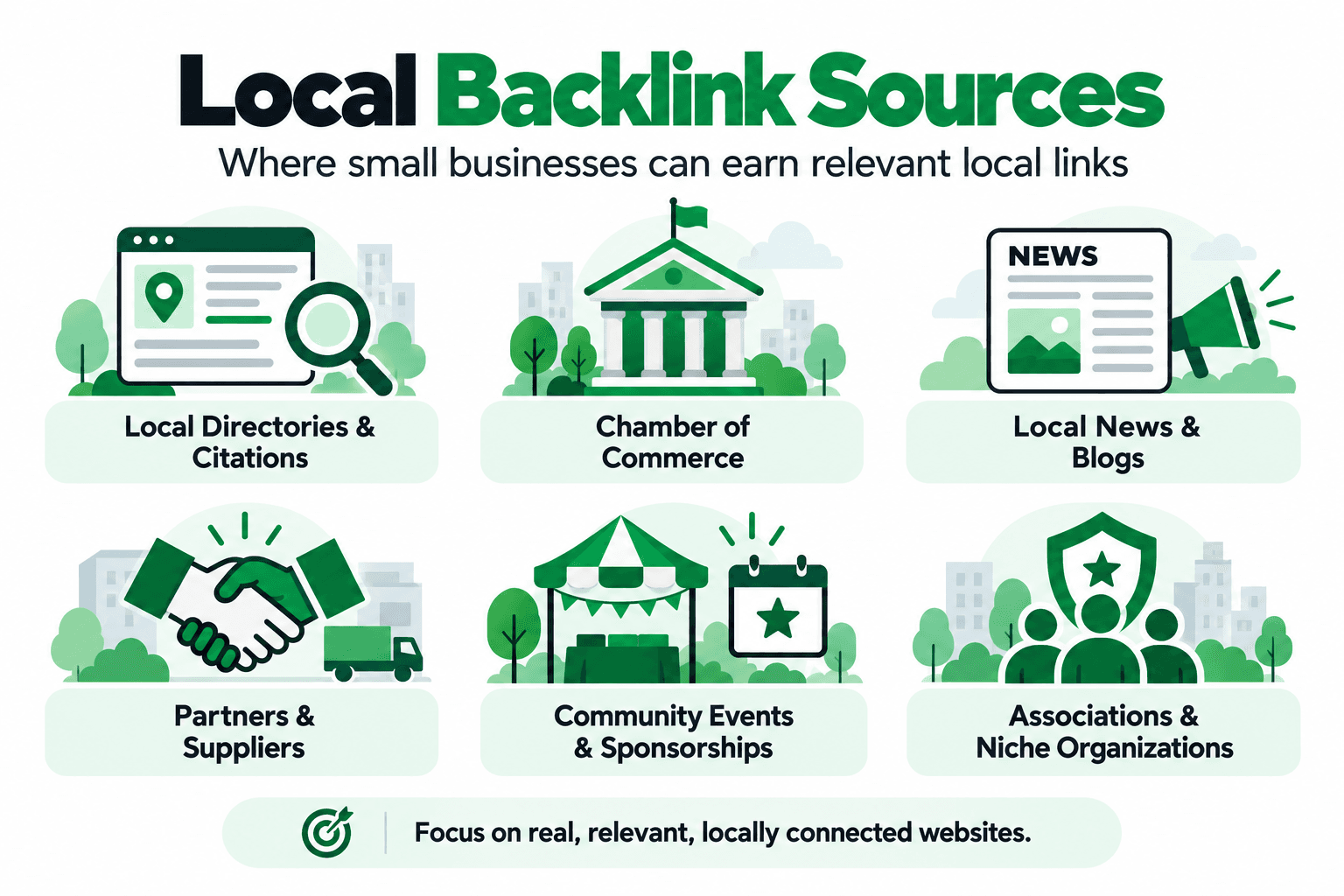
Examples can include links from local organizations, business associations, community resources, local publications, genuine partners or suppliers, and other websites that have a real reason to reference the business.
A local backlink is not simply any link from a website that happens to be based in the same city. Context matters. A link is more useful when the relationship between the source, the business, the destination page, and the reader makes sense.
Why Are Backlinks Important for Local SEO?
Links help connect pages across the web. They can help search engines discover pages and can form part of the wider signals used to understand relationships and reputation online.
For a local business, relevant links can also put useful pages in front of people who are already reading a local resource, association page, community publication, supplier page, or other context related to the business.
That does not mean more backlinks automatically produce higher rankings. There is no universal backlink count that guarantees better organic visibility, and backlinks do not guarantee Local Pack or Google Maps rankings. Local SEO backlinks are one part of a broader strategy that also includes the website, business information, Google Business Profile, content, technical health, and other relevant signals.
What Makes a Good Local Backlink?
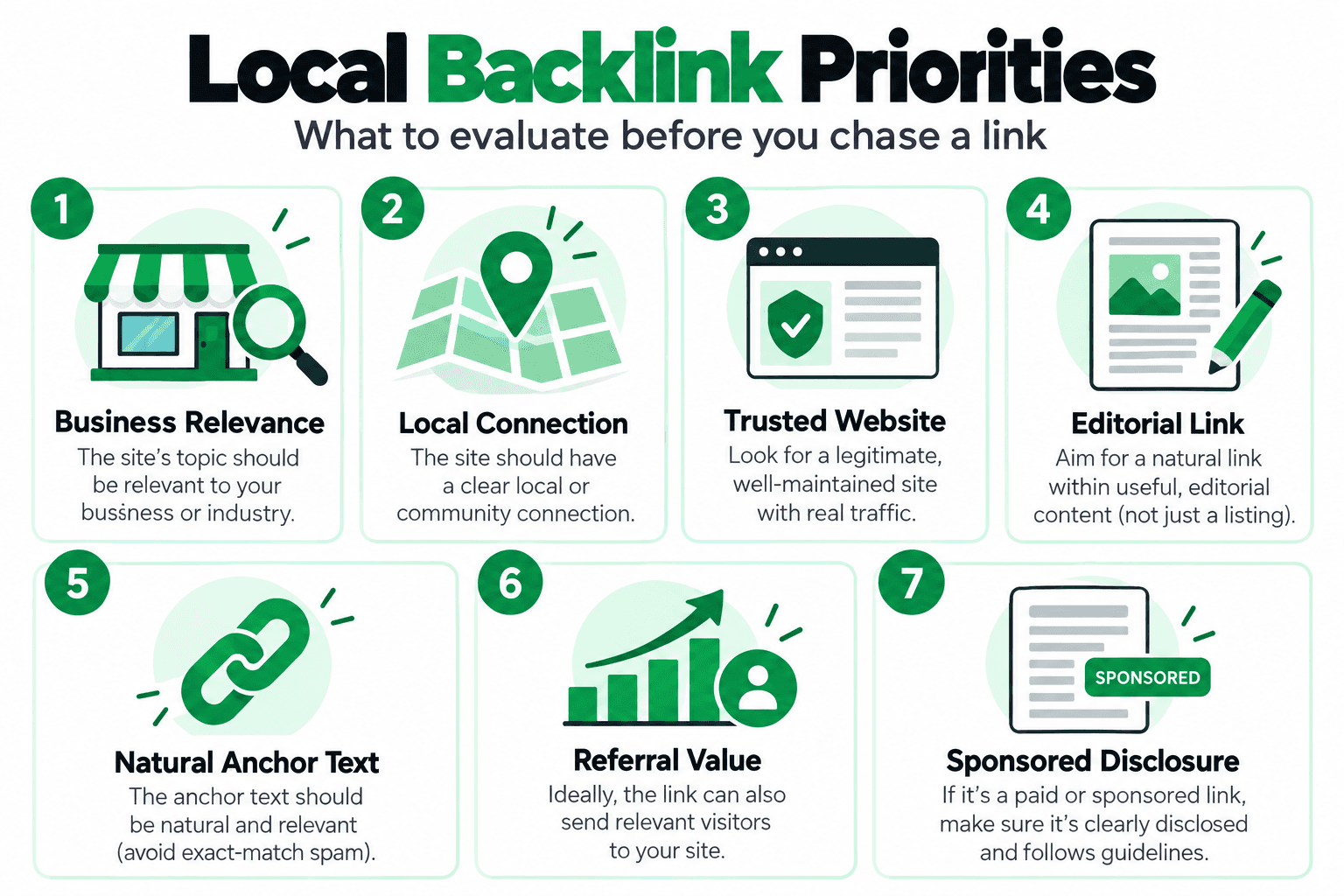
There is no single formula that turns a link into a “good” backlink. A practical evaluation should consider the reason for the link and whether it is genuinely useful in context.
Relevance
Ask whether the linking page or website has a legitimate connection to your business, industry, audience, location, or community. Local relevance can be geographic, but it can also be based on a real business or professional relationship.
Editorial Legitimacy
A legitimate link exists because referencing the business or its resource makes sense to the publisher and the reader. It should not exist only because someone wanted to manufacture a ranking signal.
Context
Look at the content around the link. Does the reference help the reader understand why the destination is useful? Context is more informative than looking at the anchor text or domain in isolation.
Source Quality
The source should appear to be a real, useful website rather than a site built primarily to sell or place links. Review the site as a user would: what does it publish, who is it for, and does the page have a credible reason to exist?
Destination Relevance
A backlink should point to a page that actually helps the person clicking it. Sending every link to the homepage is not always the most useful choice when a service page, resource, guide, or other page better matches the reference.
Natural Acquisition
The strongest reason for a link is usually simple: there is a legitimate relationship, contribution, resource, mention, or other reason for the business to be referenced.
Local Link Building Strategies That Make Sense
Sustainable local SEO link building starts with legitimate relationships and useful reasons to be referenced. The following approaches can create opportunities without treating backlinks as a commodity.
Local Business Associations and Organizations
Relevant business associations, professional organizations, chambers, or community groups may list genuine members, contributors, resources, or participating businesses. The relationship should be real; joining an irrelevant organization only for a backlink is not the goal.
Local Partnerships and Business Relationships
Genuine suppliers, partners, complementary businesses, organizations, and professional relationships may sometimes have a natural reason to reference one another. Think real relationship first, link second, rather than creating artificial reciprocal-link networks.
Create Resources Worth Referencing
A local business can publish resources based on real expertise or recurring customer needs. Useful guides, checklists, local resources, explanations, or original business information can give another publisher a genuine reason to reference the page. Avoid thin “link bait” produced only to attract backlinks.
Local Media and Community Coverage
Legitimate opportunities can come from noteworthy business activity, community participation, expert contributions, useful local information, or genuinely newsworthy developments. The aim is real coverage, not manufactured stories created only to obtain a link.
Relevant Sponsorships and Community Involvement
Genuine sponsorships and community involvement can create visibility and may sometimes lead to online references. Do not treat paying for sponsorship solely to obtain ranking links as a shortcut, and do not assume payment turns a link into an editorial endorsement.
Reclaim Legitimate Unlinked Business Mentions
If a legitimate website already mentions your business and a link would genuinely help its readers, you can politely ask whether the mention could point to the most relevant page. Focused, relevant outreach is more useful than sending generic requests to large numbers of unrelated websites.
Local Citations vs. Local Backlinks
A local citation and a backlink are related concepts, but they are not the same thing.
A citation is generally an online mention or listing of business information such as the business name, address, phone number, or other identifying details. A citation does not need to contain a clickable link.
A backlink is an actual hyperlink from another webpage or website to your website. A citation can include a backlink, but a citation can also exist without one.
The practical goal is accuracy and relevance, not hitting a specific citation or backlink quota. Mass submissions to low-quality directories should not replace careful evaluation of where the business genuinely belongs.
Local Backlink Tactics to Avoid
Google's spam policies describe link spam as practices involving links created primarily to manipulate search rankings. Local link building should avoid turning legitimate outreach into a search-manipulation exercise.
Buying Links for Ranking Manipulation
Paying for a link specifically to manipulate rankings can create policy risk. Commercial relationships should not be presented as independent editorial endorsements simply because a link is included.
Mass Backlink Packages
Packages promising large numbers of links often prioritize volume over relevance and legitimacy. A backlink count by itself does not demonstrate quality.
Automated Link Creation
Automated systems that place links across unrelated sites, profiles, comments, or low-value pages can create patterns with little genuine value to users.
Irrelevant Directory Submissions at Scale
A relevant directory can be useful when it serves a real audience or business purpose. Submitting to large numbers of unrelated directories just to manufacture links is a different practice.
Excessive Link Exchanges
Businesses may naturally reference partners or related organizations, but creating large exchange networks primarily for ranking manipulation is not the same as legitimate linking.
Artificial Link Networks
Private or artificial networks built mainly to pass links do not reflect genuine editorial relationships. Avoid creating fake local sites or interconnected properties whose primary purpose is to manufacture backlinks.
Comment and Forum Spam
Dropping promotional links into unrelated comments, forums, or profiles adds little user value and should not be treated as a local SEO strategy.
Manipulative Anchor Text
Do not force exact-match commercial anchors across outreach or link arrangements. Natural references should use wording that makes sense to the publisher and reader.
For the official policy framework, review Google's spam policies for Google web search.
How to Find Local Backlink Opportunities
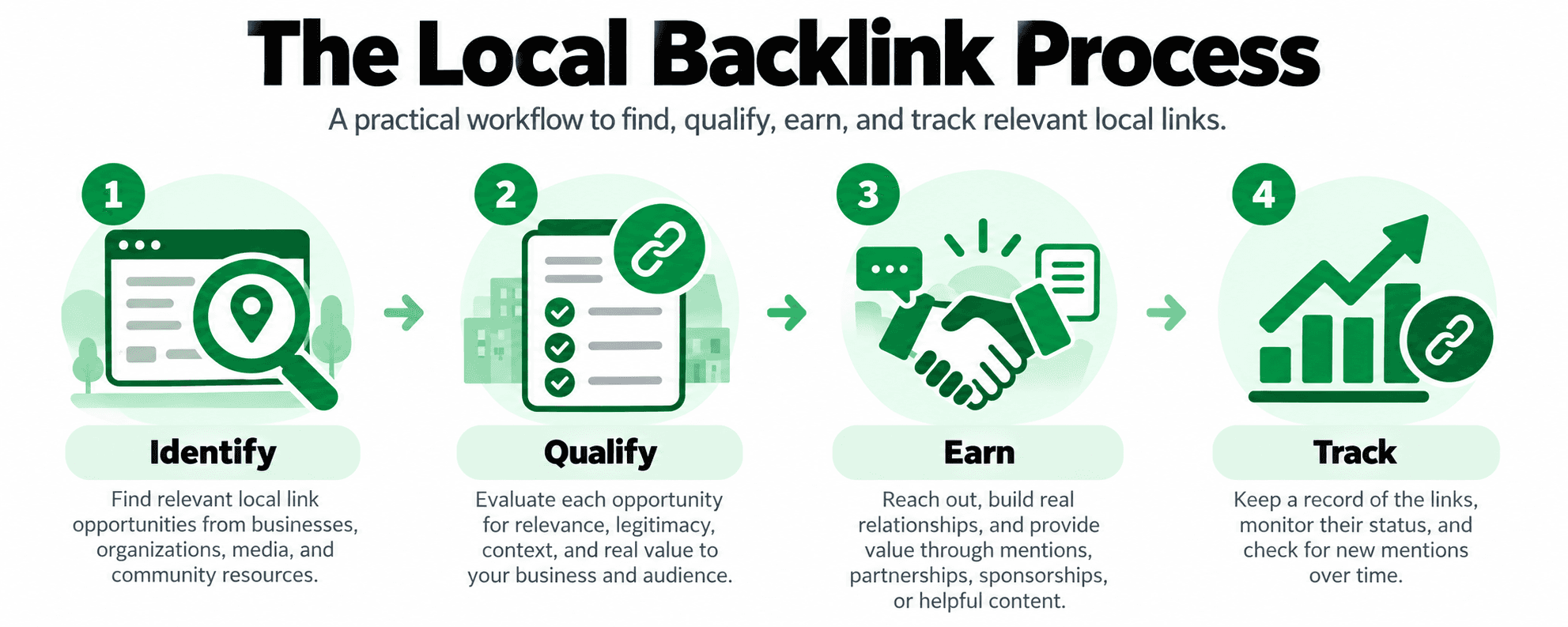
You do not need to turn local link building into a complicated backlink-tool exercise. A practical workflow is:
Identify → Qualify → Earn → Track
Identify
Look for legitimate relationships, organizations, resources, publications, suppliers, partners, or community opportunities connected to the business, industry, or location.
Qualify
Before pursuing a link, ask whether the opportunity is relevant, legitimate, useful to a real user, and supported by a genuine reason for the website to mention your business.
Earn
Give the publisher a real reason to reference you. That may be a useful resource, a genuine relationship, a contribution, membership, community involvement, or a reasonable outreach request tied to an existing mention or opportunity.
Track
Keep a simple record if it helps you manage legitimate outreach, mentions, and earned links. Avoid turning the process into an arbitrary quota such as “build X backlinks every month.”
| Opportunity | Why It Fits | Next Step | Status |
|---|---|---|---|
| Local association | Real membership and relevant audience | Review member profile/resource options | Qualified |
| Supplier mention | Existing business relationship | Ask whether a useful page can be referenced | Outreach |
| Community resource | Business provides relevant local information | Share the resource where appropriate | Research |
Should You Focus on Quantity or Relevance?
Do not chase raw backlink quantity. The number of links pointing to a site does not tell you whether those links are legitimate, relevant, useful, or editorially meaningful.
A better decision process is to ask why the link exists, who the source serves, whether the destination helps the reader, and whether the relationship is natural. Relevance, legitimacy, and context are more useful evaluation criteria than trying to maximize a backlink count.
This does not mean every locally relevant link is automatically valuable or that one link can be assigned a universal value. Evaluate each opportunity in context.
Where RankCrow Fits In
RankCrow is a page-level SEO analyzer. It does not provide a backlink database, backlink discovery, competitor backlink analysis, backlink monitoring, domain authority measurement, link outreach, link-building automation, or full-site crawling.
Where it can help is the destination page itself. Before earning links to an important page, make sure that page is useful, accessible, and reasonably optimized. RankCrow can review supported page-level signals such as:
- title and meta description;
- headings and heading hierarchy;
- content and keyword usage;
- internal and external links present on the analyzed page;
- images and ALT text;
- canonical and indexability signals;
- HTTPS;
- structured-data detection;
- RankCrow SEO Score.
RankCrow's SEO Score is a RankCrow page-analysis metric, not a Google ranking factor.
For broader local optimization beyond backlinks, see RankCrow's Local SEO for Small Business guide. To understand how internal links support your site's overall structure, see RankCrow's Internal Linking Guide.
Frequently Asked Questions
What are local backlinks?
Local backlinks are links from other websites that have a meaningful geographic, community, business, or local-market connection to your business. Relevance comes from context and the reason for the reference, not simply the physical location of the website.
How do I get backlinks for local SEO?
Start with legitimate relationships and useful reasons to be referenced. Relevant associations, genuine partners, useful local resources, community involvement, local media coverage, and existing unlinked mentions can all create sensible opportunities.
What are the best backlinks for local SEO?
There is no universal list that fits every business. Useful local SEO backlinks are generally relevant, legitimate, contextual, editorially sensible, and helpful to the person clicking them.
Are local citations the same as backlinks?
No. A citation is an online mention or listing of business information and may exist without a clickable link. A backlink is an actual hyperlink to your website. A citation can include a backlink, but the terms are not interchangeable.
How many backlinks does a local business need?
There is no universal number. Relevant opportunities vary by market, competition, business type, existing online presence, and the resources or relationships the business can legitimately earn references from.
Should I buy backlinks for local SEO?
Buying links specifically to manipulate search rankings can conflict with Google's spam policies. Focus on legitimate relationships, useful resources, and editorially sensible references rather than paid ranking-link schemes.
Final Thoughts
Local backlinks work best when the link is a by-product of something real: a relationship, a useful resource, a legitimate membership, community participation, relevant coverage, or a business mention that genuinely helps readers.
Start by identifying opportunities that make sense for your business. Qualify them for relevance and legitimacy. Give the publisher a real reason to reference the right page. Track the work if that helps you stay organized, but do not turn link building into a race for arbitrary numbers.
The core principle is simple: earn links because the business has a legitimate reason to be referenced, not merely because a backlink can be created.