
A small business can offer excellent products or services and still be difficult to find when nearby customers search online.
Local SEO helps make your business easier to discover and understand across Google Search, Google Maps, your website, and other relevant places online.
For a small business, local SEO is not about repeating city names, publishing dozens of similar pages, or chasing shortcuts. It is about keeping your business information accurate, maintaining a useful Google Business Profile, improving important website pages, earning genuine reviews, and making it clear where you operate and what you offer.
What Is Local SEO for a Small Business?
Local SEO is the process of improving a business's online presence so it can be more relevant and useful for searches connected with a particular area, service location, or nearby customer need.
Someone searching for a plumber, dentist, restaurant, computer repair shop, or accountant may want a business that serves their area. Local SEO helps search engines and users understand what the business does, where it operates, and whether it may be relevant to that search.
Local SEO is not the same as Google Business Profile alone. Your Business Profile matters, but your website and broader online presence also help explain your services, locations, and relevance.
Why Is Local SEO Important for Small Businesses?
Local SEO can help a small business become easier to discover when people search for relevant products or services in a nearby area.
- help nearby customers discover the business;
- make services and service areas clearer;
- provide accurate contact and operating information;
- strengthen the website's connection to the local business;
- help users decide whether the business fits their needs.
The goal is not to chase a guaranteed Maps or Search position. A better objective is to make the business easier to find, understand, and evaluate when a relevant local customer is searching.
How to Improve Local SEO for Your Small Business
There is no single Local SEO tactic that fixes everything. Start with the fundamentals and improve them in a sensible order.
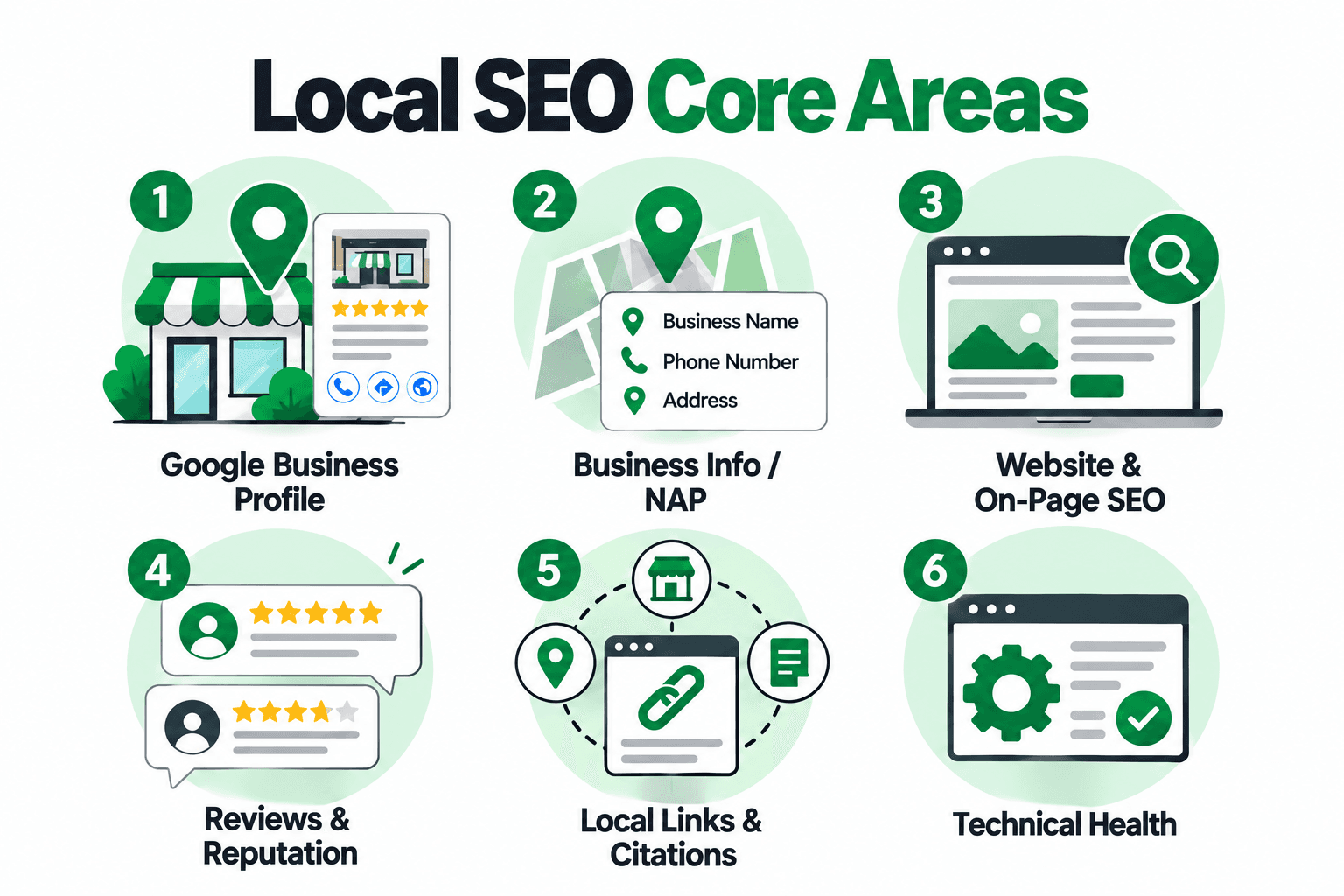
Optimize Your Google Business Profile
Review your real-world business name, categories, address or service area, phone number, website, opening hours, description, photos, and other customer-facing information. Keep those details current as the business changes.
Completing fields does not automatically guarantee better rankings. The purpose is accuracy, clarity, and usefulness. For deeper profile optimization, read RankCrow's Google Places SEO article.
Keep Your Business Information Accurate
Your business name, address, and phone number are often referred to as NAP. Keep these details accurate across your website and the important listings customers actually use.
Optimize Your Website for Local Search
Make sure important pages clearly explain what you offer, who you serve, and where you operate. Review descriptive titles, logical headings, service information, contact details, internal links, mobile usability, HTTPS, crawlability, and indexability.
For broader page-level guidance, see the On-Page SEO Guide.
Create Content That Helps Local Customers
Useful local content can answer customer questions, explain services, clarify service areas, provide relevant FAQs, or cover genuinely useful location-specific information.
Avoid near-identical location pages where only the city name changes. A location page should offer substantive value for that audience rather than exist only as another search entry point.
Earn and Manage Genuine Customer Reviews
Ask real customers for honest feedback, make the review process straightforward, respond professionally, and learn from recurring feedback. Avoid fake reviews, fabricated testimonials, and manipulative review schemes.
Build Relevant Local Links and Mentions
Legitimate opportunities may come from local organizations, genuine business partnerships, industry associations, community resources, local publications, or editorial mentions.
Keep Your Website Technically Healthy
Review crawlability, indexability, HTTPS, mobile usability, canonicalization, page structure, and structured data where appropriate.
For related technical checks, see common SEO problems, the Search Engine Indexing Guide, and the Schema Markup Examples Guide.
DIY Local SEO for Small Business
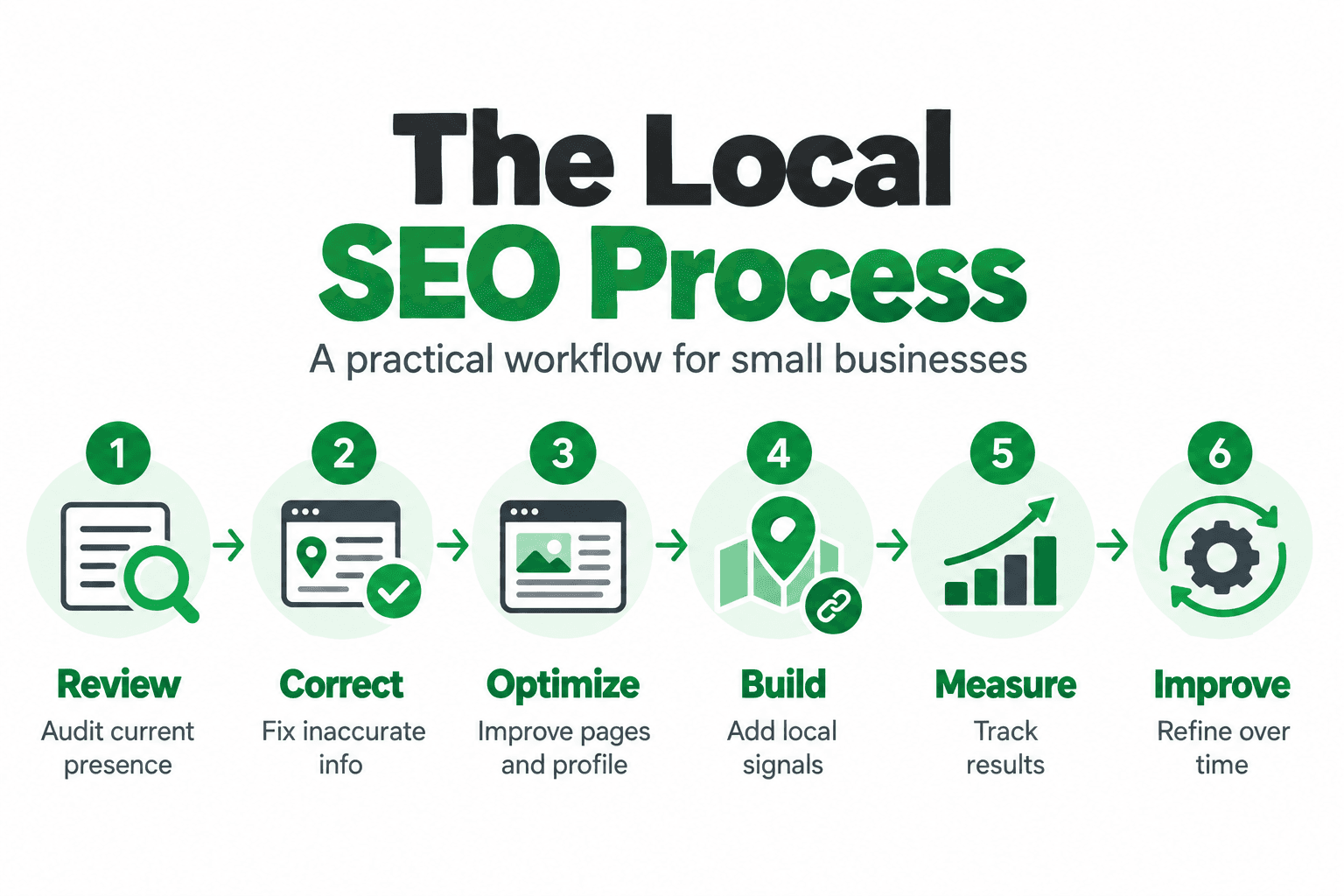
Many small-business owners can handle important Local SEO fundamentals themselves. A manageable process is:
Review → Correct → Optimize → Build → Measure → Improve
Local SEO Tactics to Prioritize First
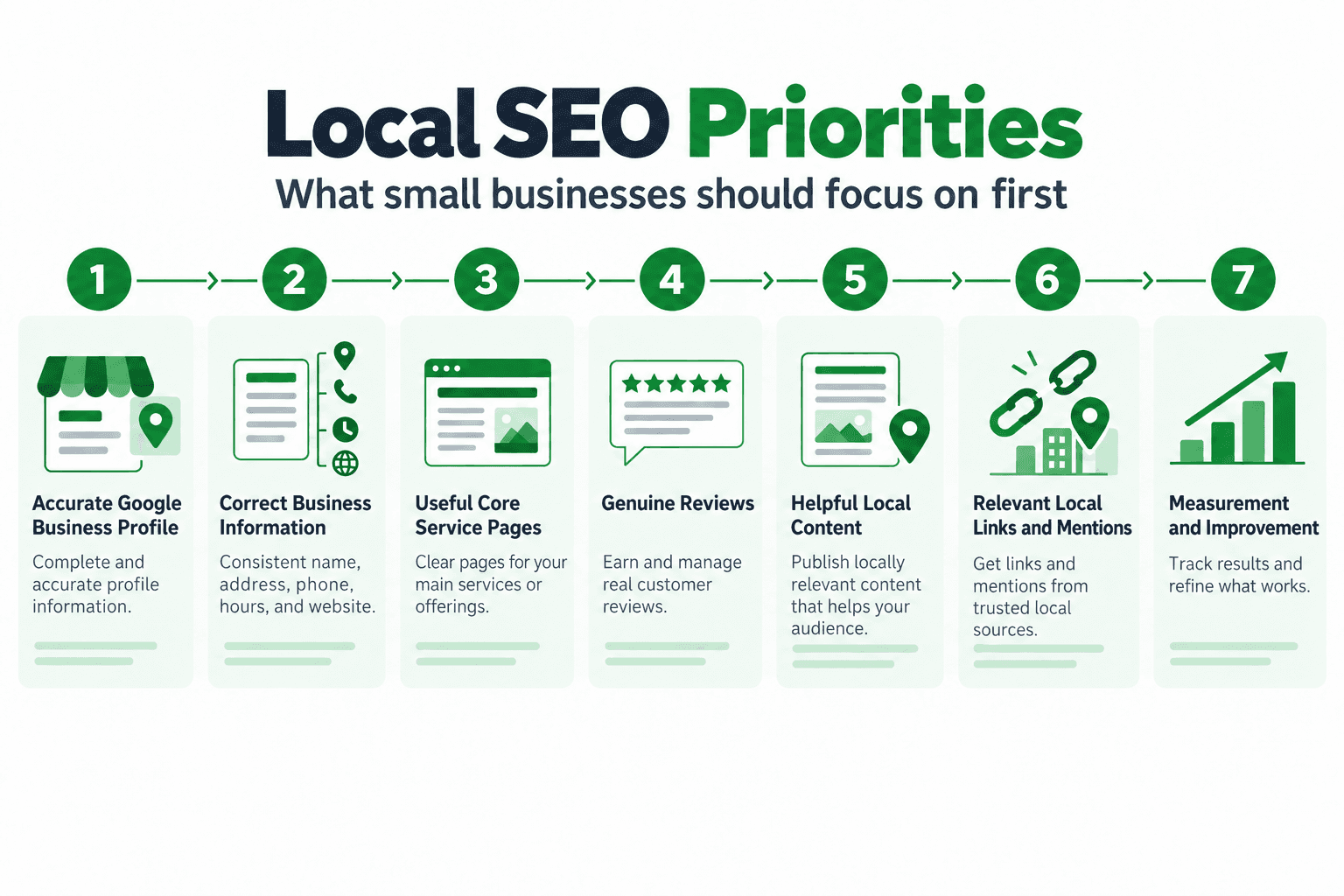
The right priority can vary by business, but most small businesses benefit from fixing fundamentals before experimenting with advanced tactics.
- Accurate Google Business ProfileKeep important profile information complete and current.
- Correct business informationReduce conflicting names, addresses, phone numbers, hours, or website details.
- Useful core service pagesGive important services clear, helpful pages.
- Genuine customer reviewsEarn authentic feedback and respond professionally.
- Helpful locally relevant contentAnswer real customer questions instead of creating pages only for keywords.
- Relevant local links and mentionsBuild legitimate references from useful local sources.
- Measurement and improvementReview performance and refine the work over time.
How to Measure Local SEO Performance
Measure Local SEO using signals connected with the business's actual goals rather than one isolated number.
- relevant organic traffic;
- search queries;
- impressions and clicks;
- enquiries or conversions when properly tracked;
- Google Business Profile performance information;
- changes in relevant local visibility.
Common Local SEO Mistakes to Avoid
- inaccurate business information or outdated hours;
- neglected Google Business Profile;
- location or keyword stuffing;
- thin or near-duplicate city pages;
- fake reviews or fabricated testimonials;
- manipulative backlinks;
- low-value content;
- technical or indexability problems;
- unrealistic expectations.
Where RankCrow Fits Into Local SEO
RankCrow is a free page-level SEO analyzer. It can help review the website side of Local SEO for an individual page.
- title and meta checks;
- headings and heading hierarchy;
- content analysis;
- keyword presence and usage;
- internal and external links;
- images and ALT text;
- canonical, indexability, and robots signals;
- HTTPS and viewport;
- structured-data detection;
- RankCrow SEO Score.
RankCrow does not manage Google Business Profiles, track Maps rankings, manage reviews, create citations, analyze backlinks, crawl an entire website, or automatically fix SEO. Its SEO Score is a RankCrow page-analysis metric, not a Google ranking factor.
Frequently Asked Questions
What is local SEO for a small business?
Local SEO is the process of improving a business's online presence so it can be easier to discover and understand for searches connected with a specific area or nearby customer need.
Why is local SEO important for small businesses?
It can help nearby customers discover the business, understand its services, find accurate information, and connect with it through Search or Maps.
Can I do local SEO myself?
Yes. Many fundamentals can be handled by a business owner, including correcting business information, maintaining the Business Profile, improving important pages, requesting genuine reviews, and monitoring basic search performance.
How can a small business improve local SEO?
Start with accurate business information, a maintained Google Business Profile, useful service pages, genuine reviews, locally relevant content, legitimate local links, and a technically healthy website.
How long does local SEO take?
There is no guaranteed timeframe. Results vary with competition, the business's starting point, market, existing online presence, website condition, and the quality and consistency of implementation.
Final Thoughts
Local SEO for a small business does not need to begin with complicated tools or dozens of tactics.
Start with accuracy. Keep your Google Business Profile current. Make sure your website clearly explains what you offer. Keep business information consistent. Publish content that genuinely helps customers. Earn authentic reviews. Build legitimate local relationships. Keep the website technically healthy.
Then measure what happens and improve based on real information. The goal is not to manufacture signals for search engines. It is to make your business easier to find, understand, and trust when a relevant local customer is looking for what you offer.