
A business can appear prominently for one local search and much lower for another. Someone a few streets away may even see a different set of results for the same query.
That is because local search rankings are strongly influenced by the search itself and the location context around it.
Google says local results are mainly based on relevance, distance, and popularity. In its detailed guidance, Google describes that third area under Prominence, meaning how well known a business is. Google does not publish a complete formula or fixed weighting for local rankings. Google Business Profile Help
For businesses, the practical goal is not to find a hidden ranking trick. It is to make the business accurate, relevant, useful, and easy for both customers and Google to understand while strengthening the parts of its online presence that can legitimately be improved.
What Are Local Search Rankings?
Local search rankings describe how prominently a business appears when Google determines that a search has local intent.
For example, someone might search for:
- emergency plumber;
- coffee shop;
- dentist near me;
- computer repair in Chicago.
Depending on the query, Google may show local businesses in Maps, a local result feature within Search, traditional organic webpage results, or a combination of these.
That distinction matters because local visibility is not identical to traditional organic webpage ranking.
A business may perform well in organic search while appearing differently in Maps or the local pack. These result types can draw on overlapping information, but they should not be treated as if they use one identical ranking system.
How Does Google Determine Local Rankings?
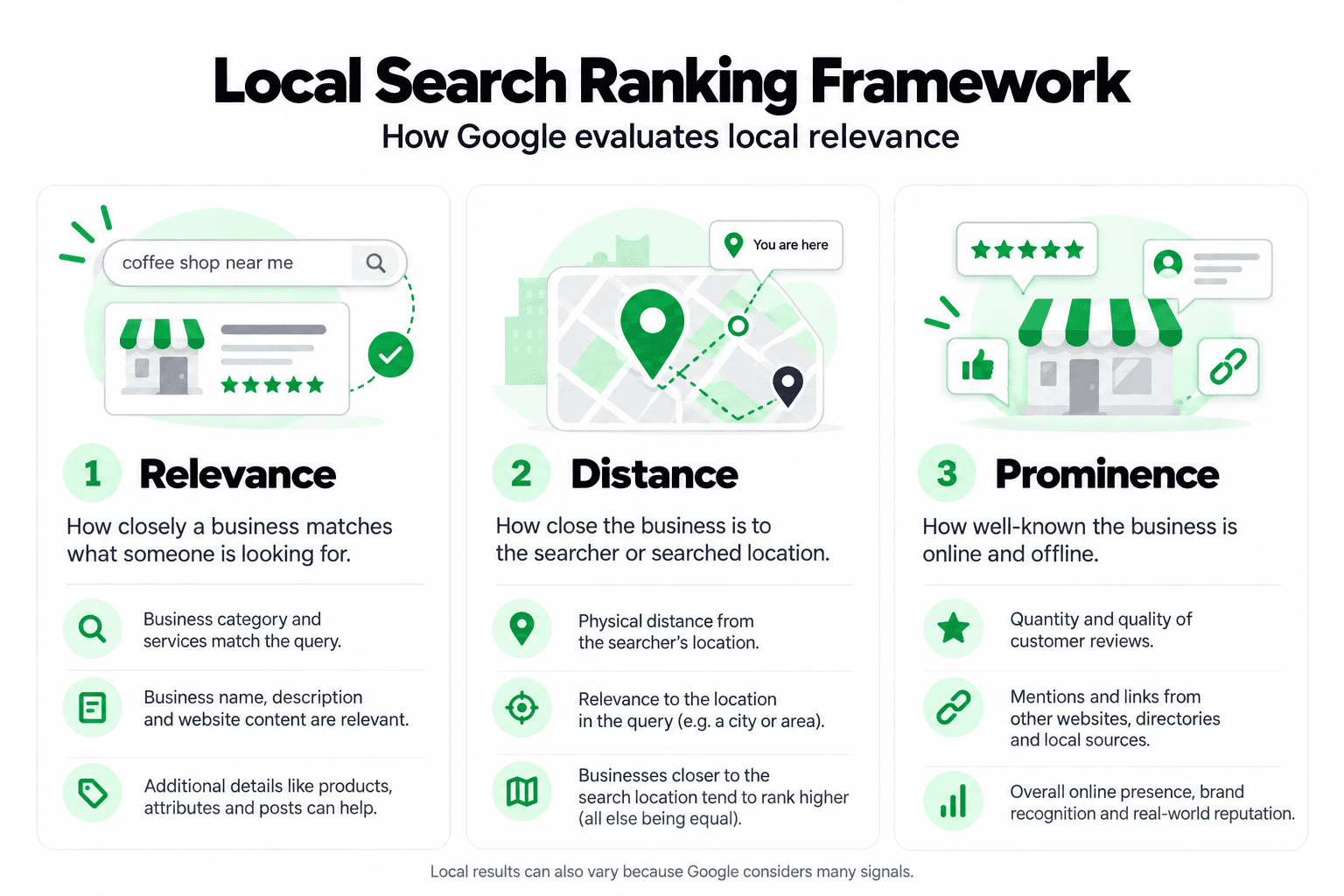
Google publicly explains three major areas behind its local results: relevance, distance, and prominence/popularity. Together, these concepts help Google identify useful local results for a search. Google Business Profile Help
Relevance
Relevance is about how well a Business Profile matches what someone is looking for.
Google recommends providing complete and detailed business information so it can better understand the business and match it with relevant searches. Google Business Profile Help
For a real business, that means accurately communicating:
- what the business does;
- what products or services it offers;
- where it operates;
- its appropriate business category;
- its contact and location information;
- useful website content that supports the same business identity.
Relevance should come from accurately describing the business, not from forcing keywords into every field or page.
Distance
Distance refers to how far a potential result is from the person searching.
If the searcher does not explicitly provide a location, Google says it can use what it knows about that person's location. Google Business Profile Help
This is one reason local results can vary significantly from one area to another.
Distance is also not something a business can simply "SEO hack." Fake addresses, misleading locations, or fabricated service areas do not solve the underlying issue.
The sensible approach is to represent your real location and service area accurately.
Prominence
Google describes prominence as how well known a business is.
Its current guidance says this can draw on information such as websites linking to a business and reviews. Google also says that more reviews and positive ratings can help local ranking. Google Business Profile Help
Prominence is therefore broader than one webpage or one third-party SEO metric.
It may be supported by a genuine reputation, relevant mentions, useful links, customer reviews, and other information that establishes the business across the web.
Relevant local backlinks can contribute to this broader picture, but they should exist for legitimate reasons rather than simply to increase a backlink count.
For deeper coverage, see our Local Backlinks guide, which explains how to identify and earn relevant local links without relying on spammy tactics.
What Is Local Pack Ranking?
The local pack is a set of business results Google may show when a search has local intent.
Depending on the query and interface, these results can give users quick access to business information such as names, ratings, locations, hours, directions, and contact options.
A local pack ranking therefore refers to visibility within these local business results rather than the position of a normal webpage in traditional organic listings.
The two should not be treated as interchangeable.
Your website can perform differently in organic search while your Business Profile appears differently in local results.
How to Improve Local Search Rankings
There is no guaranteed formula for achieving a particular local position.
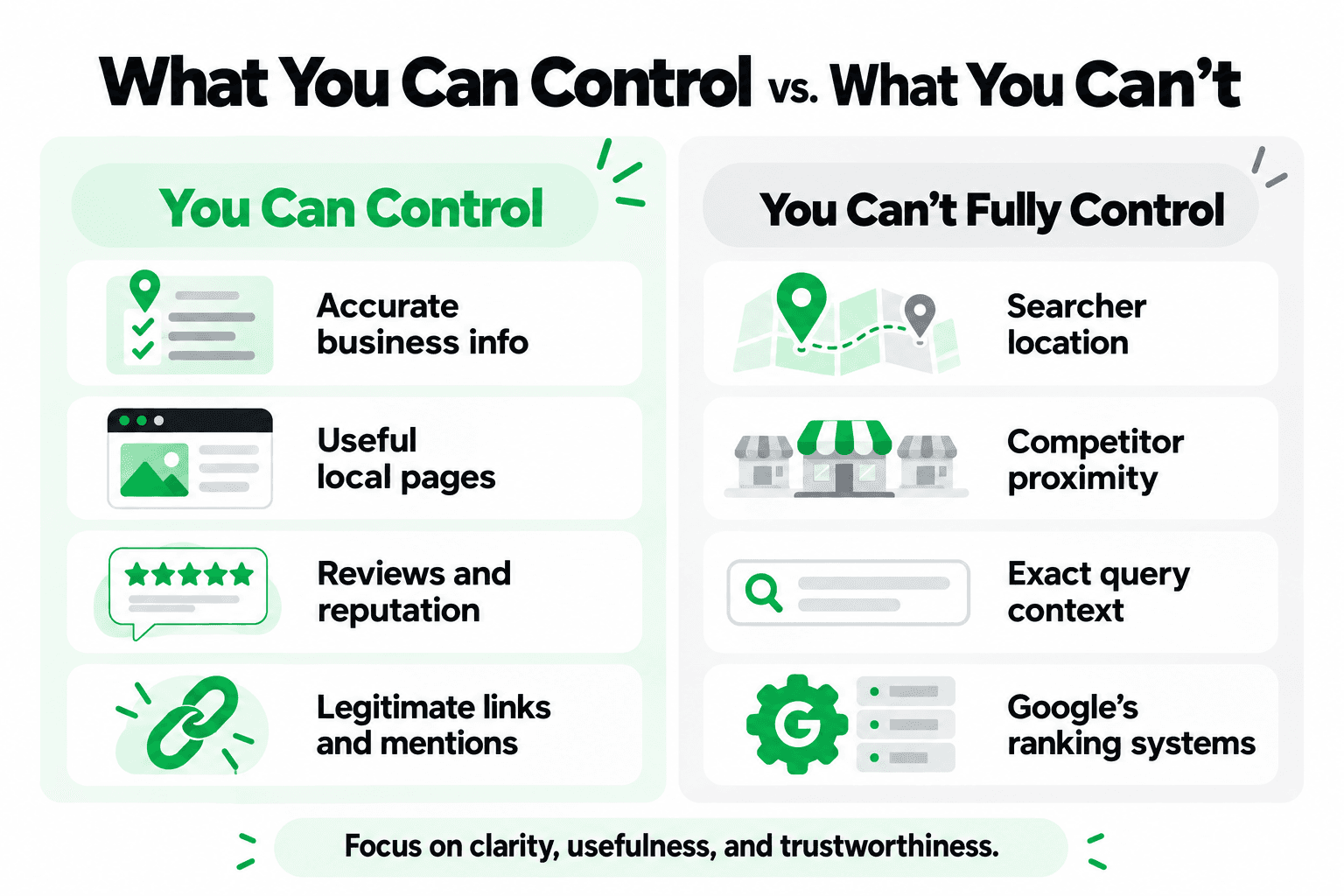
Instead, focus on legitimate areas you can improve.
Keep Your Business Information Complete and Accurate
One of Google's clearest recommendations is to maintain complete and accurate Business Profile information.
Google says businesses with complete and accurate information are more likely to appear in relevant local search results. Google Business Profile Help
Important details may include:
- business name;
- appropriate category;
- address, where applicable;
- service area, where applicable;
- phone number;
- regular and special hours;
- business attributes;
- other information that helps customers understand the business.
The goal is not to fill every field with keywords.
The goal is to represent the business accurately.
For more detailed Business Profile and Maps optimization, see our Google Places SEO guide.
Make Your Website Relevant to Local Customers
Your website should make it easy for visitors to understand what you offer and where you operate.
Useful local pages commonly include:
- clear service or product descriptions;
- genuine location context;
- accurate contact information;
- descriptive titles and headings;
- useful answers to customer questions;
- content that genuinely satisfies local search intent.
For example, a plumbing company serving a specific area should clearly explain its plumbing services and real service coverage.
That does not mean repeating the city name in every paragraph.
It also does not mean creating dozens of nearly identical pages that only swap one place name for another.
Useful local relevance should come from useful content.
Build a Strong, Useful Website
A Business Profile does not exist in isolation.
Google says local listing information can be compiled from several sources, including publicly available information such as crawled content from a business's official website. Google Local Listings Help
That gives your website an important role in the broader information Google can use to understand the business.
Important pages should make it clear:
- what the business offers;
- where it operates;
- how customers can contact it;
- why the page is relevant to a particular need.
This does not mean your website directly controls your Google Maps position.
It means accurate, useful web information contributes to the broader information ecosystem around the business.
Earn Genuine Reviews and Manage Them Properly
Reviews help potential customers evaluate a business, and Google also references them in its local-ranking guidance.
Google says more reviews and positive ratings can help local ranking. Its guidance also recommends helpful replies because they can help a business stand out to customers. Google Business Profile Help
A sensible review process includes:
- asking genuine customers for feedback appropriately;
- making the review process straightforward;
- responding professionally;
- learning from recurring customer feedback;
- avoiding fake or purchased reviews.
There is no universal review number that guarantees a particular local position.
Different businesses operate in different markets and competitive environments.
Earn Relevant Links and Mentions
Links and legitimate mentions can contribute to the broader prominence of a business.
Google specifically mentions websites linking to a business when describing prominence. Google Business Profile Help
Relevant links may come naturally through relationships with:
- local organizations;
- business associations;
- publications;
- partners;
- suppliers;
- community resources;
- genuine events or sponsorships.
The useful question is not "How many links can we build?"
"Why would this website legitimately reference this business?"
Our Local Backlinks guide covers this subject in depth, so there is no need to repeat the full link-building process here.
Keep Important Website Pages Technically Healthy
Important local pages should also be technically sound.
Useful page-level checks include:
- indexability;
- clear title tags;
- useful meta descriptions;
- logical headings;
- helpful content;
- sensible internal links;
- appropriate canonical signals;
- HTTPS;
- a usable mobile viewport;
- structured data where relevant.
None of these elements guarantees a higher local position.
Their purpose is to make important pages accessible, understandable, and technically healthy.
How to Rank for "Near Me" Searches
"Near me" searches carry strong location intent.
But the answer is not to repeatedly insert phrases such as:
- plumber near me;
- dentist near me;
- restaurant near me.
Google says a user's current location can help it show nearby results even when the searcher does not explicitly include a location in the query. Google Location Help
Instead of stuffing "near me" phrases into your pages, accurately communicate:
- what your business does;
- where it is located;
- where it genuinely operates;
- which services or products it provides;
- the information local customers need.
Distance and location context remain partly outside the business's control.
That is why no business can reasonably guarantee that it will appear first for every "near me" search across an entire city.
Why Local Search Rankings Can Vary
Local rankings are contextual.
Two people can search for the same thing and still see different results.
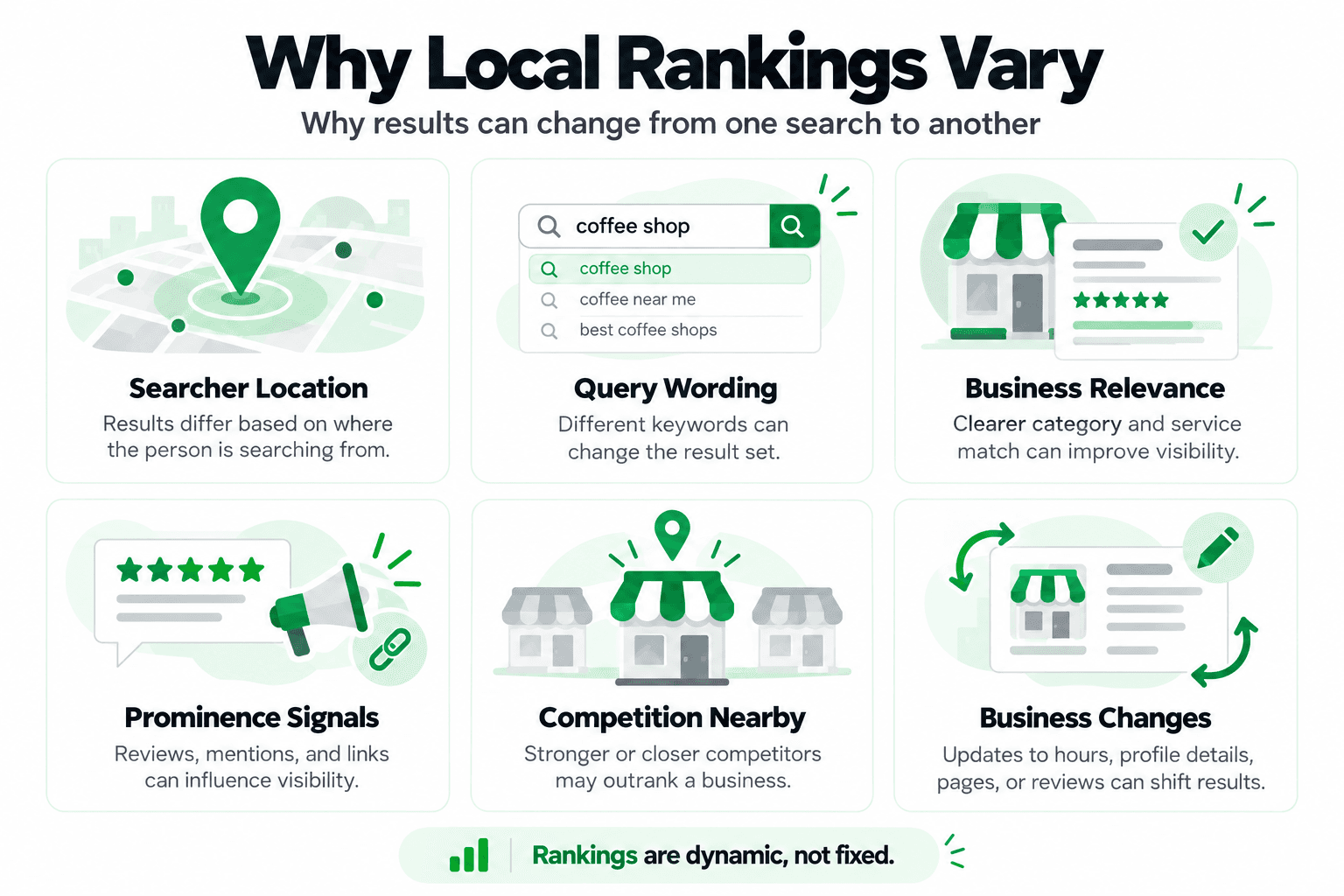
Location is especially important for locally relevant searches, and Google can use location context even when the search does not contain an explicit place name. Google Location Help
Someone searching close to your business may therefore see a different set or order of results from someone searching farther away.
This is why one manual search from one computer should not be treated as a universal measure of your local ranking.
Incognito mode also does not create one absolute "true ranking." It may reduce some personalization, but location and other contextual information can still affect what is shown.
How Local Competition Affects What You See
Every local market is different.
A business in a dense city center may compete with many nearby alternatives, while a similar business in a smaller town may operate in a very different search environment.
The useful response is not to copy whichever competitor happens to appear first.
Instead, evaluate whether your own business genuinely satisfies what local customers are searching for.
Useful questions include:
- Is our business information accurate and complete?
- Are our services clearly explained?
- Does our website answer important customer questions?
- Is our location information clear?
- Are our important pages useful?
- Are we building a legitimate reputation in the local market?
Competitors can provide context, but their keywords, links, categories, and page structures should not be copied blindly.
Common Local Ranking Mistakes
Many Local SEO problems start when businesses try to force rankings rather than improve their underlying information and customer experience.
Common mistakes include:
- incomplete or outdated business information;
- inconsistent or misleading details;
- keyword stuffing;
- fake locations;
- thin location pages;
- large numbers of near-duplicate city pages;
- fake or manipulated reviews;
- mass low-quality links;
- treating third-party SEO scores as Google ranking scores;
- expecting immediate movement after every small change;
- assuming one manual search represents everyone's results.
Google's spam policies specifically warn against practices such as keyword stuffing, doorway abuse, link spam, and scaled low-value content created mainly to manipulate rankings. Google Search Spam Policies
The better approach is to improve accuracy, usefulness, relevance, and legitimacy rather than manufacture signals.
How to Monitor Local Search Performance
Local performance should be evaluated over time, not through one search from one device.
Look for broader patterns such as:
- whether the business appears for relevant searches;
- whether important local pages are gaining organic visibility;
- whether local traffic and meaningful customer actions are improving;
- whether business information remains accurate;
- whether performance changes after substantial website or business updates.
Avoid obsessing over one position at one moment.
Because local results depend on query and location context, a single manual search tells only part of the story.
Detailed reporting, KPI selection, dashboards, and reporting cadence deserve their own guide rather than being forced into this article.
Where RankCrow Fits Into Local Search SEO
RankCrow is a page-level SEO analyzer.
It can help you review page-level signals on important local landing pages, service pages, and other webpages, including:
- title and meta information;
- headings;
- content;
- keyword usage;
- internal and external links found on the analyzed page;
- images and ALT text;
- canonical and indexability signals;
- HTTPS;
- viewport configuration;
- structured-data detection;
- SEO Score.
This can help identify avoidable on-page and technical issues on pages that support your local SEO efforts.
However, RankCrow does not currently provide:
- Google Maps rank tracking;
- local grid tracking;
- Google Business Profile management;
- review management;
- citation management;
- backlink discovery or monitoring;
- competitor local-rank tracking;
- full-site crawling;
- ranking guarantees.
Local visibility depends on more than a single webpage.
RankCrow can help you review the page-level SEO health of important local pages while other aspects of local visibility must be managed separately.
Frequently Asked Questions
What are local search rankings?
Local search rankings describe how prominently a business appears when Google returns results connected to a location, nearby need, or other local search intent. Those results can appear across Google Search and Maps.
What determines local ranking on Google?
Google says local results are mainly based on relevance, distance, and popularity. In its detailed explanation, it describes the third area under prominence. Relevance concerns how well the business matches the search, distance concerns proximity to the searcher, and prominence concerns how well known the business is. Google does not publish a complete weighting formula for these signals. Google Business Profile Help
How can I improve my local search ranking?
Focus on legitimate areas you can control: maintain accurate business information, make your website useful and relevant, earn genuine customer reviews, build legitimate links and mentions, keep important webpages technically healthy, and clearly communicate your services and location. None of these actions guarantees a particular ranking.
How do I rank for "near me" searches?
Do not stuff "near me" phrases into your pages. Clearly explain what your business does, where it operates, and what local customers need to know. Google can use location context to return nearby results even when a location is not explicitly written in the search. Google Location Help
Why does my local ranking change by location?
Distance is part of Google's documented local-ranking framework, and location context helps Google return nearby results. Someone searching from a different area may therefore see a different set or ordering of local businesses. Google Business Profile Help
Can I pay Google for a better local ranking?
No. Google states that there is no way to request or pay for a better local ranking. Google Ads is a separate paid advertising system and should not be confused with organic local search rankings. Google Business Profile Help
Final Thoughts
Local search rankings are not controlled by one metric, one webpage change, or one SEO trick.
Google publicly describes relevance, distance, and prominence/popularity as central concepts in local results, but it does not publish a complete formula or fixed weighting for local rankings. Google Business Profile Help
For a business, that leaves a practical set of priorities: keep your information accurate, make important pages useful and technically healthy, earn genuine customer feedback, build legitimate local recognition, and avoid shortcuts designed mainly to manipulate search results.
You cannot control every searcher's location, and you cannot guarantee a particular position.
You can make your business clearer, more relevant, more useful, and easier for customers and search engines to understand.