

A page can appear in search results and earn a click without giving the searcher a good experience.
The result may create the wrong expectation. The page may bury the answer under unnecessary content. Navigation may be confusing, or intrusive elements may make it harder to use the page. In some cases, the content simply does not match what the person was trying to accomplish.
That is where search experience optimization, commonly shortened to SXO, becomes useful.
SXO looks beyond search visibility alone. It considers the journey from the searcher's original need to what happens after the click.
The goal is not to replace SEO. It is to look at SEO, useful content, usability, and page experience together so that search visibility leads to an experience that actually helps the visitor.
What Is Search Experience Optimization (SXO)?
Search Experience Optimization (SXO) is an approach to improving both how people discover a page through search and the experience they have after reaching it.
It can bring together considerations such as:
- search relevance;
- SEO;
- content usefulness;
- usability;
- page experience;
- appropriate next steps.
SXO is an industry term and framework. It is not an official Google ranking system, and it should not be treated as a separate Google ranking factor.
A page should not only be discoverable by the right audience. It should also help visitors confirm that they are in the right place, understand the content, and accomplish what they came to do.
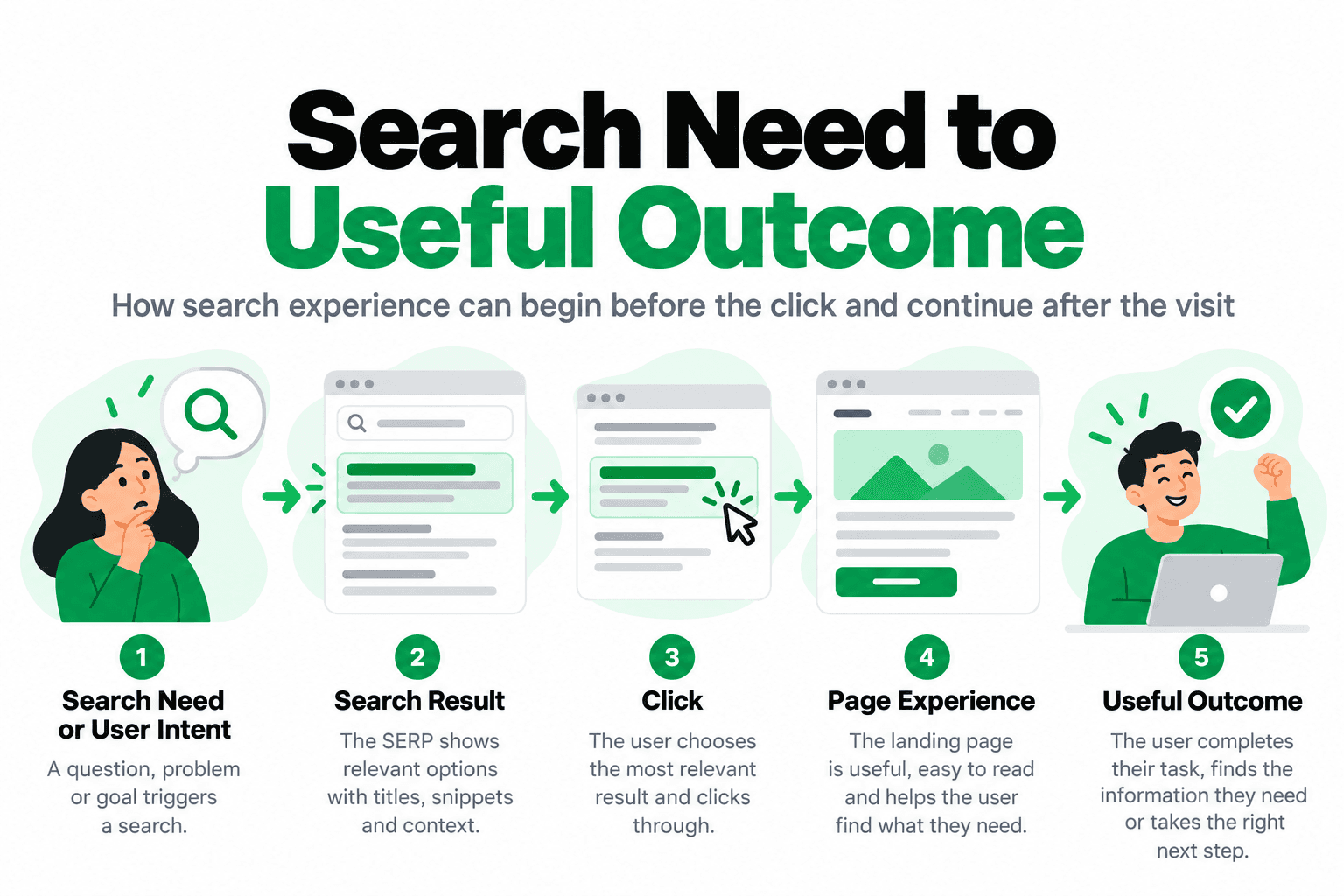
Search experience can begin before the click
The experience can start while the person is still looking at the search results. Google documents search appearance elements such as title links, snippets, sitelinks, and supported structured-data appearances that can shape expectations before someone visits the page.
What the search result appears to promise should align with what the landing page actually provides.
For example, a result that promises a step-by-step guide to cleaning a coffee maker should lead to a page where those instructions are easy to find.
If the visitor instead reaches a page dominated by product promotion, unrelated background information, or distracting interruptions, the search experience has already become weaker.
A result does not become better simply because it attracts more clicks.
How SEO and User Experience Work Together
SEO and user experience overlap in several areas, but they are not the same thing.
SEO concerns can include
- crawlability and indexability;
- search relevance;
- titles and headings;
- content;
- internal linking;
- search appearance;
- technical accessibility.
User experience concerns can include
- clarity;
- readability;
- navigation;
- accessibility considerations;
- ease of interaction;
- reducing unnecessary friction;
- helping visitors complete their task.
SXO provides a useful way to look at how these concerns interact during a visit that begins with search.
For example, an accurate page title can help communicate relevance in search results. Once someone reaches the page, a clear H1, useful content structure, and sensible navigation can help deliver on that expectation.
That does not mean every UX improvement directly increases rankings.
The point is to make the page useful for people while maintaining sound SEO fundamentals. For the page-level SEO side of this process, the On-Page SEO Guide explains the elements you can optimize directly on a webpage.
Search intent is the starting point
A strong search experience begins with understanding what the person is likely trying to accomplish.
Consider the search:
“how to clean a coffee maker”
The person probably wants clear instructions. A page that makes them work through a long company story, unrelated sales copy, and disruptive popups before reaching the instructions creates unnecessary friction.
A better page would make the steps easy to find, understand, and follow.
Now consider:
“best accounting software for small business”
This search suggests comparison or evaluation. The visitor may need clear options, differences, limitations, and useful criteria before deciding what to investigate next.
The appropriate experience changes because the searcher's objective changes.
Search intent should guide the page without being reduced to rigid labels when a query can reasonably support mixed intent.
Search Experience Optimization vs Traditional SEO
SXO does not replace SEO. Modern SEO already includes many user-focused considerations, including relevance, content quality, accessibility, site structure, and usefulness.
The difference is mainly the lens being applied.
| SEO emphasis | Broader SXO lens |
|---|---|
| Search discovery and relevance | Discovery plus what happens after arrival |
| Crawl and search accessibility | Search accessibility plus usable experience |
| Search-result optimization | Expectation plus landing-page delivery |
| Organic search performance | Search performance plus meaningful user outcomes |
SEO helps a page become discoverable and understandable in search.
What happens to the searcher after they arrive?
That broader search-to-outcome view is what makes SXO useful.
What Makes a Good Search Experience?
A good search experience usually comes from several related elements working together. An informational article, service page, product page, calculator, and contact page can all have different successful outcomes.
The experience should fit the purpose of the search.

Intent alignment
The page should genuinely address what the searcher appears to need. That does not mean repeating the keyword everywhere. Keywords help clarify the subject of the page, but they should support the user's intent rather than replace it.
Our How to Use Keywords for SEO guide explains how to use keywords naturally without turning them into a repetition target.
Accurate search expectations
The title link and snippet should reasonably represent what the page provides. Avoid creating a stronger promise in search results than the content can deliver.
A click gained through a misleading expectation is not a better search experience.
Immediate relevance
Visitors should be able to tell quickly that they have reached the right page. A focused introduction, descriptive H1, logical content order, and clear headings can help.
Useful content
A technically clean page can still provide a poor experience if the information itself is weak. Useful content should solve the actual problem rather than stretching a simple answer into unnecessary filler.
Good information can also become difficult to use when it is buried under poor structure, misleading headings, excessive filler, confusing navigation, or intrusive elements.
For a deeper look at useful search-focused content, see the Content SEO Guide.
Readability and structure
People often scan a page before deciding what deserves closer attention. Make important information easy to locate with:
- descriptive headings;
- readable paragraphs;
- lists where useful;
- logical content order;
- clear separation between related ideas.
Navigation and internal links
Navigation should help visitors move through the site without unnecessary confusion. Internal links can help when they lead to information the reader may genuinely need next.
For example, someone learning about SXO may want a deeper explanation of how contextual links support user journeys. In that case, an SEO Internal Linking Strategy Guide is a useful next resource.
Page experience
Page experience overlaps with SXO, but the two are not synonyms. SXO is a broader industry framework around the journey from search discovery to a useful outcome.
Google uses page experience to describe multiple aspects of the experience a page provides. Google says there is no single “page experience signal”; its core ranking systems use multiple signals that align with overall page experience.
Page experience can therefore be one part of SXO without defining the entire framework.
Core Web Vitals
Core Web Vitals are one relevant page-experience consideration. Google states in its page experience guidance that Core Web Vitals are used by its ranking systems, while also making clear that good Core Web Vitals scores do not guarantee top rankings.
Core Web Vitals matter, but they are not SXO.
Google also notes that other page-experience aspects beyond Core Web Vitals do not directly make a page rank higher, although they can make the site more satisfying to use.
Mobile experience and intrusive elements
A page can become difficult to use when text is hard to read on a phone, controls are awkward, navigation is unclear, main content is difficult to access, large overlays interrupt the task, or excessive ads distract from the content.
Google's page-experience guidance includes considerations such as mobile display, secure serving, excessive distracting ads, intrusive interstitials, and keeping main content easy to distinguish.
This does not mean every popup automatically causes a ranking penalty. The practical question is whether the page creates unnecessary friction.
Appropriate next action
A good search experience should also make the next step sensible for the visitor. That next step might be to continue reading, compare options, use a tool, visit a related guide, contact a business, sign up, or make a purchase.
The right action depends on intent. An informational query does not need to be forced into a commercial conversion.
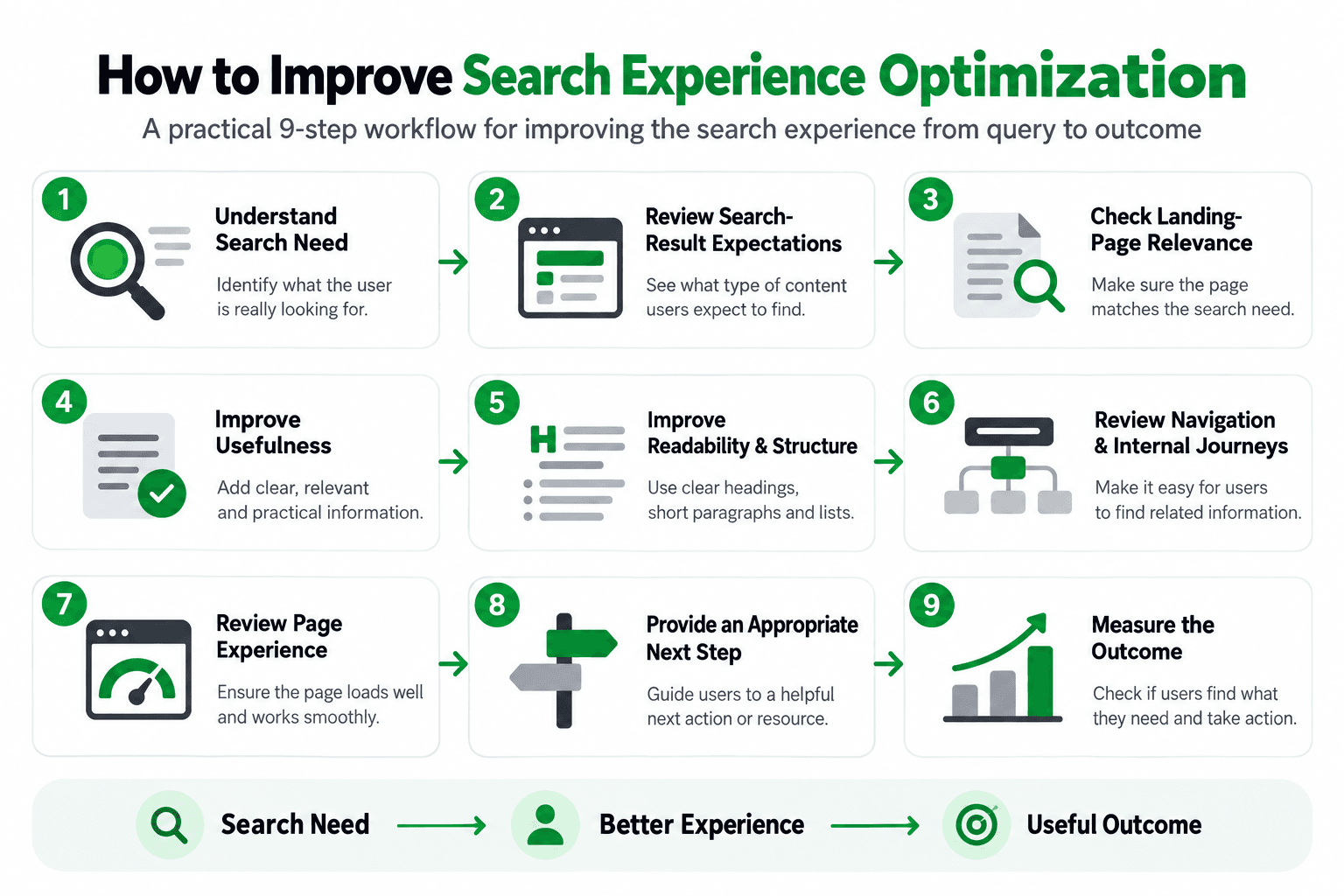
How to Improve Search Experience Optimization
SXO becomes much easier to apply when you treat it as a process.
1. Understand the search need
Start with the person behind the query. What are they trying to learn, compare, find, solve, buy, or accomplish? The answer should shape the page's purpose.
2. Review search-result expectations
Look at the title link and snippet associated with the page. Do they accurately represent the destination? Is the main promise clear? Would the right searcher reasonably expect to find what the page actually delivers?
3. Check landing-page relevance
Once someone arrives, can they quickly tell that the page addresses their need? The H1, introduction, main content, and structure should make that clear.
4. Improve usefulness
Answer the actual need. Include enough information to solve the problem properly, but remove unnecessary detours and filler.
5. Improve readability and structure
Make the important information easy to find and consume. Use headings, lists, examples, and content order where they genuinely improve comprehension.
6. Review navigation and internal journeys
Consider what the visitor may reasonably need next. A useful internal link can lead them to a related guide, deeper explanation, tool, or next step. Do not force the journey.
7. Review page experience
Check for issues that may make the page harder to use, including mobile usability, responsiveness and loading, HTTPS, intrusive overlays, distracting ads, difficult controls, and visibility of the main content.
8. Provide an appropriate next step
Match the next action to the visitor's intent. An informational page may simply help someone get an answer. A commercial page may reasonably lead toward comparison, contact, signup, or purchase.
9. Measure the outcome
Do not assume a change worked simply because it was implemented. Compare relevant outcomes over time and interpret them in context.
The SEO Progress Guide covers this measurement process in more depth.
How to Measure SXO
There is no universal single SXO score that proves a search experience is good. Measurement should reflect what the page is supposed to accomplish.
Search performance
Google Search Console can help evaluate search-related data such as impressions, clicks, CTR, queries, and page performance. These metrics can show how a page is performing in Google Search, but they do not describe the entire search experience.
On-site outcomes
Analytics can help evaluate configured events, conversions, and other on-site outcomes relevant to the page's goal.
An informational article may succeed by helping someone find a clear answer. A service page may reasonably be evaluated partly through leads. A product page may have a purchasing objective.
Technical experience
Relevant diagnostics can help identify performance or usability issues that may affect the experience. Technical scores should still be treated as evidence rather than a complete measure of user satisfaction.
Business outcomes
Where appropriate, useful outcomes may include leads, sales, signups, or other meaningful actions. The important point is to connect measurement to the actual purpose of the page.
CTR is not SXO
CTR can tell you something about how people interact with a search result. It does not measure the full search experience.
A result can attract clicks and still send visitors to a page that fails to satisfy their need. There is also no universal CTR percentage that proves a page has a good search experience.
SXO is not just conversion optimization
Conversions can matter on commercial pages, but conversion rate should not become the definition of SXO. An informational visitor may simply want a correct answer.
Useful outcome depends on intent.
Common SXO Mistakes
- optimizing keywords while missing intent;
- creating misleading title or snippet expectations;
- burying the main answer under filler;
- focusing only on rankings;
- treating SXO as another name for UX;
- treating Core Web Vitals as the entire search experience;
- ignoring mobile usability;
- using disruptive interruptions;
- making navigation confusing;
- forcing conversions onto informational visitors;
- measuring only traffic;
- assuming every UX improvement directly affects rankings.
Another mistake is turning analytics metrics into supposed Google ranking signals. Metrics such as bounce rate or time on page can be useful to site owners in the right context. That does not automatically make them direct Google ranking factors.
Search Experience Optimization Checklist
Before considering a page finished, ask:
Does the page match the likely search intent?
Does the search result accurately represent the page?
Can visitors quickly identify the main answer or content?
Is the information genuinely useful?
Is the page easy to scan and understand?
Does it work well on mobile?
Are intrusive elements controlled?
Is navigation clear?
Are internal links genuinely useful?
Is the next action appropriate to intent?
Are important page-level SEO signals implemented correctly?
Are meaningful outcomes being measured?
This is not a scoring formula. It is a practical review of the journey from search need to useful outcome.
Where RankCrow Fits Into SXO
SXO extends beyond what any single page-level SEO audit can measure.
RankCrow can still help with an important part of the process by reviewing supported page-level areas such as titles and meta descriptions, heading structure, content and readability checks, links, images and ALT attributes, canonical and indexability signals, HTTPS, viewport configuration, structured-data detection, and social metadata.
That can help identify page-level SEO areas worth reviewing as part of a broader SXO process.
RankCrow does not measure complete search experience, user satisfaction, conversions, Search Console performance, or Google rankings. It is also not a full-site crawler or rank tracker.
The RankCrow SEO Score is an analyzer indicator, not a Google ranking score or ranking factor.
Frequently Asked Questions
What does SXO stand for?
SXO stands for Search Experience Optimization. It describes an approach that looks at both how people discover a page through search and what they experience after clicking the result.
Is SXO a Google ranking factor?
No. SXO is not an official Google ranking factor or Google-defined ranking framework. It is an industry concept that can include SEO, content usefulness, usability, page experience, and appropriate user outcomes.
What is the difference between SEO and SXO?
SEO focuses on areas such as search accessibility, relevance, content, technical implementation, and organic search performance. SXO keeps those concerns but applies a broader lens to what happens from search discovery through the landing-page experience and useful outcome. SXO does not replace SEO.
Is SXO the same as page experience?
No. Page experience can be part of SXO, but SXO is broader. SXO can also involve search intent, search-result expectations, content usefulness, navigation, internal journeys, and the outcome the visitor is trying to achieve.
How do you measure SXO?
There is no single universal SXO score. Depending on the page's purpose, useful evidence may include Search Console performance, configured analytics events or conversions, technical experience diagnostics, and relevant business outcomes. These signals should be interpreted together and in context rather than treated as a single score.
Final Thoughts
Search experience optimization is useful because appearing in search is only one part of the journey.
A person begins with a need. A search result creates an expectation. The landing page then has to provide something relevant, usable, and genuinely helpful.
SEO remains essential for discovery and relevance. Content helps satisfy the need. Usability and page experience affect how easily the information can be accessed and used. Measurement helps you understand what happened after the changes were made.
SXO does not replace SEO, and it is not a single Google ranking factor.
It is a practical way to look at whether the experience that begins in search actually works for the person who clicked.